AKO-15724/AKO-15725 Temperature Data Logger
Professional temperature data logger for monitoring and recording thermal conditions with NTC probe or 4-20 mA inputs, featuring SD card support and alarm management.
Table of contents
Product Overview
The AKO-15724 and AKO-15725 are advanced temperature data loggers designed for precise monitoring and recording. They support NTC probes or 4-20 mA inputs, making them versatile for various industrial and commercial applications. The devices feature an internal memory for data storage and an SD card slot for easy data transfer to a PC in .csv format.
Installation and Safety
Install the device in a location protected from vibrations, water, and corrosive gases. Ensure the ambient temperature does not exceed the specified limits. Important: Always disconnect the power supply before performing any wiring. Use only AKO-supplied probes for correct operation. The power supply circuit must include a nearby circuit breaker (min. 2 A, 230 V). Keep probe cables separate from power or control cables to avoid interference.
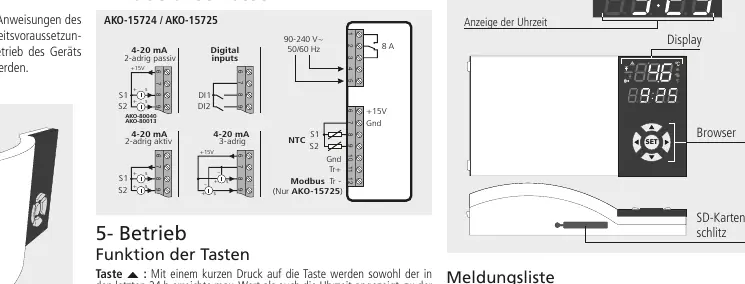
Operation and Configuration
The device is operated via front-panel buttons. Users can view current, maximum, and minimum temperatures, as well as access alarm logs. The programming menu allows for detailed configuration of inputs, alarms, and recording intervals. Upon initial startup, the date and time must be set to ensure accurate data logging.
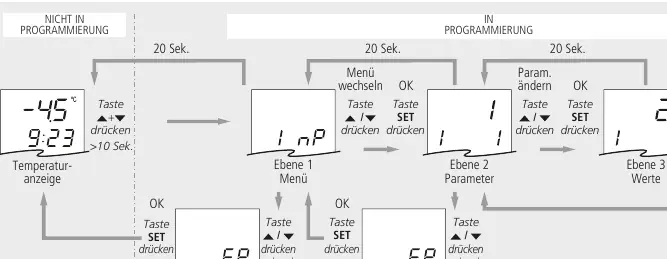
Data Management
Data is organized into register blocks in the internal memory. Users can download data to an SD card using the dedicated buttons. The device also maintains an alarm register to track activation and deactivation events. Note: Do not remove the SD card until the SD card indicator light has turned off.
Maintenance and Troubleshooting
The device includes a comprehensive list of error codes to assist in troubleshooting. For example, E01 and E02 indicate probe faults, while E13-E16 relate to SD card issues. Regular maintenance involves checking probe connections and ensuring the SD card is formatted correctly (FAT/FAT32). The device is designed for long-term reliability when installed and operated according to the manufacturer's instructions.