ANENG 168Max Battery Tester
Comprehensive guide for the ANENG 168Max battery tester, covering operation, compatibility, and voltage measurement interpretation for various battery types.
Table of contents
Product Overview
The ANENG 168Max is a versatile battery tester designed to measure the voltage of a wide range of battery types. It is an essential tool for quickly determining the health and charge status of household batteries, ensuring you know exactly when to replace them.
Supported Battery Types
This device is compatible with a variety of common battery formats, including:
- Standard cylindrical batteries: D, C, AA, AAA
- 9V rectangular batteries
- Button cell batteries: 1.5V and 3V
- Lithium batteries: 16340, 14500, 10440, 18650
The tester operates within a voltage range of 1.2V to 4.8V.
Operation Instructions
The ANENG 168Max is designed for ease of use and does not require any internal power source, as it draws the necessary energy directly from the battery being tested.
- Preparation: Before measurement, identify the positive (+) and negative (-) terminals of your battery.
- Alignment: Align the battery terminals correctly with the corresponding measuring ports on the device.
- Measurement: Ensure firm contact between the battery terminals and the detector ports. If the battery has a charge, the voltage will be displayed on the screen.
- Troubleshooting: If no value is displayed on the screen, the battery is completely depleted.
Measurement Reference Table
Use the following guidelines to interpret the health of your batteries based on the voltage reading:
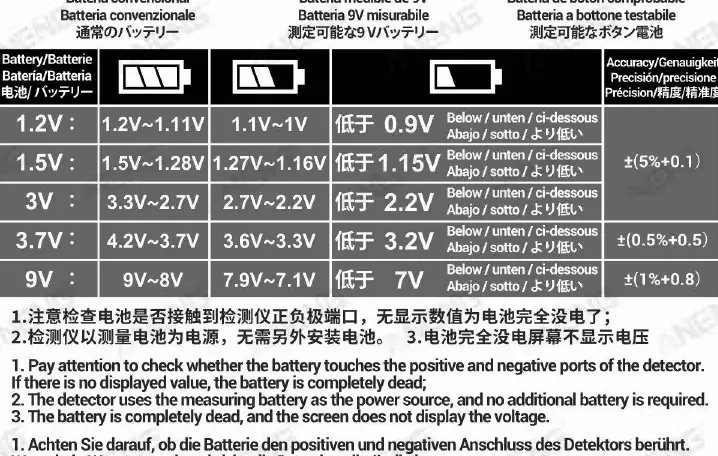
- 1.2V Batteries: Good: 1.2V-1.11V, Weak: 1.1V-1V, Replace: Below 0.9V
- 1.5V Batteries: Good: 1.5V-1.28V, Weak: 1.27V-1.16V, Replace: Below 1.15V
- 3V Batteries: Good: 3.3V-2.7V, Weak: 2.7V-2.2V, Replace: Below 2.2V
- 3.7V Batteries: Good: 4.2V-3.7V, Weak: 3.6V-3.3V, Replace: Below 3.2V
- 9V Batteries: Good: 9V-8V, Weak: 7.9V-7.1V, Replace: Below 7V
Safety and Maintenance
The device is intended for indoor use. Keep the measuring ports clean and free of debris to ensure accurate readings. Do not attempt to measure batteries outside the specified voltage range, as this may damage the device. The unit requires no external batteries, making it maintenance-free regarding power supply.

Manual page author
Emily Carter
User documentation editor
Prepares concise manual descriptions and highlights the most useful setup, operation, and maintenance information for readers.