General / Other Manuals
Universal 16s PCR Barcoding Kit
A specialized kit for the amplification of the 16s rRNA gene region, designed for research applications in bacterial and archaeal species differentiation.
Table of contents
Product Overview
The Universal 16s PCR Barcoding Kit is designed for the specific amplification of the 16s ribosomal RNA (rRNA) gene region. This sequence is highly conserved across bacteria and archaea, containing variable regions that are essential for species differentiation. The kit is intended for research use only and is not suitable for diagnostic procedures.
Applications
This kit is optimized for the amplification of the 16s gene region in various liquid genomic DNA (gDNA) samples, including water, wastewater, and algal cultures.
Components and Equipment
The kit includes a 170uL 16s region-specific primer mixture (sufficient for 150 reactions) and 1.5mL of PCR-clean water. Users must provide their own real-time PCR instrument, qPCR 2X Master Mix, DNA extraction kit, PCR reaction tubes or plates, vortex, centrifuge, and micropipettes with tips.
Reagent Preparation and Storage
All reagents are sensitive to contamination and should be handled in a clean area, away from positive control templates. Reagents must be stored at -20°C. To maintain stability and shelf life, minimize freeze-thaw cycles by creating aliquots if necessary. Do not use expired kits or mix reagents from different batches, as this may significantly reduce sensitivity.
Assay Setup and Protocol
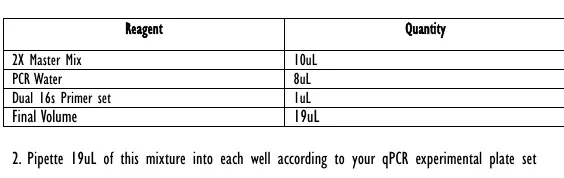
Before starting, ensure high-quality gDNA isolation (optimal results require >10ng/uL concentration with a ratio >1.80). Prepare a reaction mix by combining 10uL of 2X Master Mix, 8uL of PCR water, and 1uL of the primer set per reaction. Pipette 19uL of this mixture into each well, then add 1uL of the gDNA sample (or water for negative controls) to reach a final volume of 20uL.
Amplification Conditions
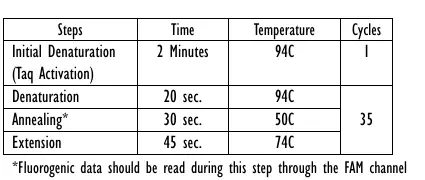
- Initial Denaturation: 2 minutes at 94°C (1 cycle)
- Denaturation: 20 seconds at 94°C
- Annealing: 30 seconds at 50°C
- Extension: 45 seconds at 74°C
The denaturation, annealing, and extension steps should be repeated for 35 cycles. Fluorogenic data must be read during the extension step through the FAM channel.
Controls and Maintenance
To ensure accuracy, include a Negative Extraction Control (NEC) and a No Template Control (NTC) in each plate setup. These controls help verify the integrity of the reaction and detect potential contamination. Always shake reagents gently before use.
Related manuals
Related manuals from the same brand or category.

Manual page author
David Miller
Documentation analyst
Organizes user manual content into clear summaries, with attention to model details, product context, and everyday usability.