CEE Room Heat Pump Specification and ENERGY STAR Commentary
A technical guide and commentary document from the Consortium for Energy Efficiency (CEE) regarding ENERGY STAR Room Air Conditioner and Room Heat Pump specifications, including performance tiers, efficiency metrics, and recommended...
Table of contents
Manual images
Click an image to enlargeOverview of CEE Room Heat Pump Specification
This document serves as a formal commentary from the Consortium for Energy Efficiency (CEE) regarding the proposed ENERGY STAR Version 6.0 and 7.0 specifications for Room Air Conditioners (RACs) and Room Heat Pumps (RHPs). It outlines the CEE's recommended performance tiers and definitions for the nascent room heat pump market, aiming to align industry standards with federal tax credit requirements and DOE minimums.
CEE Room Heat Pump Specification Tiers
The CEE has established three performance tiers for Room Heat Pumps, effective January 1, 2025. These tiers are designed to ensure reliable heating and cooling performance across different climate conditions.
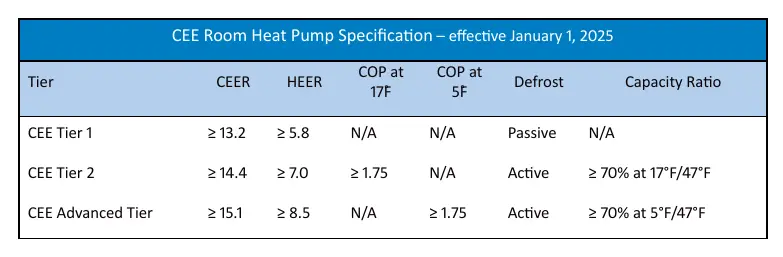
- CEE Tier 1: Baseline efficiency, passive defrost, CEER ≥ 13.2, HEER ≥ 5.8.
- CEE Tier 2: Higher efficiency, active defrost, CEER ≥ 14.4, HEER ≥ 7.0, COP ≥ 1.75 at 17°F.
- CEE Advanced Tier: Highest efficiency, active defrost, CEER ≥ 15.1, HEER ≥ 8.5, COP ≥ 1.75 at 5°F.
Performance Metrics Explained
The specification relies on several key metrics to define high-performance units:
- CEER (Combined Energy Efficiency Ratio): Measures the overall cooling efficiency of the unit.
- HEER (Heating Energy Efficiency Ratio): Measures the heating efficiency of the unit.
- COP (Coefficient of Performance): Indicates the heating efficiency at specific low ambient temperatures (17°F and 5°F).
- Capacity Ratio: Defines the percentage of heating capacity maintained at low temperatures relative to the capacity at 47°F.
Room Heat Pump Types (1-4)
The ENERGY STAR test method categorizes Room Heat Pumps into four types based on defrost capabilities and compressor cut-in/cut-out temperatures. The CEE recommends that ENERGY STAR differentiate requirements based on these types to reflect technological feasibility and ensure accurate representation of cooling and heating efficiency. The CEE specifically advocates for the removal of Type 2 requirements, as they may offer inadequate heating performance.
Recommendations for ENERGY STAR Alignment
The CEE encourages the EPA to:
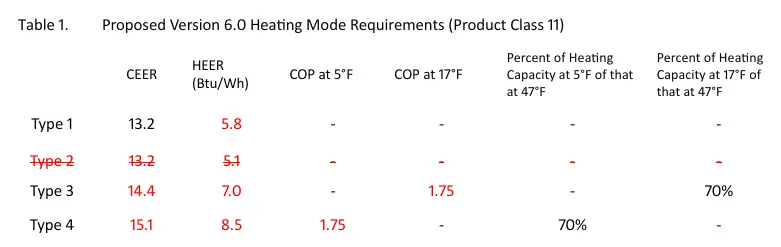
- Align Type 3 and 4 Room Heat Pump criteria with CEE Tier 2 and Advanced Tier, respectively.
- Differentiate CEER and HEER requirements based on RHP type rather than grouping them.
- Ensure that performance definitions are consistent to minimize market confusion and support consumer adoption of energy-efficient technology.
Practical help
Common problems
Refer to CEE Tier definitions to identify high-performance units that meet specific heating and cooling criteria.
Ensure the unit meets the COP and Capacity Ratio requirements for the intended climate zone, specifically looking for active defrost capabilities.
Before use
- Verify the RHP Type (1-4) classification of the unit.
- Check if the unit meets CEE Tier 1, Tier 2, or Advanced Tier efficiency standards.
- Confirm the unit's HEER and CEER ratings against the proposed ENERGY STAR Version 6.0/7.0 criteria.
- Assess if the unit's COP at 17°F or 5°F meets the requirements for the desired performance tier.
Specs in practice
- Capacity Ratio
- The percentage of heating capacity at low temperatures compared to capacity at 47°F.
Model compatibility
- CEE Tier 2 and Advanced Tier are designed to align with ENERGY STAR Type 3 and 4 Room Heat Pumps.
- Type 2 units are excluded from CEE specifications due to concerns regarding inadequate defrost and heating capabilities.

Manual page author
David Miller
Documentation analyst
Organizes user manual content into clear summaries, with attention to model details, product context, and everyday usability.