10-Point Guide to Specifying Humidifiers
A comprehensive guide for HVAC consultants on specifying, sizing, and installing humidification systems for various applications, including manufacturing, preservation, and health.
Table of contents
Why Humidify
Maintaining proper air humidity is essential for three primary reasons: improving manufacturing efficiency, preserving moisture-sensitive articles, and protecting human health. In industrial settings, humidity control prevents moisture loss in products like pharmaceuticals and textiles, while also dissipating electrostatic charges in data centers. For preservation, consistent humidity prevents dimensional changes in wood and natural materials, protecting art, musical instruments, and heritage buildings. Regarding health, maintaining 40-60% RH is crucial, as dry air below 40% RH impairs the body's natural defenses and allows viruses to remain airborne longer.
Psychrometric Charts and Sizing
A psychrometric chart is a vital tool for calculating the moisture required to reach a target humidity level. It maps processes such as isothermal humidification, heating, cooling, and adiabatic humidification. To size a system, you must determine the starting and end conditions of the air, the volume of air being treated, and the specific moisture addition required. Rules of thumb include needing approximately 25 kg/hr of humidity for every 35.31 ft³/s of fresh air, and understanding that gas-fired systems often offer lower operating costs despite higher initial capital investment.
Technology Selection
Choosing the right technology depends on energy costs, control accuracy, and physical constraints. Resistive steam humidifiers offer the most accurate control, while evaporative and high-pressure systems are suitable for large-scale cooling and high-capacity needs. For AHU projects, steam lances are often preferred due to space constraints. For direct room applications, mobile units or wall-mounted steam humidifiers are practical for smaller areas, whereas high-pressure spray systems are ideal for larger, noise-sensitive environments.
Installation and Hygiene
Proper installation is critical for performance. For AHU systems, ensure laminar airflow and sufficient absorption distance to prevent condensation. In-room systems require careful placement to avoid wetting walls or ceilings and to ensure sensors are positioned for accurate readings. Hygiene is paramount; systems must be designed to prevent water stagnation, manage nutrient sources, and avoid respirable aerosols. Features like automated flush cycles, UV water treatment, and silver ion dosing help mitigate risks such as Legionella. Regular professional maintenance and commissioning are essential for long-term hygienic operation.
Manufacturer information
Condair
Practical help
Common problems
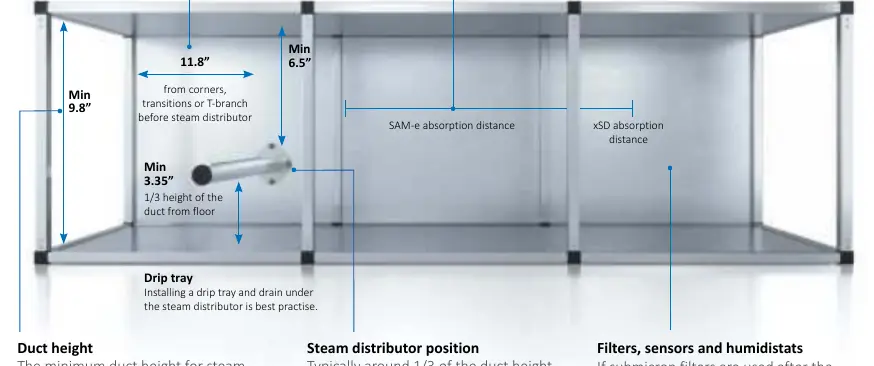
Ensure sufficient absorption distance, avoid duct bends in the absorption area, and maintain proper steam distributor positioning.
Avoid water stagnation, use UV treatment, implement automated flush cycles, and keep water temperatures outside the 20-45°C range.
Ensure sensors are placed in the return air duct or near the critical point of the process, away from external heat sources or drafts.
Use reverse osmosis (RO) water filtration or choose resistive humidifiers that are easier to clean.
Before use
- Determine starting and end air conditions (temperature and RH).
- Calculate the required volume of moisture addition.
- Verify available energy sources (gas vs. electricity).
- Check physical space constraints for AHU or in-room installation.
- Assess water quality and need for treatment (RO/softener).
- Confirm maintenance access for the chosen unit location.
- Ensure proper drainage and service connections are available.
Specs in practice
- Relative Humidity (RH)
- The ratio of moisture in the air compared to the maximum amount the air can hold at that temperature.
- Absorption Distance
- The physical length required for steam or aerosol to be fully absorbed by the airstream without condensing on surfaces.
- Specific Enthalpy
- The total heat content of the air, used in psychrometric calculations.
Images and diagrams
- Psychrometric chart: Shows the relationship between air temperature, moisture content, and RH.
- AHU load calculation: Formula using airflow, fresh air percentage, and moisture addition to find total humidity load.
- Steam distributor positioning: Shows minimum clearances from floor and ceiling to prevent turbulence and condensation.
- Adiabatic installation: Illustrates required clearances for nozzles, droplet eliminators, and maintenance access.
Model compatibility
- Steam humidifiers should be located within 4m of the AHU to prevent pipe condensation.
- High-pressure spray systems require RO water to prevent mineral dust.
- Electrode boiler humidifiers require minerals in the water to conduct current, making them incompatible with pure RO water.
- Submicron filters in ducts require increased absorption distance (x2.5) to prevent moisture removal.

Manual page author
Michael Turner
Technical manual editor
Reviews PDF manuals for structure, safety notes, and practical product details so readers can find the right information quickly.