MRS Solid State Relays (SSR) Operating Instructions
Comprehensive operating instructions for MRS Solid State Relays (5A, 15A, 25A models), covering safety, installation, wiring, maintenance, and disposal.
Table of contents
Product Overview
The MRS Solid State Relays (SSR) are advanced electronic switching components designed as a wear-free, electronic alternative to traditional mechanical relays. By utilizing semiconductor technology, these relays eliminate moving parts, ensuring long-term reliability in demanding environments. They are specifically engineered for use in vehicles and self-propelled work machines.
Safety and Handling
Safety is paramount when working with electronic assemblies. These relays must only be installed, serviced, and uninstalled by qualified specialists who understand the relevant safety standards. Users must be aware of potential hazards, including electrical currents and elevated surface temperatures during operation. Always ensure the complete system is de-energized and secured against accidental restart before performing any maintenance or installation tasks.
Installation and Wiring
Proper installation is critical for the longevity and safety of the relay. The device should be mounted in a fixed location, ideally with connectors pointing downwards to prevent condensation buildup. When wiring, ensure that all cables are strain-relieved and protected from mechanical damage. It is mandatory to use an external fuse in the power supply line to protect against overvoltage. Always verify that the slot is free of dirt, moisture, and corrosion before inserting the relay vertically into its position.
Maintenance and Troubleshooting
The solid state relays are maintenance-free and must not be opened. If the casing, seals, or plugs show signs of damage, the unit must be taken out of service immediately. Cleaning should only be performed in a dust-free environment without the use of high-pressure cleaners, steam jets, or aggressive solvents. If a fault occurs, check the circuitry and parameter settings, and inspect all connections for signs of overheating or corrosion. Damaged units must be replaced and disposed of according to national environmental regulations.
Intended Use
These relays are intended exclusively for switching circuits in vehicles and self-propelled work machines. They are not permitted for use in safety-relevant systems where functional safety is required, nor should they be used in explosive atmospheres. Any misuse, unauthorized modifications, or operation outside of specified environmental conditions will void the warranty and may lead to dangerous system malfunctions.
Practical help
Common problems
Check circuitry and parameter settings; ensure the relay is not damaged or corroded.
Inspect all flat plugs and pins; replace the relay if damage is found.
Ensure the relay is mounted with connectors pointing downwards and use appropriate seals.
Before use
- Verify the relay type (5A, 15A, or 25A) matches system requirements.
- Ensure the complete system is de-energized.
- Check that the mounting location is free from excessive mechanical or thermal load.
- Inspect all flat plugs for dirt, moisture, or corrosion.
- Confirm an external fuse is installed in the power supply line.
- Ensure the relay is secured against vibration if necessary.
- Verify that the cable harness has proper strain relief.
Images and diagrams
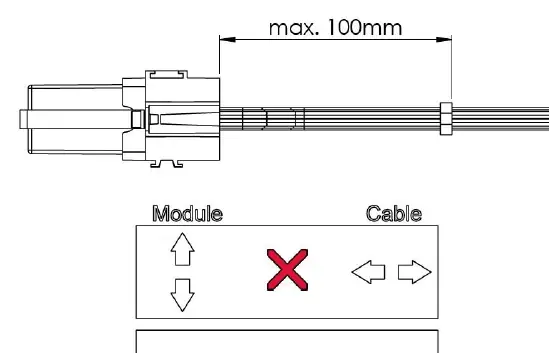
- Figure 1 illustrates the mandatory strain relief for the cable harness.
- The diagram shows that the cable must move identically to the controller/plug direction.
- A maximum distance of 100mm for strain relief is required.
Model compatibility
- Compatible with vehicles and self-propelled work machines.
- Designed for use with flat plugs pursuant to ISO 7588-1: 1998-09.
- Limited to the European Economic Area (EEA) unless market access research is conducted.

Manual page author
Michael Turner
Technical manual editor
Reviews PDF manuals for structure, safety notes, and practical product details so readers can find the right information quickly.