Philips 6605 Halogen Lamp Specification Sheet
Technical specifications and dimensional data for the Philips 6605 10W G4 6V halogen non-reflector lamp. Includes light output, electrical requirements, and physical dimensions for installation.
Table of contents
Quick guide from the manual
This document provides the technical specifications and dimensional data for the Philips 6605 halogen non-reflector lamp. It is intended for users and technicians to verify compatibility, electrical requirements, and physical dimensions before installation or replacement.
Product overview
The Philips 6605 is a high-quality halogen non-reflector lamp designed for applications such as projection systems. It features a distortion-free quartz bulb and precise filament positioning to ensure optimal beam performance. It provides a full spectrum of light with a Color Rendering Index (CRI) of 100, mimicking natural daylight.
Technical specifications
- Cap-Base: G4
- Power Consumption: 10 W
- Voltage: 6 V
- Luminous Flux: 150 lm
- Correlated Color Temperature: 2700 K
- Color Rendering Index (CRI): 100
- Operating Position: Universal (can be installed in any orientation)
- Life to 50% Failures: 2,000 hours
- Bulb Material: Quartz-UV Open
Dimensions
The physical dimensions of the lamp are critical for ensuring it fits within your specific fixture or projection system:
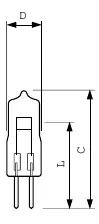
- D (max): 9.5 mm
- L (max): 19.75 mm
- C (max): 31 mm
Manufacturer information
Philips
Practical help
Common problems
Verify that your fixture is designed for a G4 bi-pin base.
Ensure the power supply is strictly 6V. Over-voltage will significantly reduce the lifespan of halogen lamps.
Before use
- Verify the socket type is G4.
- Ensure the power supply provides 6V.
- Handle the bulb with care; avoid touching the quartz glass with bare fingers as skin oils can cause hot spots and premature failure.
- Check that the fixture allows for the dimensions (D: 9.5mm, L: 19.75mm, C: 31mm).

Manual page author
David Miller
Documentation analyst
Organizes user manual content into clear summaries, with attention to model details, product context, and everyday usability.