Sports / Marine Navigation
User Manual for Silva 100BH Marine Compass
Quick guide for the Silva 100BH marine compass. Learn about installation, magnetic compensation, maintenance, and technical specifications for accurate navigation.
Quick answers from the manual
Quick answer
- The Silva 100BH is a bulkhead-mounted marine compass designed for sailing boats and motor yachts. This manual provides instructions for positioning, mounting, compensation, and maintenance. p. 1
Key actions
- Position the compass away from magnetic interference (e.g., speakers, instruments). p. 1
- Mount the compass at right angles to the boat's longitudinal direction using the provided template. p. 1
- Perform compass compensation if deviation is more than 5 degrees. p. 1
First start
- Ensure the compass is positioned away from magnetic sources and mounted at right angles to the boat's longitudinal direction. p. 1
Maintenance and reset
- Clean with a mild soap solution or detergent; avoid strong solvents like spirit, acetone, or petroleum. p. 1
Technical specifications
| Parameter | Value | Meaning | Pages |
|---|---|---|---|
| Accuracy | ±0.5° | Compass precision | p. 1 |
| Illumination | 12V, Red | Built-in light specification | p. 1 |
| Weight | 910 g | Unit weight | p. 1 |
| Operating Temperature | -10°C to +70°C | Operational temperature range | p. 1 |
Where to find it in the PDF
- Full Manual p. 1
Table of contents
Manual images
Click an image to enlargeQuick guide from the manual
The Silva 100BH is a marine compass designed for sailing boats, motor sailing vessels, and larger motor yachts. Before using the compass, ensure it is mounted correctly and free from magnetic interference. If the compass deviation is greater than 5 degrees, you must perform the compensation procedure. The compass is not considered an accurate navigational instrument until compensation is carried out and a deviation table is produced.
Product Overview
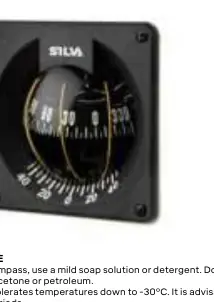
The packaging includes the compass unit, illumination, and a mounting kit. The compass features a built-in clinometer (+/- 45°) and is delivered with built-in illumination.
Installation and Positioning
The compass is intended for flush mounting. Follow these guidelines for proper installation:
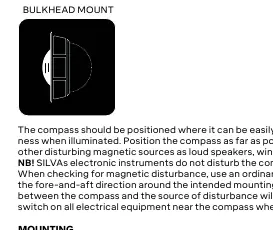
- Positioning: Position the compass vertically or sloping (max 30°). It must be mounted exactly at right angles to the boat's longitudinal direction.
- Magnetic Interference: Place the compass as far as possible from iron objects or magnetic sources like loudspeakers, windscreen wipers, and other instruments.
- Interference Check: Use an ordinary handheld compass to check for magnetic disturbance around the mounting site. Ensure all electrical equipment near the compass is switched on during this check.
- Mounting Depth: Ensure the compass has the correct mounting depth to avoid affecting the expansion membrane, which could lead to leakage.
Magnetic Compensation
Compensation is recommended if the deviation is more than 5 degrees. If the error is less than 5 degrees, a deviation table is sufficient. Compensation requires the optional compensator.
- Aim the boat due North and turn the N/S screw until the compass reading is 0°.
- Aim the boat due East and turn the E/W screw until the compass reading is 90°.
- Aim the boat due South. If the compass does not show 180°, turn the N/S screw until the error is halved.
- Aim the boat due West. If the compass does not show 270°, turn the screw until the error is halved.
- Repeat the procedure to check the adjusted values.
- Check the compass every 20 degrees and produce a deviation table and curve.
Maintenance
Clean the compass using a mild soap solution or detergent. Do not use strong solvents such as spirit, acetone, or petroleum. The compass tolerates temperatures down to -30°C, but it is advisable not to subject it to severe cold for long periods.
Technical Specifications
- Accuracy: ±0.5°
- Illumination: 12V (red). 24V adaptation requires a 270 ohm, 0.5 W resistor connected in series.
- Operating Temperature: -10°C to +70°C
- Storage Temperature: -30°C to +70°C
- Apparent card diameter: 100 mm
- Weight: 910 g
Practical help
Common problems
Compass deviation is greater than 5 degrees
Perform the magnetic compensation procedure using the E/W and N/S adjuster screws.
Compass reading is affected by magnetic interference
Relocate the compass further away from iron objects, loudspeakers, windscreen wipers, or other magnetic sources.
Compass leakage
Ensure the mounting depth is correct; incorrect depth can damage the expansion membrane.
Before use
- Check for magnetic interference using a handheld compass.
- Ensure all electrical equipment near the compass is switched on during the interference check.
- Verify the mounting surface is at a right angle to the boat's longitudinal direction.
- Perform compensation if deviation exceeds 5 degrees.
- Create a deviation table and curve after compensation.
Specs in practice
- Illumination
- 12V system; 24V systems require a 270 ohm, 0.5 W resistor.
- Operating Temperature
- Safe range for use is -10°C to +70°C.
- Storage Temperature
- Safe range for storage is -30°C to +70°C.
Images and diagrams
- The bulkhead mount diagram illustrates the required installation depth to protect the expansion membrane.
- The compass unit image shows the front-facing display and the location of the adjuster screws.
Model compatibility
- Compatible with 12V electrical systems.
- 24V systems require an additional 270 ohm, 0.5 W resistor.
- Compensator is an optional extra required for compensation procedures.

Manual page author
David Miller
Documentation analyst
Organizes user manual content into clear summaries, with attention to model details, product context, and everyday usability.