User Manual for TRIO Phoenix LED Ceiling Lamp
Quick guide for installing and operating the TRIO Phoenix LED ceiling lamp. Includes wiring diagrams, safety instructions, and technical specifications.
Table of contents
Important Safety Information
Before beginning any installation work, please read the safety instructions carefully. Ensure that the power supply is switched off at the main circuit breaker before starting the installation to prevent electrical shock.
Installation
The installation process involves mounting the fixture to the ceiling and connecting the electrical wiring. Follow these steps based on the provided diagram:
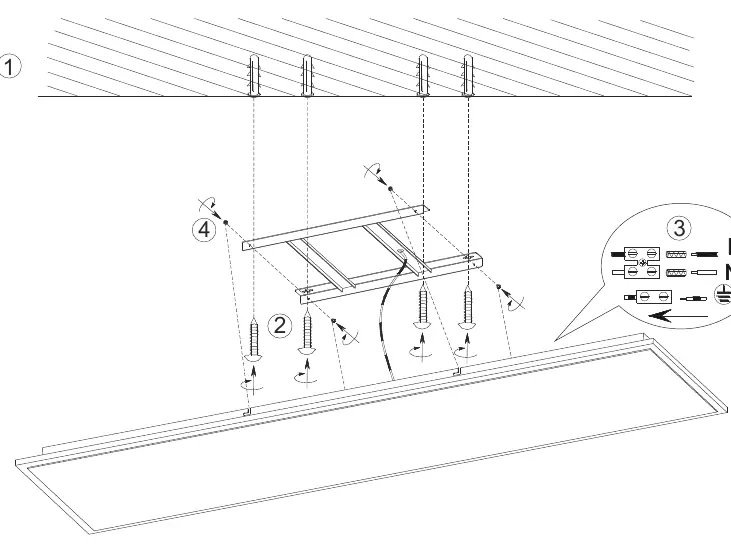
- Preparation: Drill the necessary holes in the ceiling according to the mounting bracket dimensions.
- Mounting: Secure the mounting bracket to the ceiling using the provided screws and wall plugs.
- Wiring: Connect the electrical wires to the terminal block. Ensure the Live (L) and Neutral (N) wires are connected correctly, and connect the Ground wire to the designated terminal.
- Final Assembly: Attach the lamp housing to the mounted bracket and secure it in place.
Technical Specifications
The TRIO Phoenix LED ceiling lamp operates under the following parameters:
- Voltage: 230V~50Hz
- Power Consumption: 31W
- Protection Class: IP20 (Indoor use only)
Energy Efficiency
This product contains a light source of energy efficiency class F.
Practical help
Common problems
Check if the power supply is connected correctly and the circuit breaker is switched on.
Ensure all wire connections (L, N, Ground) are secure and properly tightened in the terminal block.
Before use
- Ensure power is switched off at the main circuit breaker before starting installation.
- Verify the ceiling surface can support the weight of the lamp.
- Check that all necessary tools (drill, screwdriver) are available.
- Confirm the local voltage matches the 230V~50Hz specification.

Manual page author
David Miller
Documentation analyst
Organizes user manual content into clear summaries, with attention to model details, product context, and everyday usability.