TWS Battery Modules Technical Specifications
Technical specifications and performance data for TWS rechargeable lithium-ion battery modules, including NCM and LFP series models. View capacity, voltage, dimensions, and operating temperature ranges.
Table of contents
Quick Guide
This document serves as a technical specification sheet for TWS rechargeable lithium-ion battery modules. It provides essential electrical and physical parameters for NCM and LFP series modules, intended for integration into electric vehicles (EV), energy storage systems (ESS), and material handling equipment.
Product Overview
TWS offers two primary categories of battery modules:
- NCM Modules: Designed for EV applications, featuring compact cell-stack VDA module construction with low leakage and intrinsic safety.
- LFP Modules: Designed for ESS and Material Handling applications, featuring compact cell-stack construction with low leakage and intrinsic safety.
Technical Specifications
The modules are categorized by their chemical composition and configuration. Key parameters include nominal voltage, capacity, maximum continuous charge/discharge currents, and physical dimensions.
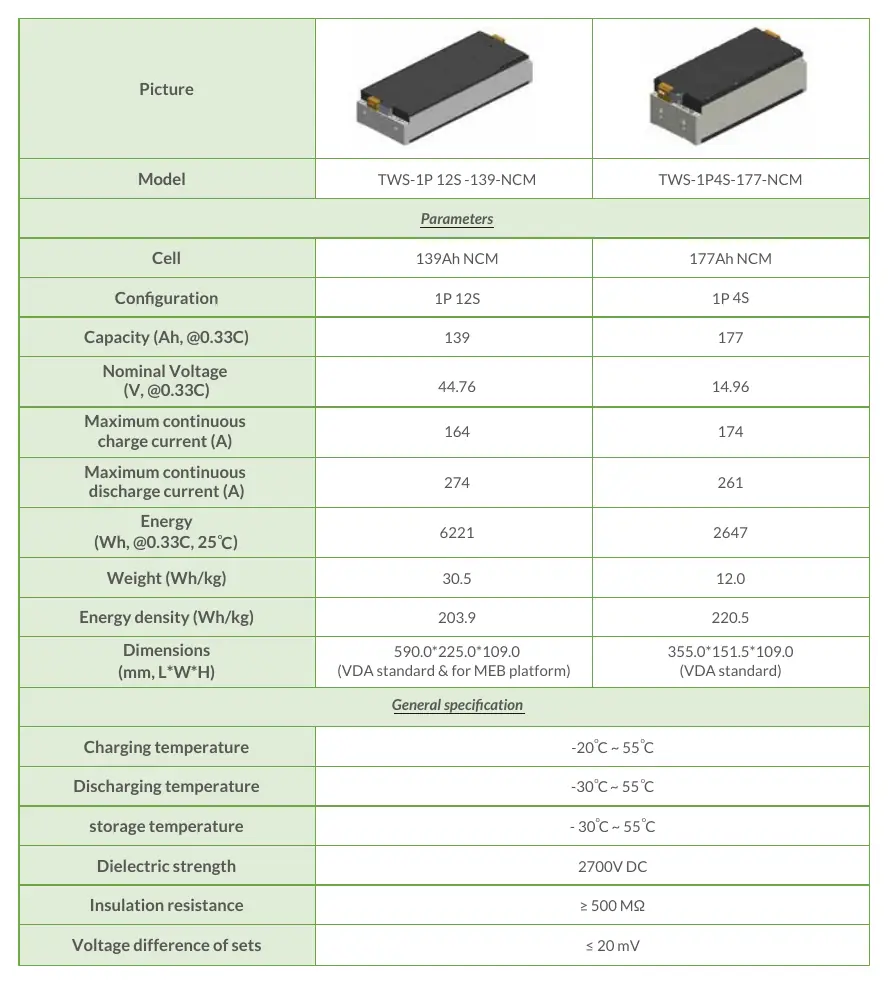
NCM Series
Includes models TWS-1P12S-139-NCM and TWS-1P4S-177-NCM. These modules are built to VDA standards, with specific models compatible with the MEB platform.
LFP Series
Includes models TWS-1P8S-50-LFP and TWS-1P9S-50-LFP. These modules are designed for high-cycle applications.
Operating Conditions
To ensure safety and performance, observe the following environmental limits:
- Charging Temperature: -20°C to 55°C
- Discharging Temperature: -30°C to 55°C
- Storage Temperature: -30°C to 55°C
- Dielectric Strength: 2700V DC
- Insulation Resistance: ≥ 500 MΩ
- Voltage Difference of Sets: ≤ 20 mV
Practical help
Before use
- Verify the specific module model (NCM or LFP) matches your application requirements (EV vs. ESS/Material Handling).
- Ensure the operating environment remains within the specified temperature range (-20°C to 55°C for charging).
- Confirm that the system design accommodates the module's physical dimensions (VDA standard or non-standard).
- Check that the charging system supports the maximum continuous charge current specified for the module.
- Verify insulation resistance requirements (≥ 500 MΩ) are met during installation.
Specs in practice
- Nominal Voltage
- The standard operating voltage of the battery module at 0.33C discharge rate.
- Energy Density
- The amount of energy stored per unit of weight (Wh/kg), indicating the efficiency of the battery design.
- Dielectric Strength
- The maximum electric field that the insulating material can withstand without breaking down (2700V DC).

Manual page author
Emily Carter
User documentation editor