Electronics / Audio
AirLive 1000Base-SX MiniGBIC Transceiver SFP-SX-1.25G-500M User Guide
Comprehensive user guide for the AirLive SFP-SX-1.25G-500M multi-mode fiber transceiver, covering technical specifications, installation, and operational characteristics.
Table of contents
Product Overview
The AirLive SFP-SX-1.25G-500M is a high-performance, cost-effective multi-mode SFP fiber transceiver designed for serial optical data communication applications. It supports data rates up to 1.25Gbps and transmission distances of up to 500 meters. The module operates at a nominal wavelength of 850nm and is designed for use in Gigabit Ethernet applications, providing an IEEE802.3z compliant link and Class I Laser safety compliance.
Key Features and Capabilities
This transceiver is built for reliability and ease of use in demanding network environments. It features a duplex LC connector interface and utilizes an 850nm VCSEL laser alongside a PIN photo detector. The module is hot-pluggable, allowing for easy installation or replacement without powering down the network equipment. It also includes Digital Diagnostic Monitoring (DDM) support, which provides real-time information about the fiber connection, making it significantly easier to identify faults or poor connections within the network infrastructure.
Operational Environment and Safety
The device is engineered for stable performance across a wide range of conditions. It is designed to operate in temperatures ranging from 0°C to +70°C, with a storage temperature range of -40°C to +85°C. The module is highly resistant to electromagnetic interference (EMI) and includes excellent ESD protection to ensure long-term durability. It is suitable for various high-speed applications, including storage area networks, computer cluster cross-connects, and customized high-speed data pipes.
Technical Specifications
The transceiver operates with a power supply voltage between 3.15V and 3.45V, with a typical requirement of 3.3V and a maximum power dissipation of 1.0W. It is fully compliant with SFF-8472 digital diagnostic standards and IEC-60825 safety standards. The transmitter features an average output power between -9dBm and -3dBm, while the receiver sensitivity is rated at -19dBm. The module is designed to be used in diverse environments such as banks, airports, hotels, and industrial facilities, ensuring robust connectivity for SDH/SONET and ATM switch infrastructures.
Manufacturer information
AirLive Technology
Practical help
Common problems
Faulty fiber connection
Use the DDM (Digital Diagnostic Monitoring) function supported by the SFP port to retrieve real-time diagnostic data and identify the specific location of the fault.
Before use
- Ensure the SFP port on your switch supports 1.25Gbps data rates.
- Verify that the fiber cable uses a duplex LC connector.
- Check that the operating environment temperature is between 0°C and 70°C.
- Confirm the power supply voltage is within the 3.15V-3.45V range.
- Ensure the module is handled with ESD precautions.
Specs in practice
- Wavelength (850nm)
- The specific light frequency used for data transmission, optimized for multi-mode fiber.
- Data Rate (1.25Gbps)
- The maximum speed at which the transceiver can transmit and receive optical data.
- Hot-pluggable
- The ability to insert or remove the module from a powered-on device without causing system damage.
- Receiver Sensitivity (-19dBm)
- The minimum optical signal strength required for the receiver to accurately detect data.
Images and diagrams
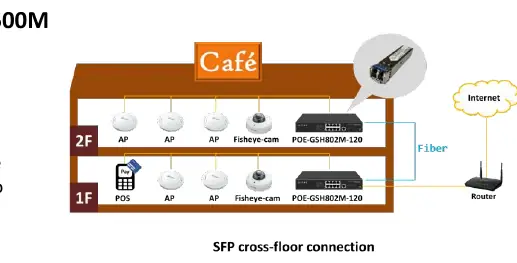
- The diagram illustrates a typical SFP cross-connection setup.
- It shows the transceiver inserted into a switch SFP port.
- Fiber cables connect the switch to other network devices like cameras or routers.
- The setup demonstrates how the module extends network reach up to 500 meters.
Model compatibility
- Compliant with IEEE 802.3Z standards.
- Compliant with SFF-8472 digital diagnostic standards.
- Compliant with IEC-60825 laser safety standards.
- Compatible with standard multi-mode fiber infrastructure.

Manual page author
David Miller
Documentation analyst
Organizes user manual content into clear summaries, with attention to model details, product context, and everyday usability.