General / Accessories
InLine® PoE++ Injector, 10 Gigabit
Professional 10 Gigabit PoE++ injector supporting IEEE 802.3bt standards, delivering up to 90W of power for high-performance network devices.
Table of contents
Product Overview
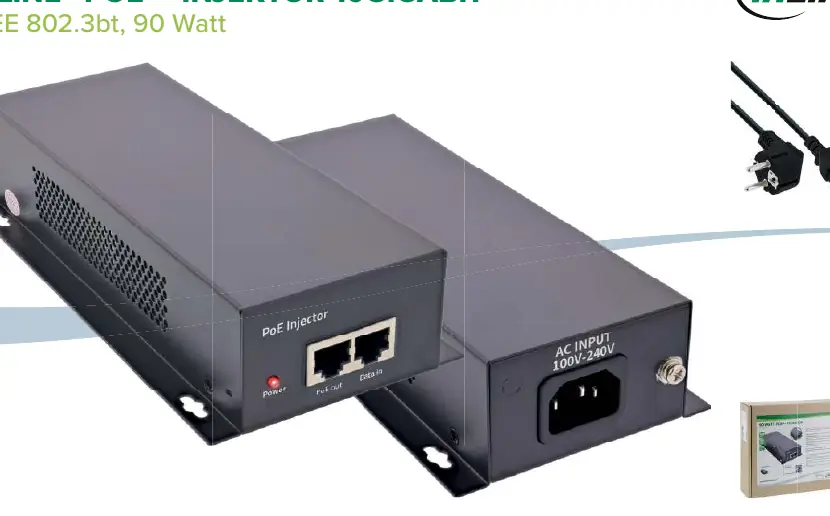
The InLine PoE++ Injector 10Gigabit is a professional-grade networking solution designed to extend existing network infrastructures with high-performance Power-over-Ethernet technology. It is specifically engineered to support modern, power-intensive network devices without requiring a complete switch replacement. By utilizing a 10GBase-T port, the injector ensures that high volumes of data are transmitted without bottlenecks, making it an ideal choice for modern IT environments.
Key Features and Performance
This injector is fully compatible with current PoE standards, including IEEE 802.3af (PoE), 802.3at (PoE+), and 802.3bt (PoE++). It delivers a maximum output power of up to 90W over Cat.6 or higher Ethernet cabling, providing reliable power for demanding hardware such as professional WLAN access points, IP cameras with PTZ functionality, video door intercoms, and thin clients. The device is designed for future-proof operation, ensuring maximum bandwidth even in complex applications.
Installation and Safety
The device features a simple plug-and-play installation process, allowing for seamless integration into existing network architectures. To ensure long-term reliability and protection of connected hardware, the injector includes integrated surge and ESD protection. This makes it suitable for operation even under challenging conditions. The unit is built for continuous operation and maintains high performance while protecting against electrical spikes.
Technical Specifications
The injector operates with an input voltage of AC 100V-240V at 50/60Hz. It provides a PoE output voltage between DC 44V and 57V. The unit is equipped with a single 10GBase-T RJ45 Data-in port and a single 10GBase-T RJ45 PoE-out port. It is designed to function within an operating temperature range of -20 to 50 degrees Celsius and can be stored in temperatures ranging from -40 to 85 degrees Celsius. The device is compact, weighing approximately 490 grams, and features a power LED indicator for status monitoring.
Maintenance and Disposal
The product is designed for durability and requires minimal maintenance. Users should ensure that the device is kept in a dry environment within the specified humidity range of 5-90 percent (non-condensing). As with all electronic equipment, the device should be kept away from children, as it may contain small parts. When the product reaches the end of its service life, it should be disposed of in accordance with local electronic waste regulations to ensure environmental safety.
Manufacturer information
InLine
Practical help
Common problems
Device not powering connected equipment
Ensure the Ethernet cable is Cat.6 or higher and that the power source is active.
Data bottleneck
Verify that the connected network infrastructure and cables support 10GBase-T speeds.
Before use
- Verify the power source is AC 100V-240V
- Ensure use of Cat.6 or higher Ethernet cabling
- Check that the end device is compatible with IEEE 802.3af/at/bt
- Confirm operating environment temperature is between -20 and 50 degrees Celsius
Specs in practice
- Surge Protection
- Protects against electrical spikes (2KV differential, 6KV common mode).
Images and diagrams
- The device features a Data-in port for network connection.
- The PoE-out port provides both data and power to the end device.
- A power LED indicates the operational status of the injector.
Model compatibility
- Supports IEEE 802.3af, 802.3at, and 802.3bt standards.
- Requires Cat.6 or better cabling for full 90W performance.

Manual page author
David Miller
Documentation analyst
Organizes user manual content into clear summaries, with attention to model details, product context, and everyday usability.