Health / Laboratory Reagents
Technical Manual for Promega GoTaq Probe 1-Step RT-qPCR System
Quick guide for the Promega GoTaq Probe 1-Step RT-qPCR System. Includes reaction setup, thermal cycling conditions, storage instructions, and reference dye guidelines for optimal performance.
Table of contents
Quick guide from the manual
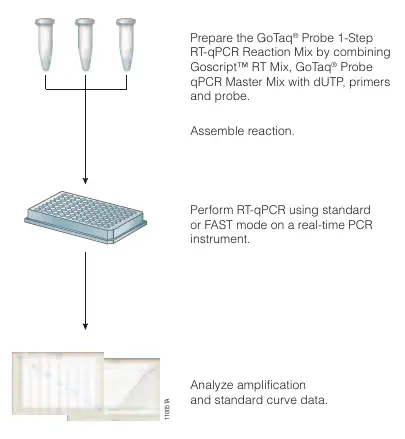
The GoTaq Probe 1-Step RT-qPCR System is designed for quantitative PCR assays. The workflow involves preparing a reaction mix by combining the GoScript RT Mix, GoTaq Probe qPCR Master Mix with dUTP, primers, and the hydrolysis probe, followed by the addition of the RNA template. The reaction is then performed on a real-time PCR instrument using either standard or fast cycling conditions.
Product Description
This system enables detection and relative quantification of RNA expression levels using a one-step RT-qPCR method. It combines GoScript Reverse Transcriptase and GoTaq Probe qPCR Master Mix. The master mix is a ready-to-use 2X formulation containing GoTaq Hot Start Polymerase, MgCl2, dNTPs, and a proprietary reaction buffer. It is formulated with dUTP to allow for carryover contamination control using UNG.
Storage Conditions
- Temperature: Store all components between -30°C and -10°C.
- Light: Protect components from light at all times.
- Handling: Mix thawed solutions gently to minimize aeration and foaming. Store on ice during use.
- Short-term: The master mix can be stored at +2°C to +10°C for up to 3 months if protected from light.
General Considerations
- Contamination Prevention: Use designated work areas and pipettes for pre- and post-amplification steps. Wear gloves and change them often. Use aerosol-resistant pipette tips. Do not open reaction plates after amplification.
- RNA Template: For unknown expression levels, start with 100ng of total RNA per reaction. Ensure the template is free of genomic DNA contamination.
- CXR Reference Dye: The system includes a separate tube of CXR Reference Dye. Add this to the master mix if your real-time PCR instrument requires normalization.
Protocol: Adding CXR Reference Dye
If your instrument requires normalization, add the CXR Reference Dye to the master mix before assembling the reaction:
- Thaw the GoTaq Probe qPCR Master Mix with dUTP.
- Vortex for 3–5 seconds.
- Add the appropriate volume of CXR Reference Dye based on your instrument requirements (Low-dye: 30nM; High-dye: 500nM).
- Vortex again for 3–5 seconds to mix.
- Mark the tube/bottle to indicate the dye has been added.
Assembling the Reaction Mix
The final reaction volume is 20µl. Prepare the reaction mix (minus RNA template) by combining:
- GoTaq Probe qPCR Master Mix with dUTP: 10µl
- GoScript RT Mix: 0.4µl
- Forward Primer (20X): 1µl
- Reverse Primer (20X): 1µl
- Hydrolysis Probe (20X): 1µl
- Nuclease-Free Water: To a final volume of 20µl
Add the RNA template (2–5µl) to the reaction mix in the PCR plate. Seal the tubes/plate and centrifuge briefly before cycling.
Thermal Cycling Conditions
Standard Cycling
- Reverse Transcription: 45°C for 15 minutes (1 cycle)
- RT Inactivation/Polymerase Activation: 95°C for 2 minutes (1 cycle)
- Denaturation: 95°C for 15 seconds (40 cycles)
- Annealing/Extension: 60°C for 1 minute (40 cycles)
FAST Cycling
- Reverse Transcription: 45°C for 5 minutes (1 cycle)
- RT Inactivation/Polymerase Activation: 95°C for 2 minutes (1 cycle)
- Denaturation: 95°C for 3 seconds (40 cycles)
- Annealing/Extension: 60°C for 30 seconds (40 cycles)
Practical help
Common problems
Contamination
Use designated work areas, wear gloves, use aerosol-resistant pipette tips, and do not open reaction plates after amplification.
Genomic DNA interference
Ensure the RNA template is free of genomic DNA contamination, especially when amplifying targets within a single exon.
Before use
- Thaw reagents on ice; do not thaw at elevated temperatures.
- Verify if your real-time PCR instrument requires CXR Reference Dye.
- Prepare dedicated pipettes for pre-amplification work.
- Ensure you have optical-grade PCR plates and covers.
- Determine the number of reactions, including negative controls.
Specs in practice
- CXR Reference Dye
- Used for normalization in real-time PCR instruments. Requirements vary: None, Low (30nM), or High (500nM).
- Hot-start chemistry
- Allows reaction setup to be performed at room temperature.
Images and diagrams
- Figure 1 illustrates the workflow: Prepare reaction mix -> Assemble reaction -> Perform RT-qPCR -> Analyze data.
Model compatibility
- Compatible with both standard and fast instrument cycling programs.
- CXR Reference Dye requirements depend on the specific real-time PCR instrument model.

Manual page author
Emily Carter
User documentation editor
Prepares concise manual descriptions and highlights the most useful setup, operation, and maintenance information for readers.