HVAC / Air Purifiers
Installation and Owner's Guide for Ultravation FS Series UV-C Air Disinfection System
Comprehensive installation and maintenance guide for Ultravation FS Series UV-C air disinfection systems (FS-22F, FS-33F, FS-22F-CR, FS-33F-CR). Includes safety precautions, mounting instructions, lamp replacement procedures, and technical...
Quick answers from the manual
Quick answer
- The Ultravation FS Series is an upper-room UV-C air disinfection system. It must be mounted horizontally at least 7 feet above the floor. Maintenance requires replacing the UV-C lamp every 9,000 hours. p. 2, 3
Key actions
- Mounting the unit p. 3
- Replacing the UV lamp p. 2, 3
First start
- Ensure the unit is mounted at least 7 feet from the floor and is level. Reverse the grill plates so fins face outward. Connect power and turn on. p. 3
Show 3 more answers Show less
Maintenance and reset
- Replace UV-C lamp every 9,000 hours (approx. 1 year). p. 2
Technical specifications
| Parameter | Value | Meaning | Pages |
|---|---|---|---|
| Lamp Life | 9,000 hours | Recommended replacement interval. | p. 3 |
| Power | 120-277 VAC | Auto-sensing input voltage. | p. 3 |
Where to find it in the PDF
- Safety and Maintenance p. 2
- Installation Instructions p. 3
- Principle of Operation and Placement p. 4
Table of contents
Manual images
Click an image to enlargeQuick guide from the manual
The Ultravation FS Series is an upper-room UV-C air disinfection system. Crucial safety requirement: The unit must be mounted at least 7 feet (approx. 2.1 meters) from the floor to prevent direct UV exposure. Never look directly at the UV lamps while in operation. The unit requires annual maintenance (lamp replacement every 9,000 hours) and should be installed by a trained technician.
Safety precautions
- UV Hazard: Always protect eyes from ultraviolet light. Never look at UV lamps while in operation.
- Mounting Height: Do not install the sanitizer with the bottom of the unit lower than 7 feet from the floor.
- Clearance: Ensure no objects are within 6 feet of the direct line of sight from the front of the sanitizer to prevent structural degradation or color shift.
- Orientation: Horizontal mounting only. Do not mount vertically.
- Disposal: Dispose of UV lamps in accordance with local environmental laws regarding mercury-containing fluorescent lamps.
Installation
The unit can be hardwired into an electrical circuit or powered via the provided 6 ft. power cord. It is recommended that a licensed electrician perform the installation.
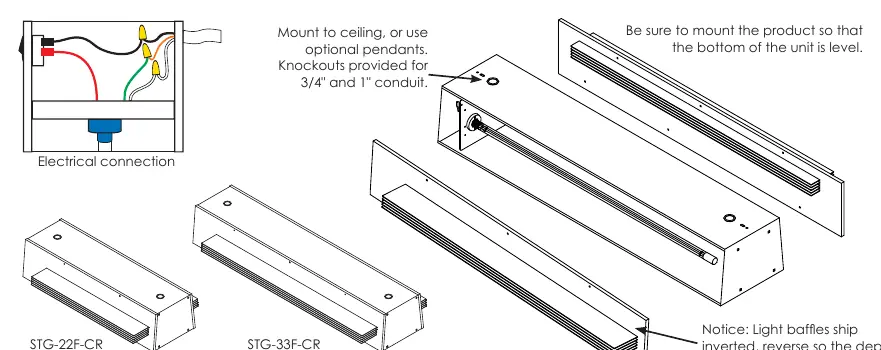
Mounting steps
- Remove front and rear grill plates using a #2 Phillips screwdriver. Note that grills ship with fins facing inward; these must be reversed to face outward upon re-installation.
- Carefully remove the UV lamp and packaging material.
- Set the power switch to the off position.
- Securely fasten the unit in its desired location. The unit must be level.
- Slide top reflector pieces to access mounting holes.
- Install a safety chain if required by local code (chain not included).
- Wire the unit per local and state codes. If hardwired, a dedicated on/off switch is recommended.
- Re-install cover plates with fins facing outward.
Maintenance and lamp replacement
Maintenance includes replacing the UV-C lamp every 9,000 hours (approximately 1 year). UV lamps undergo a photochemical process that reduces disinfection effectiveness over time.
- Replacement: Use only genuine Ultravation replacement lamps to avoid ozone production.
- Cleaning: When changing lamps, inspect the unit for accumulated dust on reflectors. Ensure lamp glass is free of fingerprints or debris; use rubbing alcohol and a dry cloth to clean if necessary.
- Part Numbers: 22" Germicidal lamp (non-ozone): AS-IH-1015; 33" Germicidal lamp (non-ozone): AS-IH-0614.
Principle of operation
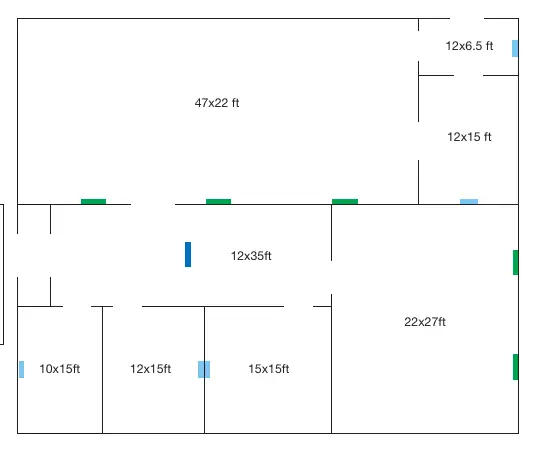
The system works by drawing air through the UV system and passing it into the room's upper air. Disinfected air naturally circulates downward. Ceiling mount models extend coverage by creating disinfection zones at both the front and rear of the unit.
Technical specifications
All models feature auto-sensing power (120-277 VAC, 50/60 Hz). The mounting surface must be able to safely support 30 lbs.
- FS-22F / FS-22F-CR: 10W output, 254nm wavelength, 9,000 hrs lamp life.
- FS-33F / FS-33F-CR: 16W output, 254nm wavelength, 9,000 hrs lamp life.
Practical help
Common problems
Ozone production
Use only genuine Ultravation replacement lamps. Third-party lamps may produce ozone, which is not recommended for occupied spaces.
Reduced disinfection effectiveness
Replace UV-C lamp every 9,000 hours (approx. 1 year) as the photochemical process reduces UV output over time.
Structural degradation or color shift in the room
Ensure no objects are within 6 feet of the direct line of sight from the front of the sanitizer.
Before use
- Ensure mounting surface can support 30 lbs.
- Verify the bottom of the unit is at least 7 feet from the floor.
- Ensure the unit is mounted horizontally.
- Check that the power switch is in the OFF position before installation.
- Ensure the unit is level.
- Clean lamp glass with rubbing alcohol if fingerprints are present.
Show more Show less
Specs in practice
- UV-C Lamp Life
- 9,000 hours (approx. 1 year) before replacement is required for optimal performance.
- Mounting Weight
- The surface must support 30 lbs.
Images and diagrams
- The mounting diagram shows the unit with knockouts for 3/4" and 1" conduit and key slots for safety chains.
- The grill plates must be reversed so the fins face outward.
- Placement diagrams illustrate how ceiling mounts extend coverage zones.
Model compatibility
- Compatible with 120-277 VAC power sources.
- Requires specific replacement lamps (AS-IH-1015 for 22", AS-IH-0614 for 33").

Manual page author
David Miller
Documentation analyst