HVAC / Heaters & Fireplaces
Installation Manual for Ximax Designer Radiator
A comprehensive installation and maintenance guide for Ximax designer radiators. This manual provides step-by-step assembly instructions, connection diagrams, dimension tables, and troubleshooting procedures to ensure proper setup and...
Table of contents
Manual images
Click an image to enlargeQuick guide from the manual
Before beginning the assembly of your Ximax designer radiator, ensure you have read the instructions carefully. The installation must be performed by a qualified plumber or competent specialist. Always wear protective clothing, such as gloves and reinforced work shoes, during the process.
Required tools: Phillips screwdriver, flat screwdriver, tape measure, wrench, drill bit, and drilling machine.
Important safety and preparation:
- Do not dispose of packaging until all small parts (brackets, mounting accessories) are secured.
- Ensure the wall is suitable for mounting; supplied wall plugs are for solid masonry only.
- Check for hidden water, electric, or gas lines before drilling.
- Maintain a minimum distance of 150 mm between the floor and the bottom of the radiator for efficient ventilation.
Scope of delivery
The standard package includes:
- 1x Radiator
- 1x Air vent (A)
- 1x Blanking plug (B)
- 4x Masonry wall plugs (C)
- 4x Screws (D)
- 4x Washers (E)
- 4x Wall brackets
Connection options
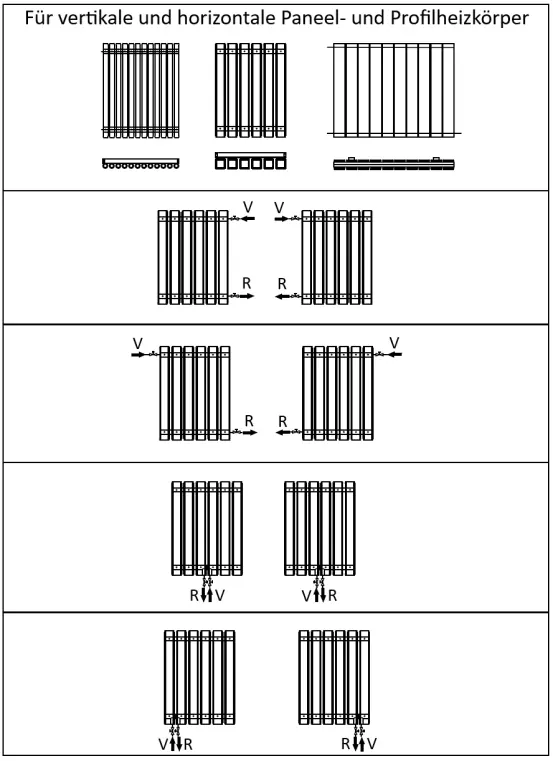
The manual provides various connection schemes for vertical and horizontal tube, panel, and profile radiators. Ensure you have the appropriate connection fittings before starting. Options include standard connections, offset/center connections, and side connections.
Assembly instructions
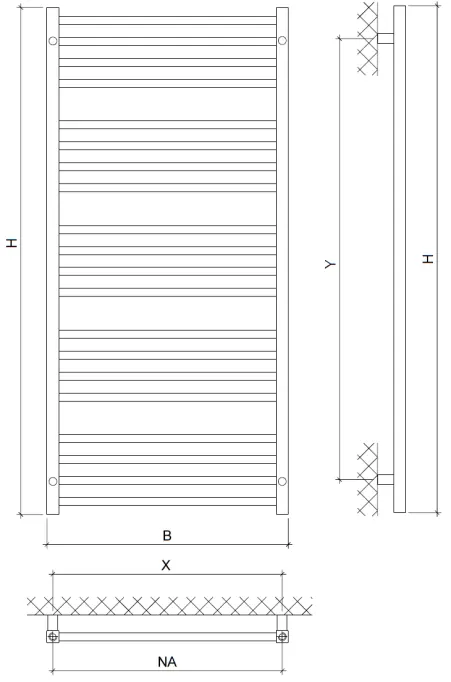
- Drill 4 holes using the dimensions specified in the assembly dimension table (approx. 60 mm depth, 8 mm diameter).
- Insert wall plugs (C) into the holes (solid walls only).
- Attach the screw (D) and washer (E) to the bracket. Do not overtighten.
- Check for a baffle inside the horizontal tubes. If present, it must be at the bottom. If clear, installation direction is universal.
- Hang the radiator on the brackets.
- Install the air valve (A) and blanking plug (B) in the upper threaded openings.
- Connect flow and return valves (not included) using watertight seals (e.g., PTFE tape).
- Filling and venting: Open the air vent, slightly open the inlet valve (10%), and allow the system to fill slowly. Once filled, close the air vent, open both valves fully, run for 2 hours, then vent again to remove remaining air.
Care and use
After installation, the system must be thoroughly rinsed to flush out debris and then vented. It is recommended to add a suitable inhibitor to the central heating system to prevent internal rust and limescale. Clean the radiator only with a soft, damp cloth; avoid scouring pads or chemical cleaning agents.
Troubleshooting
If pipes are not warm, vent the radiator again. If tubes remain cold, the radiator may have been filled too quickly; try draining and refilling slowly. If the radiator heats unevenly or takes a long time to heat, it may be installed upside down (check the baffle position). For electric radiators, a small amount of water discharge on first use is normal; if panels do not heat, top up the radiator by placing it on its side and adding water through the top side nut.
Practical help
Common problems
Radiator pipes are not warm
Check for air in the system and vent the radiator using the air valve.
Patchy heat or slow heating
The radiator may be installed upside down. Check the baffle position inside the horizontal tube; it must be at the bottom.
Electric radiator not heating
It may need to be topped up. Place the radiator on its side, undo the top side nut, and add water.
Leaks at connections
Ensure threads are sealed watertight using PTFE tape or a similar sealing product.
Before use
- Verify package contents (radiator, air vent, blanking plug, brackets, screws, washers).
- Ensure the wall type is suitable for the supplied wall plugs (solid masonry).
- Check for hidden water, electric, or gas lines behind the wall.
- Prepare necessary tools: screwdrivers, tape measure, wrench, drill.
- Ensure a minimum 150 mm clearance from the floor.
Specs in practice
- Max. Operating Pressure
- Varies by model (check the table on pages 5-6). Exceeding this limit can damage the radiator and void the warranty.
- Hub spacing (NA)
- The distance between the connection points on the radiator.
- Drill hole spacing (X/Y)
- The required horizontal (X) and vertical (Y) distances for mounting the brackets.
Images and diagrams
- Diagrams illustrate 4 mounting types based on bracket position: between cross tubes, on the manifold, fixed bracket on the back, and fixed pins with sleeves.
- Connection diagrams show standard, offset, center, and side connection configurations.
Model compatibility
- Designed for use in closed central heating systems.
- Supplied wall plugs are only suitable for solid masonry.

Manual page author
David Miller
Documentation analyst
Organizes user manual content into clear summaries, with attention to model details, product context, and everyday usability.