Tools / Power Tools
Bosch PEX 300 AE 125mm Electric Random Orbit Sander Instruction Manual
Quick guide for the Bosch PEX 300 AE 125mm random orbit sander. Includes setup, sanding sheet replacement, dust extraction, operation, and maintenance tips.
Table of contents
Quick guide from the manual
The Bosch PEX 300 AE is a random orbit sander designed for dry sanding of wood, plastic, metal, filler, and varnished surfaces. It is also suitable for polishing when equipped with appropriate accessories. Always disconnect the power plug before performing any maintenance or adjustments.
Device description
The sander features an orbital stroke rate preselection thumbwheel, an on/off switch, a microfilter dust box system, and a 125mm sanding pad. The handle is designed with an insulated gripping surface for comfort and safety.
Assembly and setup
Ensure the power plug is disconnected before assembly. To attach a sanding sheet, clean the sanding pad (4) of dust and debris. The pad uses a hook-and-loop system. Align the holes in the sanding sheet (6) with the holes in the sanding pad (4) for optimal dust extraction. An alignment aid (7) is provided to assist with precise positioning.
Operation
To switch on, slide the on/off switch (2) forward to position '1'. To switch off, slide it backward to position '0'. The orbital stroke rate can be adjusted during operation using the thumbwheel (1). Use lower settings for polishing and higher settings for heavy material removal.
Dust extraction
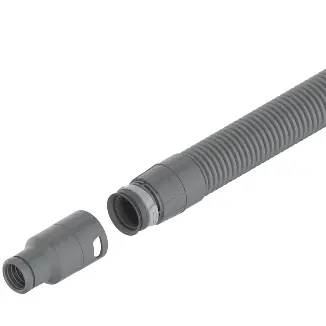
The sander includes a Microfilter System. Attach the dust box (3) to the extraction outlet (10) until it clicks. To empty, rotate and pull the box downwards. For best results, empty the box frequently and clean the filter element (11) with a soft brush. For external extraction, use the provided adapter (13) to connect a vacuum cleaner hose.
Maintenance
Keep the tool and ventilation slots clean for safe operation. If the power cord requires replacement, it must be performed by an authorized Bosch service center to avoid safety hazards.
Manufacturer information
Bosch
Practical help
Common problems
Poor dust extraction
Empty the dust box (3) frequently and clean the filter element (11) with a soft brush.
Sanding sheet not sticking
Clean the sanding pad (4) of dust and debris before attaching a new sheet.
Overheating during polishing
Select a low orbital stroke rate (level 1-2) to avoid excessive heat buildup.
Before use
- Ensure the power source voltage matches the tool's rating plate.
- Check that the sanding sheet is correctly aligned with the pad holes.
- Ensure the dust box is properly clicked into place.
- Verify the switch is in the '0' (off) position before plugging in.
Specs in practice
- Rated power input (270 W)
- The power consumption of the motor under normal load.
- No-load speed (2000–12000 min-1)
- The rotational speed range of the sanding pad without load.
- Orbit diameter (4 mm)
- The size of the circular movement of the sanding pad.
Images and diagrams
- Figures A-B: Changing the sanding sheet using the alignment aid.
- Figures C-D: Changing the sanding pad by removing the four screws.
- Figures E-H: Using and emptying the Microfilter dust box.
- Figure I: Connecting an external vacuum cleaner using the adapter.
Model compatibility
- Use only original Bosch sanding accessories.
- The tool is not suitable for bench-mounted or stationary use.

Manual page author
David Miller
Documentation analyst
Organizes user manual content into clear summaries, with attention to model details, product context, and everyday usability.