Power / Batteries & Chargers
Operating Manual for Discover Tubular Flooded SOPzS 12V Block Battery
Quick guide for the Discover Tubular Flooded SOPzS 12V Block battery. Includes installation, charging parameters, maintenance schedules, and troubleshooting.
Table of contents
Manual images
Click an image to enlargeQuick guide from the manual
This manual provides essential operating, installation, and maintenance instructions for the Discover Tubular Flooded SOPzS 12V Block battery. Key takeaways include the requirement for a commissioning charge before initial use, strict adherence to charging parameters to prevent sulphation, and regular maintenance schedules to ensure battery health.
Safety precautions
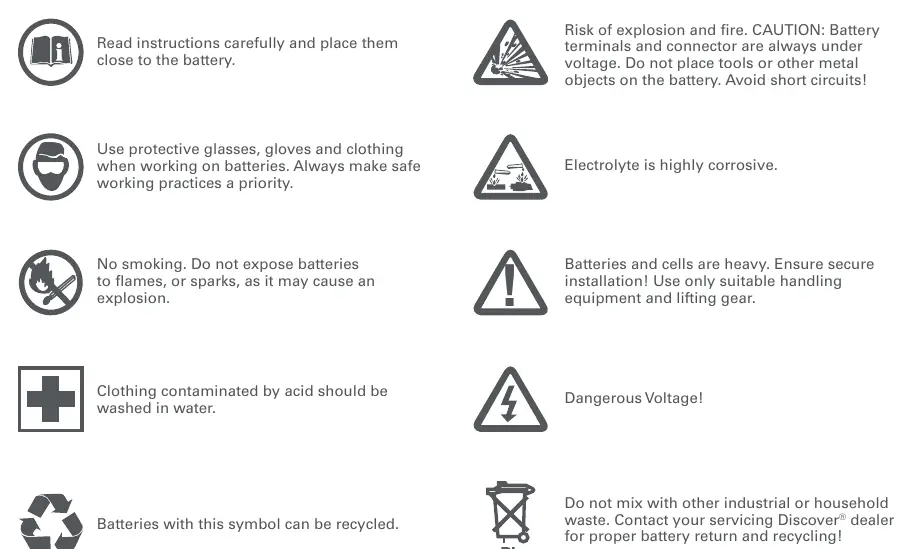
Batteries contain sulfuric acid, which is extremely corrosive. Always wear protective glasses, gloves, and clothing when working with batteries. Ensure the area is well-ventilated and keep first aid kits and fire extinguishers accessible. Do not smoke or expose batteries to flames, sparks, or high temperatures. In case of acid contact with skin or eyes, rinse immediately with plenty of water and seek medical attention if necessary.
Installation and commissioning
Before installation, inspect the batteries for leakage or damage. Ensure the installation area is clean, dry, and protected from dropped items. When connecting batteries in parallel or series strings, only use batteries of the same voltage, capacity, design, and age. Ensure all electrical connections are clean and tightened to a torque of 9-11 Nm (6.6-8.1 Ft-lbs). A commissioning charge is mandatory before putting the battery into service to ensure full capacity.
Charging
Charging is grouped into three phases: bulk, absorption, and float, with an additional equalization phase for maintenance. The battery temperature must not exceed 55°C (131°F) during charging. If the temperature reaches this limit, interrupt the charge or reduce the voltage until the battery cools. Always monitor the specific gravity of the electrolyte as an indicator of the state of charge.
Maintenance
Bi-annual maintenance: Check and record battery voltage, electrolyte density, and level. Perform deviation testing on voltages, density, and temperatures to identify imbalances or short circuits. Confirm daily and maximum Depth of Discharge (DoD) limits are respected.
Annual maintenance: In addition to bi-annual tasks, ensure all connectors are firmly tightened, inspect racks for corrosion or loss of integrity, and verify that ventilation and room temperature are sufficient.
Troubleshooting
Common issues such as terminal melting, case bulging, or capacity loss are often related to improper connections, overheating, or deep discharging. If specific gravity readings are consistently low, the battery may be severely discharged and require a recharge. If readings are consistently high, the battery may be overcharged, requiring adjustments to the absorption time or voltage settings.
Practical help
Common problems
Battery terminal melting
Usually caused by loose connections, over-tightened connections, improper cable sizing, or corroded connections. Inspect and correct cabling.
Battery case bulging
Can be normal for new batteries, but excessive bulging may indicate exposure to temperatures over 50°C or freezing. If excessive, contact your distributor.
Capacity loss
Often due to sulphation, overheating, or over-discharging. A balance charge or equalization may be necessary.
Low specific gravity readings
Indicates severe discharge. Recharge the battery and consider increasing bulk/absorption voltage or absorption time.
Before use
- Inspect for missing components and electrolyte leakage.
- Ensure correct polarity before connecting to DC power supply.
- Verify that the installation area is clean, dry, and well-ventilated.
- Tighten terminal screws to 9-11 Nm (6.6-8.1 Ft-lbs).
- Perform a commissioning charge before putting the battery into service.
- Ensure all batteries in a string are of the same voltage, capacity, design, and age.
Specs in practice
- DoD (Depth of Discharge)
- A measure of how much energy has been used from the battery, similar to a fuel gauge.
- SoC (State of Charge)
- A measure of how much energy is still available to be discharged.
- VPC (Volts per Cell)
- The voltage of each individual cell; the total system voltage is the sum of these.
Images and diagrams
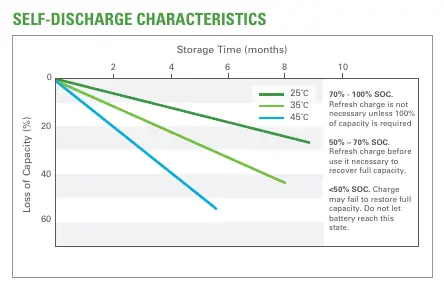
- The self-discharge characteristics chart illustrates capacity loss over time at different storage temperatures (25°C, 35°C, 45°C).
- The freezing point table shows the minimum safe temperature for different specific gravity levels to prevent electrolyte freezing.
Model compatibility
- Only connect batteries of the same voltage, capacity, design, and age in parallel or series strings.
- Maximum of 4 strings in parallel is recommended unless specific balancing requirements are met.

Manual page author
Emily Carter
User documentation editor
Prepares concise manual descriptions and highlights the most useful setup, operation, and maintenance information for readers.