Documents / Warranty Safety
Instruction Manual for E-flite UMX Air Tractor 0.70m
Quick guide for the E-flite UMX Air Tractor 0.70m, covering transmitter setup, binding, flight modes (SAFE/AS3X), battery installation, and troubleshooting.
Table of contents
Manual images
Jump to the sectionQuick guide from the manual
This document provides essential setup and operational information for the E-flite UMX Air Tractor. Key procedures include binding the receiver to your transmitter, configuring transmitter settings (NX, DX, and iX series), and understanding the differences between SAFE and AS3X flight modes. Always ensure the aircraft is on a level surface during initialization and keep hands clear of the propeller when the battery is connected.
Safety Precautions
- Always maintain a safe distance and operate in open spaces.
- Never operate with low transmitter batteries or damaged wiring.
- Keep all moving parts clean and dry.
- Always remove the flight battery after use.
- Not intended for children under 14 years.
Transmitter Setup
The manual provides specific step-by-step configurations for Spektrum NX, DX, and iX series transmitters. Key settings include:
- Wing Type: 1 Ail 1 Flap, Tail: Normal.
- Dual Rates/Expo: Aileron (Switch F) and Elevator (Switch C) set to 100% High/70% Low.
- Flap System: Switch D with specific positions for flaps and elevator compensation.
- Throttle Cut: Switch H, Position -100%.
Binding Procedure
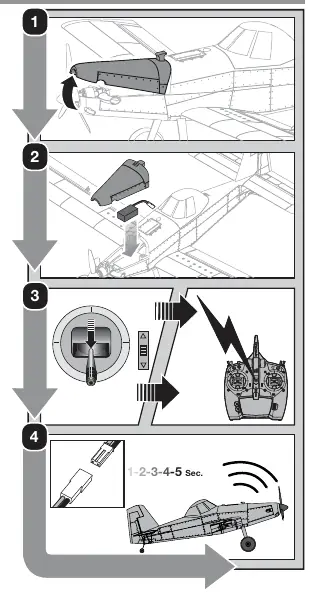
- Ensure the flight battery is disconnected and the transmitter is powered off.
- Place the aircraft on a level surface.
- Connect the flight battery; the receiver LED will flash rapidly after 5 seconds.
- Put the transmitter into bind mode.
- The LED will turn solid once binding is complete.
Flight Modes
The aircraft features two modes controlled by Channel 5:
- SAFE Mode: Provides self-leveling and bank/pitch limits. Ideal for beginners.
- AS3X Mode: Provides stabilization without self-leveling. Suitable for more experienced pilots.
Battery and ESC
The ESC includes a Low Voltage Cutoff (LVC) to protect the Li-Po battery. When power decreases, land immediately. Always disconnect the battery when not in use to prevent over-discharge. The Center of Gravity (CG) should be 29mm ± 2mm behind the leading edge of the wing.
Service and Repairs
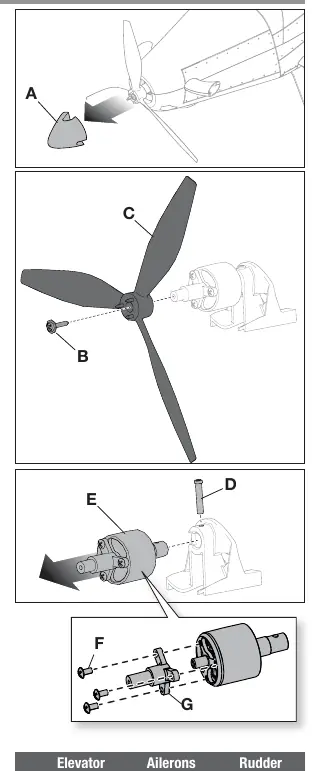
Disassembly of the propeller and motor requires specific screwdrivers (Phillips #1 and #0). The propeller and spinner are glued; use care when removing. Always ensure the propeller hub dimples face forward during reassembly.
Manufacturer information
E-flite
Practical help
Common problems
Control surfaces not at neutral when transmitter is at neutral
Center control surfaces mechanically by adjusting the U-bends on the control linkages.
Controls oscillate in flight
Check for an unbalanced propeller, loose propeller screw, or excessive trim.
Aircraft will not bind to transmitter
Ensure transmitter is not too close to the aircraft, bind switch is held long enough, and the aircraft is away from large metal objects.
Motor/ESC not armed after landing
Fully lower the throttle and throttle trim to arm the ESC.
Before use
- Ensure flight battery is fully charged.
- Check that control surfaces are centered.
- Verify transmitter is set to the correct model memory.
- Ensure throttle cut is enabled before approaching the aircraft.
- Check that the propeller is secure and undamaged.
Specs in practice
- Center of Gravity (CG)
- 29mm ± 2mm behind the leading edge of the wing.
Images and diagrams
- The manual includes diagrams for transmitter stick commands vs. control surface response (Elevator, Aileron, Rudder).
- A diagram illustrates the correct CG measurement point on the wing.
- Step-by-step visual guides are provided for propeller and motor disassembly/assembly.
Model compatibility
- Requires a full-range Spektrum DSM2/DSMX compatible transmitter.
- Recommended battery: Spektrum 3S 300mAh 30C LiPo.
- Compatible with Spektrum Smart Technology telemetry.

Manual page author
David Miller
Documentation analyst
Organizes user manual content into clear summaries, with attention to model details, product context, and everyday usability.