Documents / Warranty Safety
E-flite Extra 300 1.3m Instruction Manual
Comprehensive instruction manual for the E-flite Extra 300 1.3m RC aircraft, covering assembly, SAFE Select technology, transmitter setup, and maintenance.
Table of contents
Manual images
Jump to the sectionProduct Overview
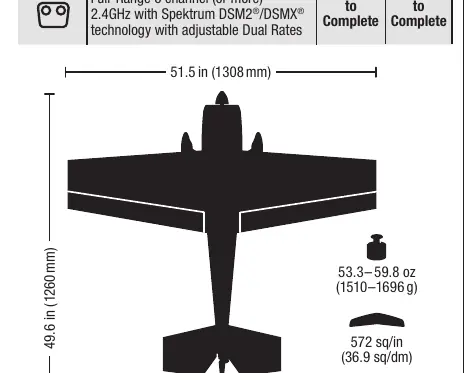
The E-flite Extra 300 1.3m is a high-performance RC aircraft designed for aerobatic flight. It features advanced SAFE Select technology, which provides optional flight envelope protection, making it suitable for a range of skill levels. The aircraft comes equipped with a powerful 4250-910Kv motor and a 60A ESC, ensuring responsive and exciting flight characteristics.
Safety and Precautions
Operating this aircraft requires caution and common sense. Always maintain a safe distance from people, vehicles, and obstacles. Never operate the model with low transmitter batteries, and ensure the aircraft is always in sight. Moisture can damage electronics, so keep the equipment dry. Always remove the battery after use and before disassembly. This product is not a toy and is recommended for users aged 14 and older.
Assembly and Setup
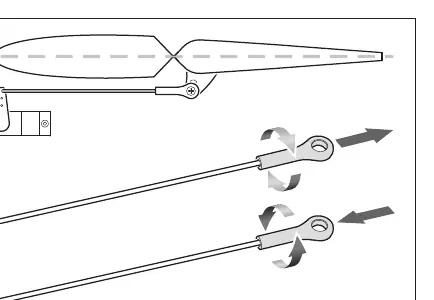
The assembly process involves installing the landing gear, horizontal stabilizer, vertical fin, and wings. Ensure all linkages move freely and test control directions before flying. The receiver should be mounted parallel to the fuselage. For transmitter setup, follow the provided dual rates and expo charts to ensure optimal control response. Always rebind the transmitter and receiver after initial setup to establish correct failsafe positions.
SAFE Select Technology
SAFE Select offers an extra level of protection by providing bank and pitch limitations and automatic self-leveling. This system can be assigned to a switch on your transmitter, allowing you to toggle it on or off during flight. When activated, it helps keep the airplane in a level attitude when the sticks are in the neutral position, which is particularly useful for takeoffs and landings.
Flight and Maintenance
Before your first flight, perform a range check and ensure the center of gravity (CG) is correctly set at 90-100mm from the leading edge of the wing. During flight, monitor your battery usage and land immediately if power reduces to prevent over-discharge. After flying, disconnect the battery and store it at a safe voltage. Regular maintenance includes checking for loose parts, ensuring linkages are secure, and keeping the aircraft clean. If repairs are needed, the EPO foam construction allows for easy fixes using standard adhesives.
Manufacturer information
E-flite
Practical help
Common problems
Oscillation during flight
Check for damaged/imbalanced propeller, loose receiver, or loose control linkages.
Aircraft will not bind to transmitter
Ensure transmitter is not too close during binding, check bind plug installation, and ensure battery is charged.
Inconsistent flight performance
Ensure trim is at neutral and the aircraft was kept immobile for 5 seconds after battery connection.
Motor power pulses or loses power
Battery may be cold, old, or have an insufficient C rating; recharge or replace the battery.
Before use
- Charge the flight battery fully.
- Setup transmitter using the provided chart.
- Fully assemble the airplane.
- Check the Center of Gravity (CG).
- Bind the aircraft to your transmitter.
- Perform a Control Direction Test.
- Perform a radio system Range Test.
Specs in practice
- Center of Gravity (CG)
- 90-100mm from the leading edge of the wing at the fuselage.
- Flight Timer
- Recommended setting of 3 minutes.
Images and diagrams
- Landing gear installation showing screw locations.
- Tail assembly showing horizontal stabilizer and vertical fin attachment.
- Wing installation showing joiner and screw locations.
- Receiver port mapping (1=Throttle, 2=Aileron, 3=Elevator, 4=Rudder, 5=Retracts, 6=Flaps).
- AS3X control direction test reaction guide.
Model compatibility
- Requires a full-range 6-channel (or more) 2.4GHz transmitter with Spektrum DSM2/DSMX technology.
- Recommended battery: 14.8V 4S 2200-3200mAh 30-40C Li-Po.
- Compatible with Spektrum AR631 receiver.
- Not compatible with BNF if using a non-telemetry receiver.

Manual page author
David Miller
Documentation analyst
Organizes user manual content into clear summaries, with attention to model details, product context, and everyday usability.