Tools / Generators
Growatt Shine WiFi-F Datalogger User Guide
Quick installation and configuration guide for the Growatt Shine WiFi-F datalogger. Learn how to connect your inverter to the ShinePhone app, interpret LED status indicators, and troubleshoot network connection issues.
Table of contents
Quick guide from the manual
The Growatt Shine WiFi-F is a datalogger designed to connect your inverter to the ShinePhone app and the Growatt ShineServer. This guide covers the physical installation, app configuration, and troubleshooting steps to ensure successful data transmission.
Installation
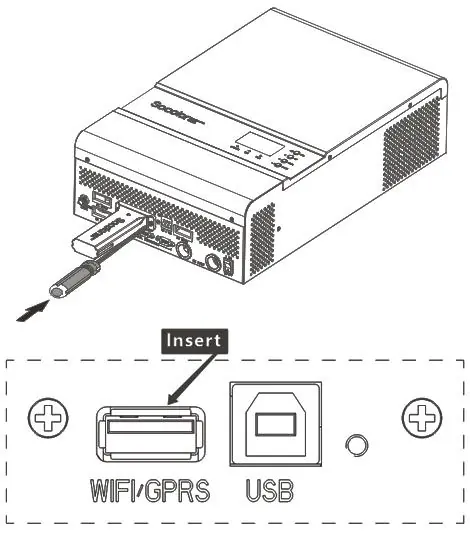
To install the ShineWiFi module, locate the WiFi/GPRS port on your inverter. Plug the ShineWiFi module directly into this port. Once installed, turn on the inverter. A flashing red LED indicates that the communication between the inverter and the ShineWiFi module is established.
Registration and Device Setup
Follow these steps to configure the device:
- Download the ShinePhone app from the iOS or Google Play Store.
- Open the app and register an account.
- Select your country and city.
- Fill in the required information to proceed to the Add Datalogger page.
- Scan the barcode on the ShineWiFi module or manually input the serial number and checkcode.
- Enter your home WiFi network name and password.
- Click Configuration. A successful message will appear, and the device will be added to your plant.
LED Status Indicators
The LEDs on the ShineWiFi module provide real-time status updates:
- All three LEDs off: Datalogger is not connected to the inverter WiFi/GPRS port.
- Only Red LED flashes: Communication between ShineWiFi and the inverter is OK.
- Only Green LED flashes: Communication between ShineWiFi, the inverter, and the router is OK.
- Only Blue LED flashes: Normal working state; communication between ShineWiFi, the inverter, the router, and the Growatt ShineServer is OK.
- Red LED always ON: ShineWiFi module error; replacement may be required.
- Blue LED always ON: ShineWiFi module is in AP mode (debug mode).
Troubleshooting
If you encounter issues, check the following:
- ShineWiFi cannot find the inverter: Ensure the DIP switch beside the inverter's WiFi/GPRS port is switched to ON.
- Cannot connect to home router: Ensure the router name consists only of English letters and numbers (no special symbols). Use an encrypted wireless network. The device does not support public networks with secondary authentication or bridge networks.
- Not connected to ShineServer: Ensure the home router is connected to the internet and that the firewall allows ports 5279 and 5280.
Factory Reset
If you change your router or password, you may need to reset the device:
- Remove the rubber plug on the ShineWiFi module.
- Press the KEY button for more than 6 seconds until all three LEDs light up.
- Log in to your ShinePhone account, click the '+' sign, and reconfigure the datalogger using its serial number.
Manufacturer information
Growatt New Energy
Practical help
Common problems
All three LEDs are dark
Check if the DIP switch beside the inverter's WiFi/GPRS port is switched to ON.
After configuration, only Red LED flashes (cannot connect to router)
Verify router name has no special symbols, use an encrypted network, and ensure it is not a public network requiring secondary authentication.
After configuration, only Green LED flashes (not connected to ShineServer)
Check if the home router is connected to the internet and ensure the firewall allows ports 5279 and 5280.
Before use
- Download the latest version of the ShinePhone app.
- Ensure your home WiFi network is encrypted.
- Verify your router name contains only English letters and numbers.
- Ensure the inverter is powered on.
- Have the ShineWiFi module serial number and checkcode ready.
Specs in practice
- Red LED flashing
- Inverter and ShineWiFi communication is established.
- Green LED flashing
- ShineWiFi, inverter, and router communication is established.
- Blue LED flashing
- Normal operation; connected to ShineServer.
Images and diagrams
- The installation diagram shows the ShineWiFi module being inserted into the WiFi/GPRS port of the inverter.
- The app interface screenshots guide you through the registration process, including scanning the barcode and entering WiFi credentials.
Model compatibility
- Does not support public networks with secondary authentication.
- Does not support bridge networks.
- Router name must not contain special symbols.

Manual page author
David Miller
Documentation analyst
Organizes user manual content into clear summaries, with attention to model details, product context, and everyday usability.