General / Service Manuals
SOLO Compression Sprayers 1.5G Series Instruction Manual
Comprehensive operator's manual for SOLO 1.5G series compression sprayers, covering safety, assembly, operation, maintenance, and troubleshooting.
Table of contents
Manual images
Jump to the sectionProduct Overview
The SOLO compression sprayer series is designed for agricultural, industrial, and household applications. These high-density polyethylene sprayers are equipped with Viton seals, providing excellent resistance to a wide range of chemicals. The units are engineered for durability and ease of use, featuring an adjustable nozzle for versatile spray patterns, ranging from a straight stream to a hollow cone.

Safety Precautions
Safety is paramount when operating chemical sprayers. Always wear rubber gloves, safety goggles, and appropriate protective clothing. Never exceed 45 psi of pressure. Do not use flammable materials, gasoline, acids, acetone, or caustic chemicals. Ensure the sprayer is in good repair before use. Never stand over the tank while pumping or loosening the pump assembly. Always release pressure using the relief valve before removing any parts. Do not use liquids with temperatures exceeding 120°F (45°C).
Operation
Before using chemicals, test the sprayer with fresh water to ensure proper assembly and function. To operate, turn the pump handle counter-clockwise to remove the pump, fill the tank with the desired formula (do not exceed the maximum fill mark), and tighten the assembly securely. Pump to a maximum of 45 psi. The pressure relief valve will automatically vent excess pressure. Use the lever on the shut-off valve to control spraying.
Maintenance and Cleaning
Regular maintenance ensures the longevity of your sprayer. After every use, empty the tank and flush the system with clean water or appropriate cleaning agents. Lubricate O-rings and seals periodically with non-water soluble grease to maintain a proper seal. Inspect the tank cap gasket, pressure relief valve, and umbrella valve regularly for signs of wear. Always store the unit in a dry area, protected from freezing temperatures, heat, and direct sunlight.
Troubleshooting
If you experience issues such as difficulty moving the pump handle, low pressure, or leaks, refer to the troubleshooting section. Common solutions include cleaning the cylinder wall, replacing worn O-rings, tightening the tank cap, or rebuilding the shut-off valve. Always perform a leak test with clean water after any repair.
Manufacturer information
SOLO Kleinmotoren GmbH
Practical help
Common problems
Difficulty in moving pump handle
Clean cylinder wall, grease, or replace swollen O-ring.
Low pressure during pumping
Lubricate piston/cylinder, replace umbrella valve, or tighten tank cap.
Leaks from end of spray wand
Rebuild shut-off valve or replace damaged O-ring.
Pressure relief valve sticks
Tighten fittings, clean, and lubricate O-rings.
Before use
- Wear rubber gloves, safety goggles, and protective clothing.
- Check that all parts are clean and in good repair.
- Test sprayer with fresh water to ensure proper assembly.
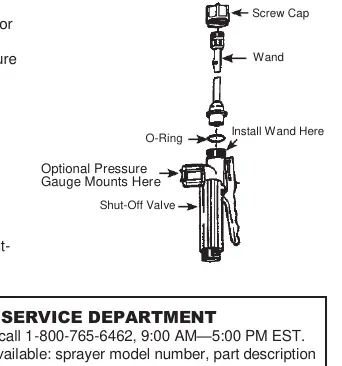
- Ensure the O-ring is on the non-threaded end of the wand.
- Do not fill above the maximum fill mark.
- Ensure the pump handle is in the locked down position after pumping.
- Verify the pressure relief valve is functioning.
Specs in practice
- Maximum Pressure
- 45 psi (3 bar) - Do not exceed this limit.
- Liquid Temperature
- Maximum 120°F (45°C).
Images and diagrams
- The wand assembly involves inserting the non-threaded end into the shut-off valve with an O-ring and tightening the screw cap.
- The adjustable nozzle is controlled by rotating the nozzle cap for different spray patterns.
- Pump maintenance involves removing the umbrella valve and pulling the piston assembly from the cylinder.
Model compatibility
- Equipped with Viton seals resistant to many agricultural and industrial chemicals.
- Not compatible with gasoline, acid, acetone, or caustic chemicals.
- Use only non-water soluble grease for lubrication.

Manual page author
David Miller
Documentation analyst
Organizes user manual content into clear summaries, with attention to model details, product context, and everyday usability.