Tools / Electronic Test Equipment
Televes Wideband LNB and Optical Transmitter 1550nm
Quick guide for the Televes Wideband LNB and 1550nm Optical Transmitter (Ref. 237411). Includes installation safety, technical specifications, and wiring application examples.
Table of contents
Manual images
Click an image to enlargeQuick guide from the manual
This document provides installation and safety instructions for the Televes Wideband LNB and 1550nm Optical Transmitter (Ref. 237411). This device is designed for satellite signal conversion and transmission over optical fiber. Ensure all safety precautions are followed, particularly regarding laser radiation and electrical connections.
Kit contents
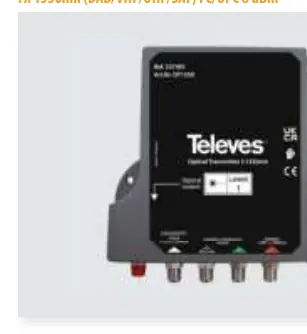
- LNB with WideBand Output (H/V)
- RF to optical converter
- AC/DC adaptor with European and UK mains plug
- Caps
Safety instructions
Laser Safety: This product emits an invisible laser beam. Do not look directly into the laser beam or use optical instruments (binoculars, magnifiers) to view it, as this increases the risk of eye damage. The laser beam must not be pointed at people or animals.
Electrical Safety:
- Power requirements: 100-240V~ 50/60Hz.
- Do not connect the equipment to the mains until all other connections are completed.
- Always pull the plug, never the cable, to disconnect from the mains.
- Ensure the socket outlet is near the equipment and easily accessible.
- Do not remove the cover without disconnecting from the mains.
Installation
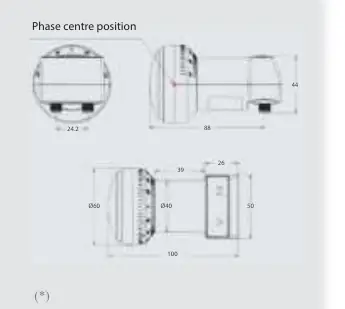
- Install the LNB and the RF/OF converter directly on the mast with minimal separation.
- Ensure the ambient temperature for the AC/DC adaptor does not exceed 45°C (113°F).
- Do not place the equipment near heat sources, in highly humid environments, or where it may be subject to vibrations.
- Allow sufficient air circulation around the equipment.
- Do not place naked flames, such as lighted candles, on or near the product.
Application example
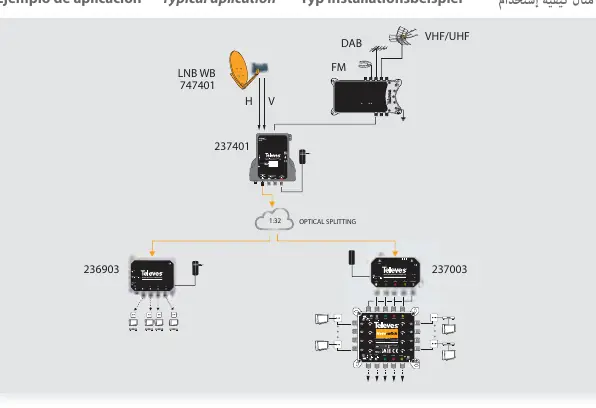
The system typically involves connecting the Wideband LNB to the RF/Optical converter. The optical output can then be distributed via an optical splitter (up to 1:32 splitting) to various optical receivers (such as Quad or Quattro optical converters) which then feed into multiswitches for signal distribution.
Notes and observations
- Capacity: Supports a maximum of 32 optical converters (236903/237003).
- Terrestrial signals: If using only terrestrial signals, the QUAD/QUATTRO converter must be powered with an external power supply.
- Signal filtering: It is necessary to filter out unwanted signals in the headend, such as noise and 4G/5G services.
Practical help
Common problems
Signal interference or poor quality
Filter out unwanted signals in the headend, specifically noise and 4G/5G services.
Terrestrial signal not working
If using only terrestrial signals, ensure the QUAD/QUATTRO converter is powered by an external power supply.
Laser safety concerns
Do not look directly into the laser beam with optical instruments like binoculars or magnifiers.
Before use
- Verify the power supply is 100-240V~ 50/60Hz.
- Ensure all RF and optical connections are made before plugging into the mains.
- Secure the device to the wall or mast.
- Check that the installation area is free from heat sources and high humidity.
- Ensure the socket outlet is easily accessible.
Specs in practice
- Optical Wavelength
- 1550 nm (emitted laser light).
- Input Frequency (WideBand)
- 290-2340 MHz.
- Protection Level
- IP 65 (dust tight and water resistant).
- Maximum Splitting
- 1:32 (optical signal distribution capacity).
Images and diagrams
- The wiring diagram illustrates the connection from the Wideband LNB to the RF/Optical converter, followed by an optical splitter (1:32) distributing the signal to multiple optical receivers.
Model compatibility
- Supports up to 32 optical converters (236903/237003).
- Compatible with standard Wideband LNBs.

Manual page author
David Miller
Documentation analyst
Organizes user manual content into clear summaries, with attention to model details, product context, and everyday usability.