Tools / Power Tools
Bosch Coolpack Battery Instruction Manual
Safety and operating instructions for Bosch lithium-ion batteries, including charging, storage, maintenance, and transport guidelines.
Table of contents
Product Description
This manual provides essential safety and operating instructions for Bosch lithium-ion batteries. These batteries are designed for use with specific Bosch power tools and must be charged only with compatible chargers recommended by the manufacturer.
Safety Instructions
Read all safety information carefully. Failure to follow these instructions may result in electric shock, fire, or serious injury. Keep these instructions for future reference.
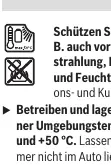
- Use the battery only with products from the manufacturer to prevent dangerous overload.
- Charge only with the specified charger to avoid fire hazards.
- Keep batteries out of the reach of children.
- Do not open the battery, as this poses a risk of short-circuiting.
- In case of damage or improper use, vapours may be emitted. Ensure the area is well-ventilated and seek medical attention if you experience adverse effects.
- If the battery is damaged, flammable liquid may leak. Avoid contact with this liquid; if contact occurs, rinse with water and seek medical advice.
- Protect the battery from heat, continuous sunlight, fire, dirt, water, and moisture to prevent explosion and short-circuiting.
Operation and Storage
Operate and store the battery only within an ambient temperature range of -20°C to +50°C. Do not leave the battery in a car during summer. Charge the battery only at ambient temperatures between 0°C and +35°C. Charging outside this range may damage the battery or increase fire risk.
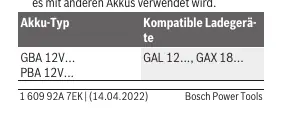
Maintenance and Cleaning
Occasionally clean the ventilation slots and terminals of the battery using a soft, clean, and dry brush. Do not use chemical substances for cleaning.
Transport
Lithium-ion batteries are subject to dangerous goods legislation. Users can transport the batteries by road without further restrictions. When shipping via third parties (e.g., air transport or forwarding agency), special requirements regarding packaging and labelling must be observed. Consult a hazardous material expert when preparing the item for shipment. Only send batteries if the housing is undamaged.
Disposal
Do not dispose of batteries with household waste. Batteries and packaging should be sorted for environmentally friendly recycling in accordance with local regulations.
Related manuals
Related manuals from the same brand or category.
Tools / Power Tools
Bosch EasyLevel Laser Spirit Level
BoschTools / Power Tools
Bosch Truvo Digital Detector
BoschTools / Power Tools
Bosch Li-Ion 18V Battery Instruction Manual
BoschTools / Power Tools
BOSCH GEX 40-150 Professional 150mm Electric Random Orbit Sander
BoschTools / Power Tools
BOSCH UniversalRotak 450-580 Electric Lawnmower
Bosch
Manual page author
Emily Carter
User documentation editor
Prepares concise manual descriptions and highlights the most useful setup, operation, and maintenance information for readers.