HVAC / Thermostats & Controls
Condair 10-POINT Humidifier Specification Guide
A comprehensive guide to specifying Condair humidifiers, covering sizing, technology selection, installation considerations, and hygiene measures for HVAC systems.
Table of contents
Manual images
Click an image to enlargeQuick guide from the manual
This document serves as a comprehensive guide for HVAC consultants and engineers to specify humidification systems. It outlines the critical factors for successful project design, including determining the need for humidification, calculating loads, selecting the appropriate technology, and ensuring proper installation and hygiene.
Why humidify?
Maintaining air humidity is essential for three primary reasons:
- Manufacturing efficiency: Prevents moisture loss in sensitive materials (print, pharmaceuticals, food) and dissipates electrostatic charge in data centers and electronics manufacturing.
- Preservation: Protects natural materials in museums, galleries, and archives from warping or damage due to moisture loss.
- Health: Maintains optimal indoor humidity (40-60% RH) to support respiratory immune function and reduce the survival of airborne viruses.
Psychrometric chart
A psychrometric chart is used to calculate the water required to raise humidity from a starting condition to a desired end condition. Key processes include:

- Isothermal humidification: Adding steam to increase moisture content with minimal temperature change.
- Adiabatic humidification/cooling: Evaporating cold water to increase moisture content while reducing air temperature.
- Heating/Cooling/Dehumidification: Adjusting temperature and moisture content to reach target conditions.
Sizing the humidifier
To calculate the required humidity load, you must determine the volume of moisture needed to raise humidity from the start to the end condition for 1 kg of dry air, and the volume of air being humidified. Key rules of thumb include:

- For every 1 m³/s of fresh air, approx. 25 kg/hr of humidity is needed.
- For every 100 kg of steam, approx. 75 kW of electrical power is required.
- For every 1 kg of cold water evaporated, approx. 0.68 kW of evaporative cooling is produced.
In-room vs. in-duct humidification
The choice depends on existing infrastructure:
- In-duct: Preferred if a central air handling unit (AHU) and duct network are already present.
- In-room: Necessary if no ducted system exists, or if humidity control is required locally for a specific area. In-room adiabatic systems can also provide additional cooling.
Technology selection
Selection is driven by energy costs, accuracy requirements, and physical constraints:
- Steam humidifiers: Offer close control (±1-2% RH) and are suitable for various water qualities. Resistive steam humidifiers are highly accurate.
- Adiabatic humidifiers: High capacity and energy-efficient, often used for cooling.
- High-pressure spray: Suitable for large areas and multiple zones.
Installation considerations
AHU Installations:
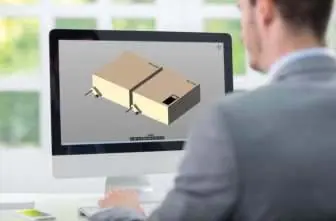
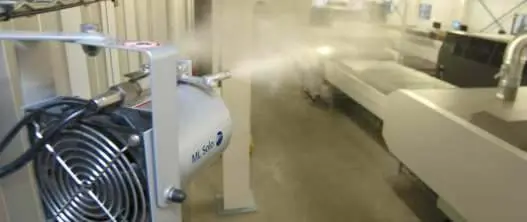
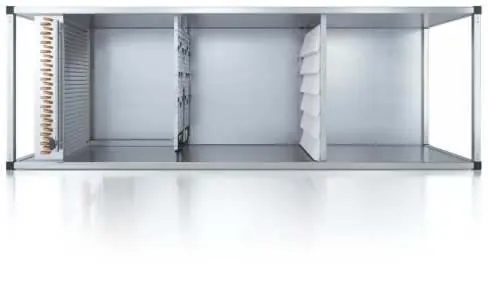
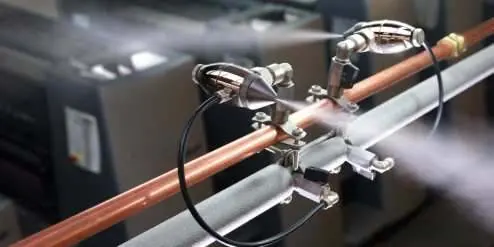
- Steam: Locate within 13ft of the AHU. Ensure proper absorption distance to avoid condensation on ductwork. Use drip trays and drains.
- Adiabatic: Requires stainless steel duct sections for spray systems. Ensure sufficient clearance for airflow and maintenance access.
In-room Installations:
- Ensure aerosol plumes have sufficient space to be fully absorbed by the air without contacting walls or ceilings.
- Provide necessary services (power, water, drain) locally.
- Use zone control strategies for large areas with varying humidity requirements.
Hygiene measures
A properly maintained system is essential. Key risk assessment points include:
- Preventing water stagnation in pipework or tanks.
- Avoiding nutrient sources for microbial growth.
- Managing water temperature (avoid 20-45°C).
- Minimizing exposure to respirable aerosols.
- Protecting high-risk individuals.
Features to mitigate risks include UV water treatment, silver ion treatment, automated flush/drain cycles, and regular maintenance.
Associated products
Consider additional components such as reverse osmosis (RO) water filtration to reduce mineral build-up, high-end humidistats for safety, leak detectors, and drain water cooling for steam systems.
Manufacturer information
Condair
Practical help
Common problems
Condensation in ducts
Ensure proper absorption distance is maintained and avoid placing duct bends or transitions in the absorption area.
Microbial growth
Ensure water does not stagnate, maintain water temperature below 20°C, and utilize hygiene features like UV or silver ion treatment.
High mineral build-up
Use RO water filtration or choose resistive steam humidifiers that can be cleaned of scale.
Before use
- Determine if the primary goal is manufacturing efficiency, preservation, or health.
- Calculate the required humidity load using a psychrometric chart.
- Assess if the building has an existing AHU or if a direct room system is required.
- Check ceiling height and space constraints for installation.
- Verify water quality and availability of necessary services (power, water, drain).
- Plan for routine maintenance and professional commissioning.
Specs in practice
- RH (Relative Humidity)
- The amount of water vapor in the air compared to the maximum amount the air could hold at that temperature.
- Isothermal Humidification
- Adding steam to increase moisture content with minimal temperature change.
- Adiabatic Humidification
- Evaporating cold water to increase moisture content while reducing air temperature.
Images and diagrams
- Psychrometric Chart: Shows the relationship between air temperature, moisture content, and relative humidity.
- Absorption Distance: The space required for steam or aerosol to be fully absorbed by the airstream without wetting duct surfaces.
Model compatibility
- Steam humidifiers should be located within 13ft of the AHU.
- High-pressure spray systems require RO water.
- Electrode boiler humidifiers are not suitable for RO water as they need minerals to conduct current.

Manual page author
Michael Turner
Technical manual editor
Reviews PDF manuals for structure, safety notes, and practical product details so readers can find the right information quickly.