Home Appliances / Ovens
Corning 012TUZ Fiber Optic Cable User Guide
Quick guide for the Corning 012TUZ industrial LSZH fiber optic cable, including technical specifications, installation requirements, and cable design details.
Table of contents
Quick guide from the manual
This document provides technical specifications and design details for the Corning 012TUZ industrial LSZH fiber optic cable. It is intended for professionals installing fiber backbones in harsh industrial environments. The cable is tray-rated and designed for both indoor and outdoor use.
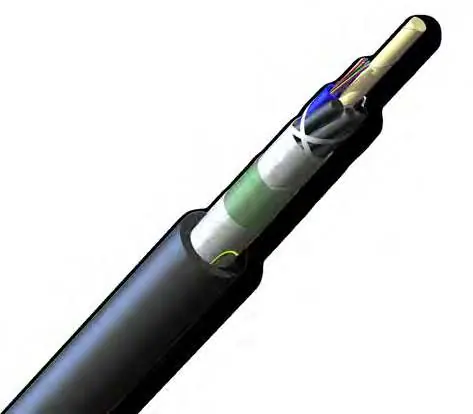
Cable design and construction
The 012TUZ cable features a stranded loose tube, gel-free design. Key components include:
- 12 multimode (OM3) fibers with 250 µm color-coding for easy identification.
- Dielectric central element.
- Water-swellable tapes and flame-retardant layers.
- FRNC/LSZH (Low-Smoke, Zero-Halogen) outer jacket.
- Two ripcords for easy sheath removal.
Installation and environmental conditions
The cable is suitable for aerial, direct buried, and duct installations. Observe the following temperature limits:
- Storage: -40 °C to 75 °C (-40 °F to 167 °F)
- Installation: -30 °C to 60 °C (-22 °F to 140 °F)
- Operation: -40 °C to 75 °C (-40 °F to 167 °F)
Important: Always adhere to the minimum bend radius requirements to prevent signal loss or fiber damage: 188 mm (7.4 in) during installation and 125 mm (4.9 in) during operation.
Standards and compliance
The cable meets several industrial standards, including:
- Tray-rated per UL 13, UL 444, UL 1277, UL 1685, and CSA C22.2 No. 230/232.
- Listed OFN-LS and CSA FT4-ST1.
- Compliant with IEC 60332-3, IEC 61034, and IEC 60754-2.
- RoHS compliant (free of hazardous substances).
Technical support
For ordering custom jacket colors or additional technical assistance, contact Corning Customer Care at 1-800-743-2675 or visit www.corning.com/opcomm.
Official resources from the manual
Manufacturer information
Corning Optical Communications
Practical help
Common problems
Signal loss due to tight bends
Ensure the cable is not bent beyond the minimum radius of 188 mm during installation or 125 mm during operation.
Difficulty identifying fibers
Use the 250 µm color-coded fibers (12 colors available) for quick identification.
Before use
- Verify the environment is within the -30 °C to 60 °C installation temperature range.
- Ensure the cable path complies with tray-rated or direct-buried installation requirements.
- Check that the fiber type (50 µm OM3) matches your network equipment specifications.
- Confirm the required jacket color (standard is black; others available via customer care).
Specs in practice
- LSZH (Low-Smoke, Zero-Halogen)
- A jacket material that emits limited smoke and no toxic halogens during a fire, essential for life-safety.
- Max. Tensile Strength (Short-Term)
- The maximum pulling force (2700 N) allowed during the installation process.
Images and diagrams
- The cross-section diagram shows the internal structure including the central element, buffer tube, fibers, and protective water-swellable/flame-retardant tapes.
- The ripcords are located under the outer jacket to facilitate safe stripping of the cable sheath.
Model compatibility
- Compatible with Corning Plug and Play and Pretium EDGE systems.
- Meets 0.75 ns optical skew when used in specified Corning system solutions.

Manual page author
David Miller
Documentation analyst
Organizes user manual content into clear summaries, with attention to model details, product context, and everyday usability.