Home Appliances / Ovens
Corning 024TUZ Industrial Fiber Optic Cable Specification Guide
Technical specification and installation guide for the Corning 024TUZ Industrial LSZH Tray-Rated Loose Tube Gel-Free Cable. Includes environmental ratings, mechanical limits, and construction details.
Table of contents
Manual images
Jump to the sectionQuick guide from the manual
The Corning 024TUZ is a 24-fiber, 50 µm multimode (OM4) industrial fiber optic cable designed for harsh environments. It features a flame-retardant, low-smoke, zero-halogen (LSZH) sheath, making it suitable for industrial plant floors where fire, extreme temperatures, or chemical exposure risks are higher than in standard datacom environments. This cable is rated for aerial, direct buried, duct, and tray installations.
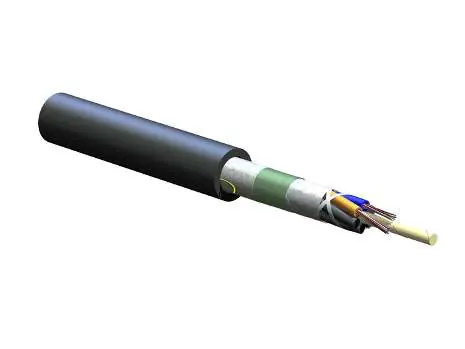
Cable construction
The cable utilizes a stranded loose tube, gel-free design. Key components include:
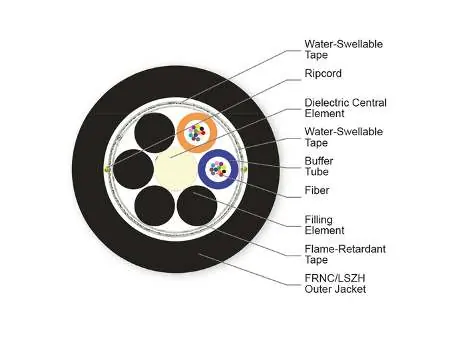
- Outer Jacket: Flame-retardant, black LSZH material.
- Buffer Tubes: Two active tubes (Blue, Orange) with a 2.5 mm diameter.
- Filling Elements: Four elements to maintain cable structure.
- Protection: Includes water-swellable tapes and a flame-retardant tape layer.
- Ripcords: Two ripcords for easy jacket removal.
- Central Element: Dielectric material.
Environmental and mechanical limits
To ensure performance and longevity, adhere to the following operational and installation limits:
- Installation Temperature: -30 °C to 60 °C (-22 °F to 140 °F).
- Operation/Storage Temperature: -40 °C to 70 °C (-40 °F to 158 °F).
- Max. Tensile Strength (Long-Term): 810 N (182.1 lbf).
- Max. Tensile Strength (Short-Term): 2700 N (606.98 lbf).
- Min. Bend Radius (Installation): 192 mm (7.56 in).
- Min. Bend Radius (Operation): 128 mm (5.04 in).
Standards and compliance
The cable meets several industry standards, including:
- RoHS: Free of hazardous substances (2011/65/EU).
- Fire Safety: LSZH (OFN-LS), IEEE-1202 flame test, IEC 60332-3, IEC 60754-2, IEC 61034.
- Approvals: NEC OFCR-LS/Riser, Sunlight Resistant (SUN RES), Suitable for Direct Burial (DIR BUR).
- Design Criteria: ANSI/ICEA S-104-696, UL 13, UL 444, UL 1277, UL 1685, CSA C22.2.
Contact information
For further technical support or inquiries, contact Corning Optical Communications LLC at 4200 Corning Place, Charlotte, NC 28216, USA. Phone: 800-743-2675, Fax: 828-325-5060, International: +1-828-901-5000. Website: www.corning.com/opcomm
Official resources from the manual
Manufacturer information
Corning Optical Communications
Practical help
Common problems
Cable jacket damage during installation
Ensure the installation bend radius does not fall below 192 mm to prevent internal fiber stress or jacket compromise.
Exceeding tensile limits
Do not exceed 2700 N during installation (short-term) or 810 N during long-term operation to avoid permanent fiber damage.
Before use
- Verify the environment temperature is within -30 °C to 60 °C for installation.
- Ensure the installation path allows for the minimum bend radius of 192 mm.
- Confirm the application (aerial, duct, direct buried, or tray) complies with the cable's ratings.
- Check that the fiber count (24) and category (OM4) match your network requirements.
Specs in practice
- LSZH (Low-Smoke, Zero-Halogen)
- A jacket material that emits limited smoke and no toxic halogens during a fire, critical for safety in enclosed industrial spaces.
Images and diagrams
- The cross-section diagram illustrates the cable's internal structure, showing the central dielectric element, the two active buffer tubes (blue/orange), and the surrounding water-swellable and flame-retardant tapes.
- The diagram highlights the placement of the two ripcords used for accessing the internal components.
Model compatibility
- Compatible with standard 50 µm OM4 multimode fiber systems.
- Suitable for indoor/outdoor use, including direct burial and aerial installations.

Manual page author
Michael Turner
Technical manual editor
Reviews PDF manuals for structure, safety notes, and practical product details so readers can find the right information quickly.