Home Appliances / Washing Machines
Fender 1225HP Professional Loudspeaker Enclosure User Manual
Quick guide for the Fender 1225HP loudspeaker, covering wiring, bi-amp configuration, horn dispersion adjustment, and technical specifications.
Table of contents
Manual images
Jump to the sectionQuick guide from the manual
The Fender 1225HP is a professional, two-way, full-range loudspeaker designed for permanent or portable sound reinforcement. This manual provides essential information on speaker wiring, bi-amp operation, and adjusting the horizontal dispersion pattern. Caution: Speakers produce strong magnetic fields; keep them at a distance from sensitive electronic devices like computer monitors or televisions to prevent interference.
Speaker wiring and connections
The 1225HP features 1/4" phone jacks and Neutrik Speakon connectors wired in parallel, allowing for easy daisy-chaining of multiple cabinets. In normal passive mode, the connections are as follows:
- Positive (+): Tip (1/4") or 1+/2+ (Speakon)
- Negative (-): Sleeve (1/4") or 1-/2- (Speakon)
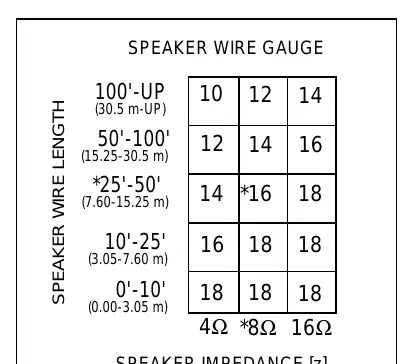
When connecting multiple speakers, parallel wiring is recommended so that if one speaker fails, the others continue to operate. Always use appropriate gauge speaker wire based on the length of the run to ensure maximum power transfer.
Horn dispersion adjustment
The 1225HP uses a Controlled Dispersion horn. You can adjust the horizontal coverage pattern by installing or removing horn inserts:
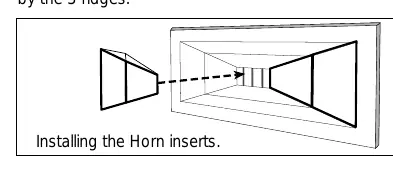
- Remove the Phillips head screws from the grille and lift it away.
- To attach inserts, place the wider end under the front lip of the horn and guide the smaller end under the ribs near the throat.
- The insert is secured by three ridges.
- Reinstall the grille.
Installing both inserts achieves a 60-degree coverage pattern, while removing them provides a 90-degree pattern.
Bi-amp operation
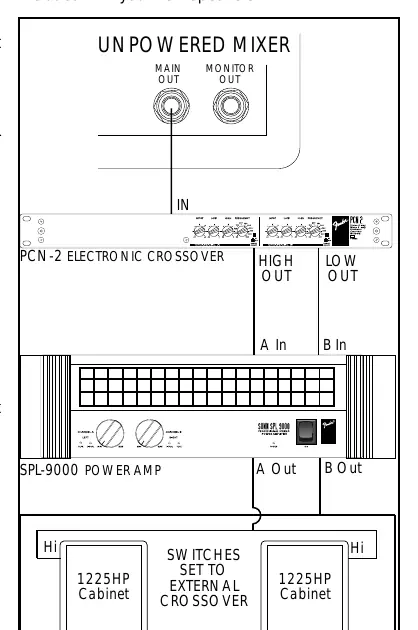
For advanced setups, the 1225HP can be switched to bi-amp mode using the switch on the back of the cabinet. This disables the internal crossover. Important: When set to external/bi-amp mode, you must use an external electronic crossover and separate power amplification for low and high frequencies. Never plug a full-range signal into the high-frequency input in this mode, as it will destroy the compression driver.
Carpet covering care
The cabinet is covered in a durable indoor/outdoor synthetic carpet. Clean it by wiping with a sponge and a light soapy water solution. For stubborn stains, use a more concentrated solution or carpet shampoo with a brush. Avoid spilling liquids on the input panel, grille, or speakers.
Manufacturer information
Fender Musical Instruments Corporation
Practical help
Common problems
Feedback or excessive bass
If the speaker is placed near a large, flat wall, bass output increases by 3dB, which may cause feedback. Move the speaker away from the wall.
High-frequency driver damage
Do not plug a full-range signal into the High Frequency input when the crossover switch is set to external/bi-amp mode.
Sound system failure
Check speaker cables, as they are the most common source of failure. Ensure cables are well-made and of sufficient gauge for the length used.
Before use
- Ensure the internal/external crossover switch is in the correct position (Normal for passive, Bi-Amp for active crossover).
- Verify that high and low frequencies are connected to their correct inputs on the back of the cabinet when in bi-amp mode.
- Check that the speaker wire gauge is appropriate for the cable length (e.g., 16 AWG for 25-50 feet at 8 ohms).
- Ensure the cabinet is positioned to minimize overlapping radiating patterns.
Specs in practice
- Frequency Response
- 60 Hz to 15 kHz (+/- 3 dB), indicating the range of sound the speaker can reproduce.
- Nominal Impedance
- 8 ohms, the standard load the speaker presents to the amplifier.
- Crossover Frequency
- 2200 Hz, the point where the signal is split between the woofer and the compression driver.
Images and diagrams
- The manual provides charts for calculating parallel and series impedance to ensure safe amplifier loading.
- Wiring diagrams for bi-amp configurations with 2-way and 3-way electronic crossovers are included.
- A speaker wire gauge chart helps select the correct cable thickness based on length and impedance.
Model compatibility
- Recommended for use with Fender PCN-2 or PCN-4 electronic crossovers.
- Compatible with Fender subwoofers for 3-way system setups.
- Requires a fourth-order Linkwitz-Riley or digital FIR active crossover for optimal bi-amp performance.

Manual page author
Emily Carter
User documentation editor
Prepares concise manual descriptions and highlights the most useful setup, operation, and maintenance information for readers.