Documents / Warranty Safety
User Manual for Granberg 114.0660W Nitrile Chemical Resistant Gloves
Quick guide for Granberg 114.0660W Nitrile Chemical Resistant Gloves. Includes safety instructions, maintenance, donning/doffing procedures, and technical performance specifications.
Table of contents
Important Information
The Granberg 114.0660W Nitrile Chemical Resistant Gloves are designed to protect hands in working environments. Before use, always inspect the gloves for any physical damage. If in doubt, discard the gloves and select a new pair. Note that these gloves protect against bacteria and fungi, but they do not protect against viruses.
Safety and Usage Warnings
- Latex Allergy: Gloves containing latex may cause allergic reactions in case of hypersensitivity. Seek medical advice if necessary.
- Entanglement Risk: Do not wear gloves when there is a risk of entanglement with moving parts of machinery.
- Chemical Resistance: The chemical resistance has been assessed under laboratory conditions. Actual workplace conditions may differ due to temperature, abrasion, and degradation.
- Food Handling: These gloves are suitable for handling all types of food for short periods of time.
Maintenance and Cleaning
Gloves can be cleaned with a damp cloth, but this will not stop permeation processes. Cleaning or disinfecting the gloves may negatively affect their quality. Performance characteristics of used or cleaned gloves may differ from the declared levels.
Storage and Transport
Store unused gloves in their original packaging. Keep them in a dry place at temperatures between 5-25°C. Avoid direct sunlight. When stored as recommended, unused gloves will not suffer changes in mechanical properties for up to three years from the date of manufacture.
Donning and Doffing
Donning: Select the correct size. Hold the glove by the cuff with one hand. Align the glove thumb with your other hand thumb and slide your hand into the glove, one finger into each finger. Pull by the glove cuff and align fingers into the right position. Repeat for the other hand.
Doffing: If gloves are not contaminated, pull by the fingertips to remove. If gloves are contaminated, hold the glove cuff and pull toward the finger until the gloves come off.
Technical Specifications
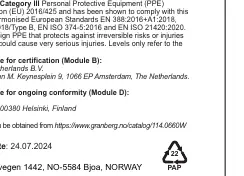
The gloves are classified as Category III Personal Protective Equipment (PPE) and comply with EN 388:2016+A1:2018, EN ISO 374-1:2016+A1:2018/Type B, EN ISO 374-5:2016, and EN ISO 21420:2020. Performance levels refer to the palm of the hand.
Manufacturer information
Granberg
Practical help
Common problems
Gloves are damaged or worn
Discard the gloves immediately and select a new pair.
Signs of tearing, swelling, or degradation
Discontinue use immediately.
Allergic reaction
If hypersensitivity to latex occurs, seek medical advice.
Before use
- Inspect gloves for any physical damage.
- Ensure the glove size fits your hand correctly.
- Verify that the gloves are suitable for the intended chemical or mechanical task.
- Check for entanglement risks with machinery.
Specs in practice
- EN 388:2016+A1:2018
- Standard for mechanical protection, including abrasion, cut, tear, and puncture resistance.
- EN ISO 374-1:2016+A1:2018
- Standard for chemical protection; includes permeation performance levels and breakthrough times.
Images and diagrams
- The permeation test table indicates the performance level (1-6) and measured breakthrough time (minutes) for specific chemicals like n-Heptane, Sodium hydroxide, Hydrogen peroxide, and Formaldehyde.
Model compatibility
- Protects against bacteria and fungi, but not viruses.
- Suitable for short-term food handling.

Manual page author
David Miller
Documentation analyst
Organizes user manual content into clear summaries, with attention to model details, product context, and everyday usability.