Industrial / Gas Detection
MSA ALTAIR Gas Detector Cross-Sensitivity Reference Guide
Understand how MSA ALTAIR gas detectors react to non-target gases. This guide provides essential cross-sensitivity data for XCell and exotic sensors to ensure accurate readings in multi-gas environments.
Table of contents
Important Information from the Manual
This document provides essential cross-sensitivity data for MSA ALTAIR gas detectors. It is critical for users to understand that electrochemical sensors may react to gases other than the target gas. These interactions are limited by design but still exist. This data is intended for reference only and should be used to understand detector readings in environments where multiple gases may be present.
Understanding Cross-Sensitivity
Cross-sensitivity occurs when a sensor responds to a gas it was not specifically designed to detect. Key points to remember:
- Additive Nature: If both the target gas and a cross-sensitive gas are present, the detector reading will combine both concentrations to provide a summed reading.
- Reference Only: The provided data is a general guide. Actual readings may vary based on environmental conditions, sensor age, and specific sensor lots.
- Not Exhaustive: The tables do not contain a complete list of all possible cross-sensitive gases, but rather a sampling of the most common examples.
How to Use the Data
When operating in environments where multiple gases may be present, use the provided tables to estimate potential interference. For example, if a CO sensor is exposed to NO, the detector will show a reading based on the cross-sensitivity percentage. Always ensure that the product instructions and user manual for your specific detector have been thoroughly read and understood before use.
Sensor Data Tables
The manual includes detailed tables for various sensor types, including:
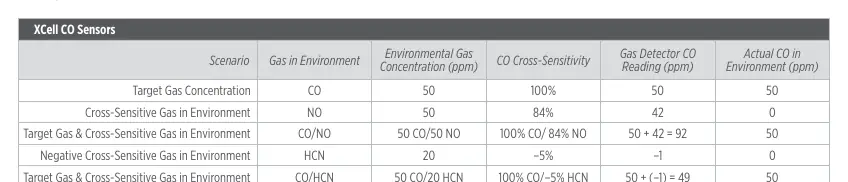
- XCell CO and CO-HC Sensors
- XCell H2S and H2S-LC Sensors
- XCell SO2 (Single and Two-Tox) Sensors
- XCell CO H2-RES Sensors
- XCell NH3 Sensors
- XCell NO2 Sensors
- Non-XCell Exotic Sensors (NO2, PH3, NO, ClO2, HCN)
Practical help
Common problems
Unexpected high gas readings
Check if other gases are present in the environment that the sensor is cross-sensitive to, as readings are additive.
Negative gas readings
Verify if gases with negative cross-sensitivity (e.g., HCN on CO sensors) are present in the environment.
Before use
- Verify the specific sensor type installed in your ALTAIR detector.
- Identify potential interfering gases present in the work environment.
- Consult the relevant cross-sensitivity table for your specific sensor.
- Calculate potential additive effects if multiple gases are present.
- Ensure the detector is used by trained and qualified individuals only.
Specs in practice
- Cross-Sensitivity
- The percentage of the target gas reading that will be displayed when the sensor is exposed to a non-target gas.
- Additive Effect
- When both target and cross-sensitive gases are present, the detector sums the concentrations to provide a total reading.
Model compatibility
- Data applies to MSA XCell and specific Non-XCell exotic sensors.
- Values are for reference only and may vary based on sensor age, lot, and environmental conditions.
- All values have been rounded up to the nearest 1 ppm.

Manual page author
Michael Turner
Technical manual editor
Reviews PDF manuals for structure, safety notes, and practical product details so readers can find the right information quickly.