Home / Security
User Manual for Danfoss DGS Gas Detecting Sensor
Quick guide for the Danfoss DGS gas detecting sensor. Includes technical specifications, sensor types (IR, SC, PE), and accessory details.
Table of contents
Manual images
Jump to the sectionQuick guide from the manual
The Danfoss DGS gas detecting sensor is designed for continuous, automatic monitoring of refrigerant gases in commercial buildings, such as supermarkets, process refrigeration plants, and cold storage. The system supports various sensing technologies to ensure optimal detection performance for specific gases.
Description of the device
The DGS sensor is available in three main sensing technologies:
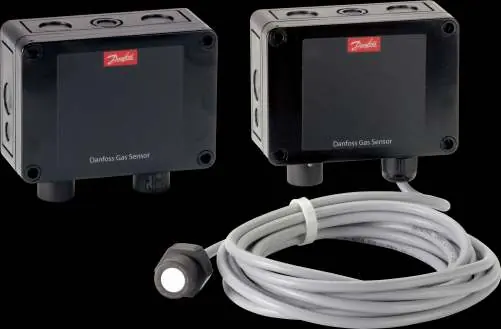
- DGS-IR: Based on infrared sensor technology (typically for CO2/R744).
- DGS-SC: Based on semi-conductor technology (typically for HFCs).
- DGS-PE: Based on pellistor technology (typically for Propane/R290).
The device features an IP65 enclosure, making it suitable for various environments. It supports digital outputs (relays), analogue outputs (0-10V or 4-20mA), and Modbus communication.
Installation and commissioning
The sensor is designed for wall mounting. Ensure the following during installation:

- Commissioning: It is essential to remove the tight-fitting protective cap from the sensor head before operation to ensure proper functioning.
- Wiring: Power supply and Modbus connections use screw-type terminals (0.25 – 2.5 mm2). Analogue and digital inputs use screw-type terminals (0.25 – 1.3 mm2).
- Environment: The device operates within a humidity range of 15–90% RH (non-condensing).
Accessories
Several accessories are available to enhance the functionality of the DGS system:

- Hand-held Service Tool: Used for display, calibration, addressing, and parameter changes.
- Strobe & Horn: Provides visual and audible alarm signaling (warning and critical levels).
- Sensor head protection: A plastic cap to protect the sensor during installation, cleaning, or painting.
- Splash guard: Protects the sensor against rain and splash water, suitable for outdoor or wash-down areas.
- Duct set: Allows for sampling from air ducts.
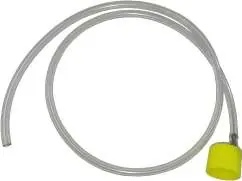
- Calibration Adapter: Facilitates the targeted supply of zero and test gases to the sensor head.
- Remote kit: Provides a cable extension and housing for remote installation of sensors.
Technical Data
The DGS sensor operates on 24V DC or 24V AC power. It features configurable alarm thresholds and response times depending on the specific sensor type (IR, SC, or PE). The device is compliant with EN61010-1 standards.
Manufacturer information
Danfoss A/S
Practical help
Common problems
Sensor not functioning after installation
Ensure the protective cap has been removed from the sensor head.
Incorrect gas readings
Verify that the sensor type (IR, SC, PE) is appropriate for the target gas and perform calibration using the Calibration Adapter.
Alarm not triggering
Check the digital output relay configuration and ensure the alarm thresholds are correctly set.
Before use
- Verify the power supply is 24V DC or 24V AC.
- Remove the protective cap from the sensor head.
- Ensure the sensor type matches the target refrigerant gas.
- Check that the installation environment is within the IP65 rating limits.
- Confirm wiring connections are secure (0.25 – 2.5 mm2 for power/Modbus).
Specs in practice
- Analogue output
- Configurable signal (0-10V, 2-10V, 0-20mA, or 4-20mA) for integration with building management systems.
Images and diagrams
- Hand-held Service Tool: Used for configuration and parameter changes.
- Strobe & Horn: Provides two levels of alarm (warning and critical).
- Calibration Adapter: Used for supplying test gases to the sensor head.
Model compatibility
- DGS-IR is for CO2 (R744).
- DGS-SC is for HFCs (various groups).
- DGS-PE is for Propane (R290).

Manual page author
David Miller
Documentation analyst
Organizes user manual content into clear summaries, with attention to model details, product context, and everyday usability.