Power / Batteries & Chargers
Rich Solar 100AH Lithium Iron Phosphate Battery User Guide
Quick guide for the Rich Solar 100AH LiFePO4 battery. Includes technical specifications, BMS protection details, charging characteristics, and usage guidelines.
Table of contents
Manual images
Click an image to enlargeQuick Guide
The Rich Solar 100AH Lithium Iron Phosphate (LiFePO4) battery is designed for various applications including solar, wind, mobility, and data centers. Key operational requirements include a charging voltage of 14.4-14.6V and an operating temperature range of 32°F to 140°F for charging. The battery features an integrated Battery Management System (BMS) for protection against over-charging, over-discharging, and short circuits.
Technical Specifications
The battery provides reliable power with the following specifications:

- Nominal Voltage: 12.8 V
- Rated Capacity: 100 AH
- Stored Energy: 1280 Wh
- Cycle Life (@DOD80%): 3000 Cycles
- Approximate Weight: 21.8 lbs
- Internal Resistance: ≤30.0 mΩ
- Max Charge/Discharge Current: 100 AH
- Charging Voltage: 14.4-14.6V
- CutOff Voltage: 11 V
- Terminal Type: M8
- Dimensions: L 12.8 x W 6.6 x H 8.5 inches
Battery Management System (BMS)
The built-in BMS monitors current and voltages during charge and discharge cycles. It employs smart balancing algorithms to ensure all cell voltages remain at the same level, optimizing capacity and safety. Protection thresholds include:
- Over-charge protection: 3.90 V per cell
- Over-discharge protection: 2.00 V per cell
- Over-current protection: 290-310 A
- Over-temperature protection: 65° C (Release at 55° C)
- Short circuit protection: Automatically recovers after removal of short
Usage and Maintenance
To ensure optimal performance and longevity, follow these guidelines:
- Connections: The battery supports up to 4 units in series or 4 units in parallel.
- Charging: Follow a Constant Current Constant Voltage (CC/CV) charging profile.
- Storage: Charge the battery every 6 months or as soon as the Open Circuit Voltage (OCV) drops to 12.8V.
- Temperature: Recommended operating temperature is 59°F (15°C) to 95°F (35°C).
For further information or support, contact Rich Solar at 5550 Jurupa St., Ontario, CA 91761, call 1-800-831-9889, or email [email protected].
Practical help
Common problems
Battery shuts down during operation
This may be due to over-current or short circuit protection. Remove the load to allow the BMS to reset.
Battery not charging
Ensure the charger is set to the correct voltage range (14.4-14.6V) and the ambient temperature is above 32°F.
Low capacity or performance
Check if the battery is operating within the recommended temperature range (59°F-95°F) and ensure it is not being discharged below 11V.
Before use
- Verify the nominal voltage is 12.8V.
- Ensure your charger supports LiFePO4 chemistry with a 14.4-14.6V charging voltage.
- Check that the ambient temperature is within the charging range (32°F to 140°F).
- Confirm your configuration (max 4 in series or 4 in parallel).
- Inspect terminals for secure connection (M8).
Specs in practice
- Self-Discharge Rate
- ≤3%/month means the battery will lose up to 3% of its charge per month when stored, requiring periodic maintenance.
- CutOff Voltage
- 11V is the minimum voltage level; the battery should not be discharged below this point to prevent damage.
Images and diagrams
- Dimensions diagram provides the physical footprint (L 12.8, W 6.6, H 8.5 inches) for installation planning.
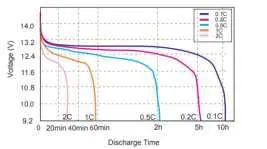
- Discharge curve illustrates how voltage remains stable over time at various discharge rates (0.1C to 2C).
- Charging characteristics graph shows the transition from constant current to constant voltage phases.
Model compatibility
- Compatible with up to 4 units in series or 4 units in parallel.
- Not for use with chargers exceeding 14.6V.
- Designed for use in various environments including solar, wind, and mobility applications.

Manual page author
Michael Turner
Technical manual editor
Reviews PDF manuals for structure, safety notes, and practical product details so readers can find the right information quickly.