Power / Batteries & Chargers
Rolls R-Series 12V & 24V LFP Battery Operating Manual
Comprehensive operating manual for Rolls R-Series 12V and 24V LFP batteries. Includes installation, wiring, charging guidelines, BMS protection, and safety procedures.
Table of contents
Manual images
Click an image to enlargeQuick Guide: Rolls R-Series LFP Batteries
This manual provides essential instructions for the safe installation, operation, and maintenance of Rolls R-Series 12V and 24V Lithium Iron Phosphate (LFP) batteries. These batteries are designed as a drop-in replacement for lead-acid batteries but require specific charging profiles and installation practices to ensure longevity and safety.
Safety Warnings
- Explosion and Fire Hazard: Never charge the battery below 0°C (32°F) or discharge below -20°C (-4°F).
- Handling: Always use insulated tools. Do not drop tools on the battery.
- Installation: Ensure adequate airflow and clearance between batteries. Do not mix old and new batteries.
- Maintenance: Battery maintenance must be performed by qualified personnel.
- Bluetooth: The integrated Bluetooth module is for technical support data collection only; do not attempt to modify or tamper with it, as this voids the warranty.
Storage and Installation
Rolls R-Series batteries should be stored in an environment between -5°C (23°F) and +45°C (113°F). If storing for extended periods, charge the battery at least once per year. For temperatures above 40°C (104°F), charge every 3 months.
Batteries can be installed in any orientation in an indoor space, away from direct sunlight. Ensure the ambient temperature is within the safe operating range to prevent degradation of internal cells.
Cable Connections and Torque
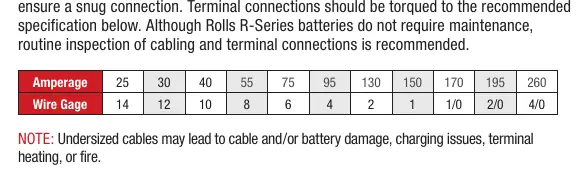
All cable connections must be properly sized, insulated, and free of damage. Use clean connectors and ensure a snug fit with the battery terminals. Terminal connections using M8 fasteners must be torqued to 10-12Nm. Do not overtighten, as this may damage the terminal.
BMS Protection Summary
The built-in Battery Management System (BMS) protects the battery from unsafe conditions. It will automatically interrupt current or disconnect the battery if it detects:
- Overvoltage/Undervoltage: Charge or discharge interruption.
- Short Circuit: Charge and discharge interruption.
- Temperature Extremes: High or low temperature at BMS or cell will trigger protection.
If the BMS disconnects the battery, it will typically reset automatically after a time delay, cooling, or warming, depending on the fault.
Wiring Configurations
Rolls R-Series batteries can be combined to achieve higher voltages or capacities:
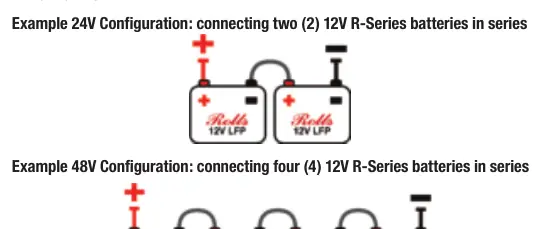
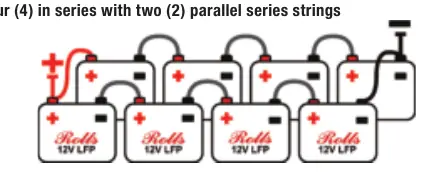
- Series Connection: Connect the positive terminal of one battery to the negative terminal of the next. Maximum of four (4) 12V batteries or two (2) 24V batteries for a 48V system.
- Parallel Connection: Connect positive to positive and negative to negative. Maximum of four (4) parallel strings.
Always ensure cabling has the same resistance (gauge and length) between batteries to ensure proper current sharing.
Charging Guidelines
Rolls R-Series batteries are compatible with most lead-acid chargers, but a lithium-specific charger is recommended. The preferred charging method is a 2-stage CC/CV profile.
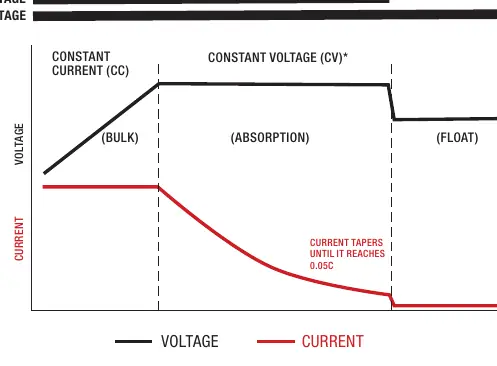
- 1-Stage (CC): Charge at recommended current until termination voltage is reached.
- 2-Stage (CC/CV): Charge at constant current until absorption voltage is reached, then hold at constant voltage until current tapers to ≤0.05C.
- 3-Stage: If using legacy lead-acid hardware, ensure temperature compensation is turned off and equalization is disabled.
Charging Temperature Limits:
- < 0°C: Do not charge.
- 0-10°C: ≤ 0.2C.
- 10-35°C: ≤ 0.5C.
- 35-55°C: ≤ 0.2C.
- > 55°C: Do not charge.
Recycling
Dispose of batteries at an authorized lithium recycling facility. Fully discharge the battery before disposal and cover terminals with protective caps or non-conductive tape to prevent short circuits.
Practical help
Common problems
Battery will not charge
Check if the ambient temperature is below 0°C or above 55°C. Ensure the BMS has not disconnected the battery due to a fault.
BMS disconnects frequently
Check for overvoltage, undervoltage, or temperature extremes. Ensure the charger is configured correctly for LFP batteries.
Terminal damage
Do not overtighten M8 fasteners. Use a torque wrench set to 10-12Nm. Do not attempt to repair damaged terminals.
Before use
- Ensure cables are properly sized for the system current.
- Verify the ambient temperature is within the safe operating range (0°C to 55°C for charging).
- Check that all cable connections are clean, tight, and insulated.
- Ensure the battery is fully charged before initial use.
- Verify that the charger settings match the LFP requirements (disable equalization).
Images and diagrams
- Series Connection: Connect the positive terminal of one battery to the negative terminal of the next to increase voltage.
- Parallel Connection: Connect positive to positive and negative to negative to increase capacity.
Model compatibility
- Not compatible with S-Series or ESS models.
- Compatible with most lead-acid chargers if configured correctly.
- Do not use equalization settings on chargers.

Manual page author
Michael Turner
Technical manual editor
Reviews PDF manuals for structure, safety notes, and practical product details so readers can find the right information quickly.