Documents / Warranty Safety
Toyota Brake Pad Clicking Noise Technical Service Bulletin
Technical service bulletin for 1990-2000 Toyota vehicles addressing brake pad clicking noise. Includes detailed procedures for applying disc brake caliper grease to floating and fixed brake calipers.
Table of contents
Manual images
Jump to the sectionQuick guide from the manual
This technical service bulletin addresses a clicking noise that may occur in 1990-2000 Toyota vehicles when changing travel direction (e.g., from Drive to Reverse). The noise is caused by normal brake pad-to-caliper clearances. The solution involves applying a specific disc brake caliper grease to the pad support plates or caliper to minimize this movement.
Required materials
Use Disc Brake Caliper Grease (50 g tube), Part Number: 08887-80609.
Floating type brake caliper procedure
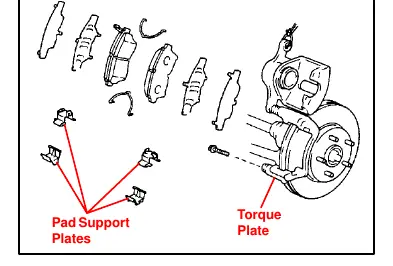
- Lift up or remove the brake caliper and suspend it securely. Do not disconnect the flexible hose.
- If equipped with an anti-squeal spring, remove it.
- Remove the brake pads with anti-squeal shims.
- Remove the pad support plates from the torque plate. Clean dust from the pad support plates, torque plates, and brake pads.
- Apply a 1-2 mm thick layer of disc brake caliper grease to both sides of the pad support plates.
- If the pad support plate is fixed with adhesive tape, follow the specific flow chart provided in the manual to determine if you need to remove the tape or apply grease to the contact portion.
- Apply a 1-2 mm thick layer of grease to the caliper as indicated in the illustration.
- Reinstall the brake pads with anti-squeal shims and the anti-squeal spring (if equipped).
- Press the piston in firmly and install the brake caliper.
- Install the wheel assembly.
Fixed type brake caliper procedure
Identify your brake pad type:
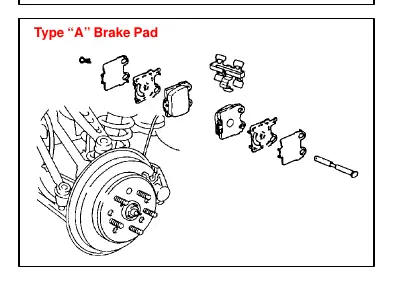
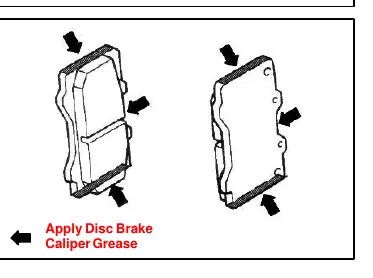
- Type A: Has a projection on the upper and lower side of the brake pad.
- Type B: Has a flat upper and lower edge on the brake pad backing plate.
For Type A:
- Remove the anti-squeal spring, clip, and pad guide pin.
- Remove the brake pads with anti-squeal shims.
- Clean dust from the brake pads.
- Apply a 1-2 mm thick layer of disc brake caliper grease to the areas indicated in the illustration.
- Reinstall the brake pads with anti-squeal shims, then install the pad guide pin, clip, and anti-squeal spring.
- Install the wheel assembly.
For Type B:
- Remove the clip, pins, and anti-rattle spring/pad retainer clip.
- Remove the brake pads with anti-squeal shims.
- Clean dust from the brake pads.
- Apply a 1-2 mm thick layer of disc brake caliper grease to the areas indicated in the illustration.
- Reinstall the brake pads with anti-squeal shims, then install the pad guide pin, clip, and anti-squeal spring.
- Install the wheel assembly.
Important warnings
- Do NOT apply grease to the friction surfaces of the brake pads or the disc rotor.
- Clean any excess grease from the brake pad and caliper after application.
- Under normal usage conditions, this grease is effective for 6 months to 1 year.
Manufacturer information
Toyota Motor Corporation
Practical help
Common problems
Clicking noise when changing vehicle travel direction
Apply disc brake caliper grease to the pad support plates or caliper as specified in the service procedure to reduce pad-to-caliper clearance noise.
Before use
- Verify the vehicle model year is between 1990 and 2000.
- Determine if the vehicle has floating or fixed type brake calipers.
- For fixed calipers, identify if the brake pads are Type A (with projections) or Type B (flat edges).
- Ensure you have the correct Disc Brake Caliper Grease (Part No: 08887-80609).
- Prepare to clean dust from brake components before applying grease.
Specs in practice
- Grease application thickness
- Apply a 1-2 mm thick layer of grease to the specified contact points.
- Grease durability
- Under normal conditions, the grease application is effective for 6 months to 1 year.
Images and diagrams
- Floating caliper diagram shows where to apply grease on pad support plates.
- Type A and Type B diagrams illustrate the specific brake pad shapes and grease application points.
Model compatibility
- Applicable to all 1990-2000 Toyota vehicles.

Manual page author
David Miller
Documentation analyst
Organizes user manual content into clear summaries, with attention to model details, product context, and everyday usability.