General / Other Manuals
Owner's Manual for 2000 Toyota Tacoma Do-It-Yourself Maintenance
A comprehensive DIY maintenance guide for the 2000 Toyota Tacoma. Learn how to check engine oil, coolant, brake fluid, power steering fluid, tire pressure, and perform tire rotations and wheel maintenance.
Table of contents
Manual images
Jump to the sectionQuick Guide to DIY Maintenance
This document provides essential maintenance procedures for the 2000 Toyota Tacoma. Always ensure the vehicle is on a level surface before performing checks. Follow all safety precautions, especially when dealing with hot engine components or pressurized systems.
Checking Engine Oil Level
To check the oil level, ensure the engine is at operating temperature and turned off. Wait a few minutes for the oil to drain back into the oil pan.
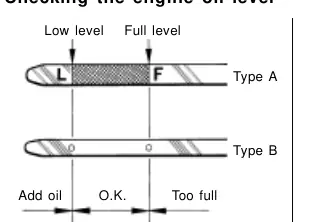
- Pull out the dipstick and wipe it clean with a rag.
- Reinsert the dipstick fully.
- Pull it out again and check the level. It should be between the 'Low' and 'Full' marks.
- If the level is low, add engine oil of the same type in small quantities, checking the dipstick frequently.
- Caution: Be careful not to touch the hot exhaust manifold.
- Notice: Avoid overfilling, as this can damage the engine.
Checking Engine Coolant Level
Check the coolant reservoir when the engine is cold. The level is satisfactory if it is between the 'F' and 'L' lines.
- If the level is low, add ethylene-glycol type coolant to bring it up to the 'F' line.
- Caution: Do not remove the radiator cap when the engine is hot to prevent burns.
- Notice: Do not use alcohol-type antifreeze or plain water alone.
Checking Brake Fluid
The brake fluid level should be between the 'MAX' and 'MIN' lines on the reservoir.
- If the level is low, add SAE J1703 or FMVSS No.116 DOT 3 brake fluid.
- Use only newly opened brake fluid to prevent moisture absorption.
- Caution: Brake fluid can harm eyes and damage painted surfaces. Flush with water if contact occurs.
Checking Power Steering Fluid
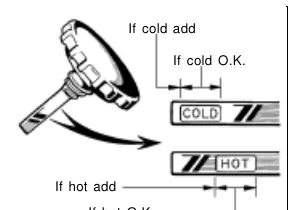
Check the fluid level on the dipstick. If the vehicle has been driven, the fluid will be hot; otherwise, check when cold.
- Clean dirt from the outside of the reservoir before opening.
- Remove the filler cap and wipe the dipstick clean.
- Reinsert and check the level against the 'COLD' or 'HOT' markings on the dipstick.
- If low, add automatic transmission fluid DEXRON II or III.
Tire Maintenance and Pressure
Keep tire pressures at the recommended levels. Check pressure every two weeks or at least once a month, including the spare tire.
- Check pressure only when tires are cold (vehicle parked for at least 3 hours).
- Always use a tire pressure gauge.
- Do not bleed or reduce tire pressure after driving.
- Ensure valve caps are reinstalled to prevent dirt and moisture entry.
Tire Rotation and Replacement
Toyota recommends rotating tires approximately every 12,000 km (7,500 miles) to equalize wear.
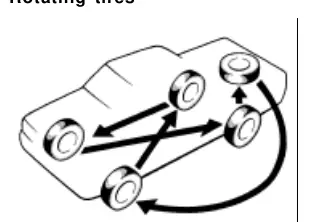
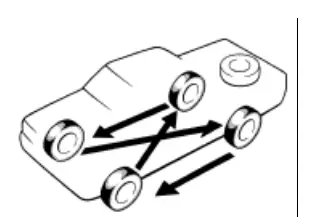
- Check for uneven wear and damage during rotation.
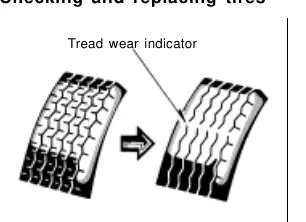
- Replace tires if tread wear indicators appear (1.6 mm or 0.06 in. depth).
- Any tires over 6 years old must be checked by a technician.
- When replacing, use the same size and construction as originally installed.
- Always balance wheels after tire replacement.
Snow Tires and Chains
Snow tires or chains are recommended for snow or ice.
- Install snow tires on all wheels.
- If using chains, install them on the rear tires as tightly as possible.
- Retighten chains after driving 0.5–1.0 km (1/4–1/2 mile).
- Do not exceed 50 km/h (30 mph) or the chain manufacturer's speed limit when using chains.
Wheel Maintenance
Replace wheels if they show damage such as bending, cracks, or heavy corrosion.
- When replacing wheels, ensure they match the original load capacity, diameter, rim width, and offset.
- For aluminum wheels, check that wheel nuts are tight after the first 1,600 km (1,000 miles) of driving.
- Use only Toyota wheel nuts and a wrench designed for aluminum wheels.
Manufacturer information
Toyota Motor Corporation
Practical help
Common problems
Oil level low
Add engine oil of the same type in small quantities, checking the dipstick.
Coolant level low
Add ethylene-glycol type coolant to the reservoir.
Brake fluid low
Add SAE J1703 or FMVSS No.116 DOT 3 brake fluid.
Power steering fluid low
Add automatic transmission fluid DEXRON II or III.
Before use
- Ensure vehicle is on a level spot.
- Engine should be at operating temperature (for oil) or cold (for coolant).
- Use a clean rag for wiping dipsticks.
- Check tire pressure only when tires are cold.
- Verify tire tread depth using wear indicators.
Specs in practice
- Power Steering Fluid
- DEXRON II or III.
Images and diagrams
- Oil dipstick: Shows 'Low' and 'Full' levels.
- Tire tread wear indicator: Shows where to check for wear.
- Tire rotation patterns: Shows how to rotate tires with and without a spare.
Model compatibility
- Do not mix radial, bias belted, or bias-ply tires.
- Use only Toyota-recommended wheel sizes.
- Do not use tire chains on front tires.

Manual page author
Emily Carter
User documentation editor
Prepares concise manual descriptions and highlights the most useful setup, operation, and maintenance information for readers.