Hvac / Heat Pumps
Viessmann Vitocal 100-AW AM2V Wiring Diagram and Component Guide
Comprehensive wiring diagram and component identification guide for the Viessmann Vitocal 100-AW AM2V heat pump system, covering indoor and outdoor unit connections.
Table of contents
System Overview
The Viessmann Vitocal 100-AW AM2V is a high-efficiency heat pump system designed for residential and light commercial heating and cooling applications. This guide provides the essential electrical wiring schematics and component identification necessary for professional installation and maintenance. The system consists of an Outdoor Unit (ODU) and an Indoor Unit (IDU), which must be connected according to the provided electrical diagrams to ensure safe and efficient operation.
Electrical Safety and Installation
Before performing any electrical work, it is critical to disconnect all power sources to prevent electrical shock. All electrical installations must comply with local, state, and national codes, including the National Electrical Code (NEC) in the U.S. and the Canadian Electrical Code (CEC) in Canada. Only qualified service personnel should perform installation or maintenance on this equipment. Ensure that all wiring is routed correctly and that connections are secure to prevent malfunctions or fire hazards.
Component Identification
The system utilizes various sensors and actuators to manage climate control. Key components include the Outdoor Unit Upper Junction Box, the Indoor Unit, and various field connections. Sensors such as the Supply Temperature (TOUT), Return Temperature (TIN), and Pressure Sensor (PRESS) provide real-time data to the control board. Heating circuits are managed via dedicated pumps (PHC1, PHC2) and mixing valves (VMC2). The system also supports DHW (Domestic Hot Water) recirculation and tank temperature monitoring.
Wiring and Connectivity
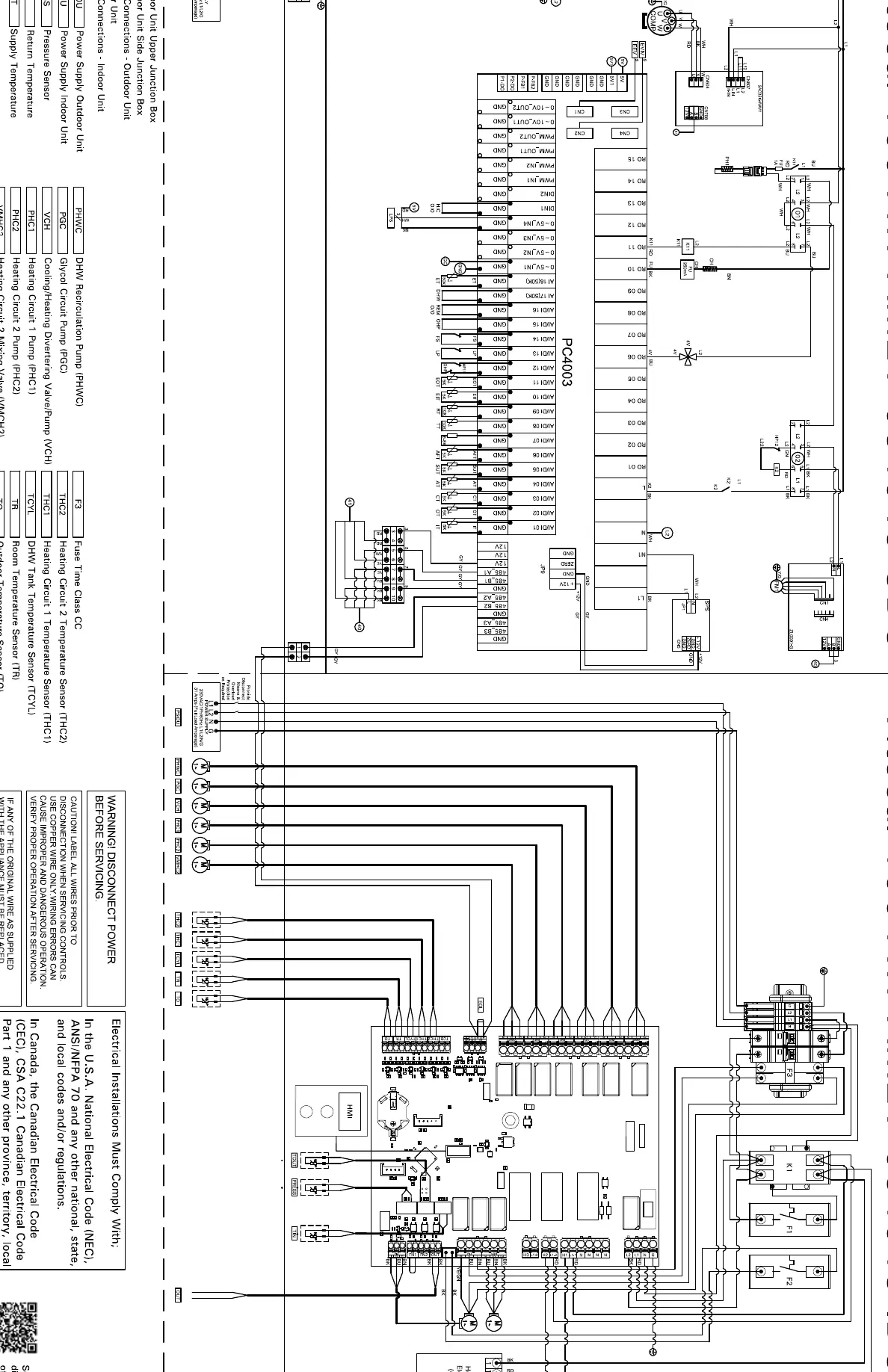
The wiring diagram illustrates the complex interconnections between the ODU and IDU. Key terminals include PWM outputs for pump control, analog inputs for temperature sensors, and digital inputs for system monitoring. The control board (PC4003) acts as the central hub for processing signals from the various sensors and controlling the heating elements and pumps. Proper termination of the Modbus communication line, including the use of the 120 OHM end-of-line resistor, is essential for stable system communication.
Maintenance and Troubleshooting
Regular maintenance is required to ensure the longevity of the Vitocal 100-AW. This includes checking all electrical connections for tightness and inspecting sensors for accurate readings. If the system fails to operate, verify the power supply and check for blown fuses (F3). Always refer to the wiring diagram to trace signal paths if a specific component is not responding. If any original wiring is damaged, it must be replaced with an equivalent component to maintain safety standards.
Manufacturer information
Viessmann Climate Solutions
Practical help
Common problems
System not responding or power failure
Check the main power supply and inspect fuse F3 for continuity.
Communication error between ODU and IDU
Verify the Modbus wiring and ensure the 120 OHM end-of-line resistor is correctly installed.
Before use
- Disconnect all power sources before starting installation.
- Ensure compliance with NEC or CEC electrical codes.
- Verify all field connections match the wiring diagram.
- Check that all sensors are properly seated and connected.
- Confirm the 120 OHM resistor is in place for Modbus communication.
- Inspect all wiring for damage or loose connections.
Images and diagrams
- The diagram shows the PC4003 control board as the central interface.
- Top section details the Outdoor Unit (ODU) connections.
- Bottom section details the Indoor Unit (IDU) and terminal blocks.
- Fuses F1, F2, and F3 are identified for circuit protection.
- Field connections are clearly marked for external sensor and pump integration.
Model compatibility
- Designed for use with standard residential heating circuits.
- Requires specific Modbus communication setup for system integration.
- Compatible with external DHW tank temperature sensors.

Manual page author
Michael Turner
Technical manual editor
Reviews PDF manuals for structure, safety notes, and practical product details so readers can find the right information quickly.