Tools / Power Tools
User Manual for Dremel 3000, 4000, 4250, 4300 Rotary Tools
Quick guide and user manual for Dremel 3000, 4000, 4250, and 4300 rotary tools. Includes safety instructions, setup, accessory changes, maintenance, and technical specifications.
Table of contents
Manual images
Click an image to enlargeQuick Guide
This manual covers the operation and maintenance of Dremel 3000, 4000, 4250, and 4300 rotary tools. Always wear eye protection and follow safety guidelines. Before use, ensure the supply voltage matches the tool's nameplate. Practice on scrap material to get a feel for the tool's high-speed action.
Device Overview
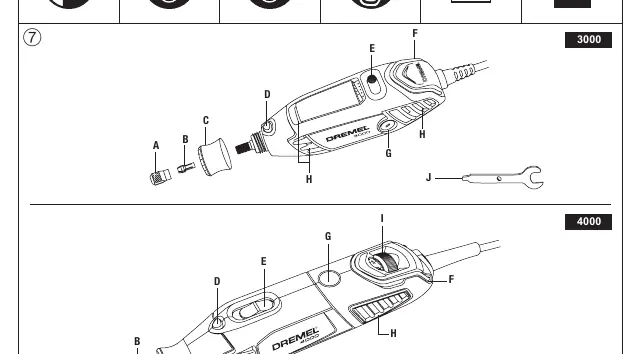
The tool features a collet nut, collet, nose cap (with integrated EZ Twist wrench), shaft lock button, and on/off switch. Models 4000, 4250, and 4300 also include a variable speed dial and electronic feedback system. The 4300 model features a light module.
Getting Started
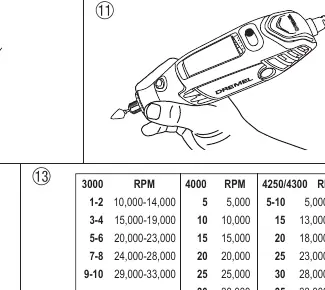
Hold the tool like a pen for precision work or use the "golf" grip for heavier operations like grinding or cutting. Do not cover ventilation openings. To turn the tool on, slide the switch forward; to turn it off, slide it backward.
Using Accessories
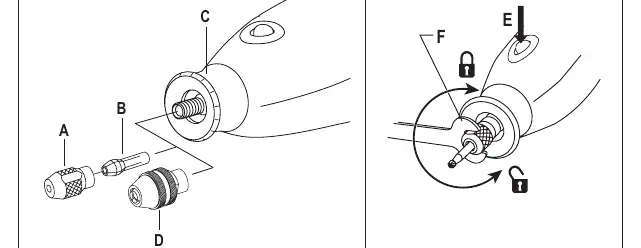
Always unplug the tool before changing accessories. Use the shaft lock button to secure the shaft while loosening the collet nut or chuck. The EZ Twist nose cap allows for tool-free accessory changes. The Dremel chuck (4486) allows for quick changes without swapping collets. If an accessory slips in the chuck, use the EZ Twist nose cap or a wrench to tighten it further.
Maintenance
Inspect carbon brushes every 40-50 hours of use. If a brush is less than 3mm long or the surface is rough, replace both brushes with original Dremel parts. Keep ventilation openings clean and free of foreign matter. Do not use pointed objects to clean vents.
Safety Warnings
Follow all general power tool safety warnings. Do not work with materials containing asbestos. Take protective measures if dust is harmful, combustible, or explosive. Always wear a dust mask and use dust extraction where possible.
Manufacturer information
Dremel
Practical help
Common problems
Accessory slipping in chuck
Use the included EZ Twist nose cap or wrench to tighten the chuck around the bit. If slippage persists, switch to using the collet and collet nut.
Tool runs erratically or loses power
Inspect carbon brushes for wear. If a brush is less than 3mm long, replace both brushes.
Run-out (accessory not running true)
Reset chuck jaws: clean the chuck, extend jaws 3mm, press against a hard surface to seat them, and tighten.
Before use
- Check that supply voltage matches the tool's nameplate.
- Ensure the switch is in the OFF position before plugging in.
- Wear eye protection and other necessary personal protective equipment.
- Check that the accessory speed rating matches or exceeds the tool's maximum speed.
- Ensure the accessory is fully inserted into the collet or chuck.
Specs in practice
- Collet capacity
- The range of accessory shank diameters the tool can accept.
- Max. accessory ∅
- The maximum diameter of the accessory that can be safely used.
Images and diagrams
- Page 4: Overview of tool components (A-J).
- Page 5: Light module setup and accessory changing.
- Page 6: Speed settings chart for different models.
- Page 8: Flexible shaft setup.
Model compatibility
- The Dremel chuck, collet, and collet nut system are interchangeable.
- The light module (4300) only works with the new style nose cap (R) included with the tool.

Manual page author
Michael Turner
Technical manual editor
Reviews PDF manuals for structure, safety notes, and practical product details so readers can find the right information quickly.