Health / Personal Care
User Manual for Etekcity Lasergrip 1025D Infrared Thermometer
Quick guide for the Etekcity Lasergrip 1025D Infrared Thermometer. Learn how to measure surface temperatures, perform non-contact voltage testing, adjust emissivity, and maintain your device.
Table of contents
Manual images
Click an image to enlargeQuick guide from the manual
The Etekcity Lasergrip 1025D is a dual-function device capable of measuring surface temperatures via infrared technology and detecting live AC voltage (90V to 600V) without contact. Important Safety Warning: This device uses a Class 2 laser. Never stare directly into the beam, aim it at people or animals, or point it at aircraft. This device is not intended for measuring body temperature.
Device Overview
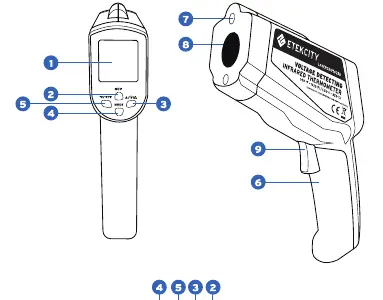
The device features an LCD display, a measurement trigger, and buttons for NCV (Non-Contact Voltage), Mode, Unit conversion (°C/°F), and Backlight/Laser control. The IR sensor and laser hole are located at the front of the unit.
Setup
To prepare the device for use:
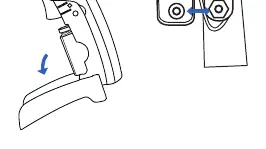
- Open the battery compartment located on the handle.
- Remove the battery notice strip.
- Unwrap the included 9V battery.
- Connect the battery ensuring correct polarity and close the compartment, ensuring wires are not pinched.
Operation
Surface Temperature Measurement
- Point the Lasergrip towards the surface you wish to measure.
- Press and hold the measurement trigger. The scan symbol will flash.
- Release the trigger to hold the reading on the display for 15 seconds.
- For continuous measurement, keep the trigger pressed.
Non-Contact Voltage Testing
- Press the NCV button to enter voltage testing mode. The screen will display 'NCV'.
- Point the device towards the electrical surface.
- The device will beep and display lines on the screen as voltage is detected.
Emissivity Settings
Emissivity is the efficiency of a material in emitting thermal energy. Most organic materials and painted surfaces have an emissivity of 0.95. To adjust:
- Press the Mode button to select emissivity adjustment.
- Use the Up and Down buttons to set the desired level.
- Refer to the emissivity table in the manual for specific material values (e.g., Aluminum Oxidized: 0.30, Concrete: 0.95, Water: 0.93).
Maintenance
- Cleaning: Use compressed air to remove dust from the lens. Use a soft, clean cloth for debris. Do not use soap or detergents on the lens.
- Battery Replacement: Replace the 9V battery immediately when the low battery icon appears on the LCD.
Specifications
- Measurement Range: -58°F to 1022°F (-50°C to 550°C)
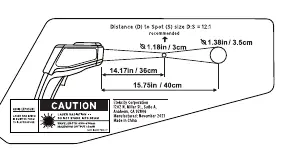
- Distance-to-Spot Ratio: 12:1
- Response Time:<= 500ms
- Operating Temperature: 32°F to 122°F (0°C to 50°C)
Manufacturer information
Etekcity
Practical help
Common problems
Inaccurate temperature readings
Ensure the emissivity setting matches the material being measured. Avoid measuring through glass, steam, or dust.
Display shows 'OH' or 'OL'
'OH' indicates the temperature is above the maximum range; 'OL' indicates it is below the minimum range.
Low battery icon on display
Replace the 9V battery immediately to ensure accurate readings.
Before use
- Remove the battery notice strip from the compartment.
- Ensure the 9V battery is installed with correct polarity.
- Check the lens for dust or debris.
- Verify the emissivity setting is appropriate for the target material.
Specs in practice
- Distance-to-Spot Ratio (12:1)
- At a distance of 12 feet, the device measures a spot with a 1-foot diameter. Closer is more accurate.
- Response Time
- The time required for the device to register a temperature change, which is 500 milliseconds or less.
Images and diagrams
- Trigger: Pull and hold to activate measurement.
- NCV Button: Toggles the non-contact voltage testing mode.
- LCD Display: Shows temperature, NCV status, and battery level.
Model compatibility
- Not suitable for measuring body temperature.
- NCV testing range: 90V to 600V AC.
- Cannot measure temperature through glass.

Manual page author
Emily Carter
User documentation editor
Prepares concise manual descriptions and highlights the most useful setup, operation, and maintenance information for readers.