Tools / Electronic Test Equipment
User Manual for Fluke 1550C/1555 Insulation Tester
Comprehensive user manual for the Fluke 1550C and 1555 Insulation Testers. This guide covers safety guidelines, measurement procedures, data management, maintenance, and technical specifications.
Table of contents
Manual images
Click an image to enlargeQuick Guide from the Manual
The Fluke 1550C and 1555 are high-voltage insulation testers designed to validate circuits, switchgear, motors, and cables. Before using the device, ensure you have read the safety information. Always confirm the absence of hazardous voltage before and after testing. The device features a rechargeable lead-acid battery, programmable test voltages, and data storage capabilities.
Safety Information
To prevent electrical shock or personal injury, follow these critical guidelines:
- Always confirm the Tester does not indicate hazardous voltage before and after testing.
- Disconnect circuit power and discharge all high-voltage capacitors before measuring resistance or capacitance.
- Connect the common test lead before the live test lead and remove the live test lead before the common test lead.
- Do not use the Tester in damp or wet environments or around explosive gas, vapor, or dust.
- Keep fingers behind the finger guards on the probes.
- Do not use in distribution systems with voltages higher than 1100 V.
Getting Started
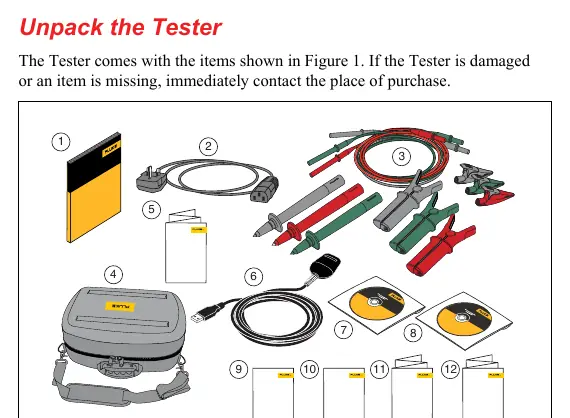
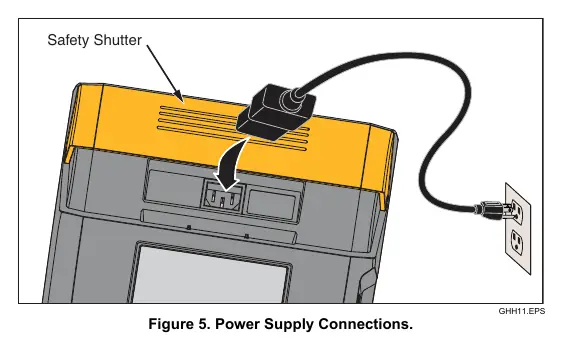
The Tester comes with test cables, an AC power cord, a soft carrying case, and software for data management. To charge the battery, use the provided AC power cord. A full charge typically takes 12 hours. Do not charge in extreme temperatures.
Tester Overview
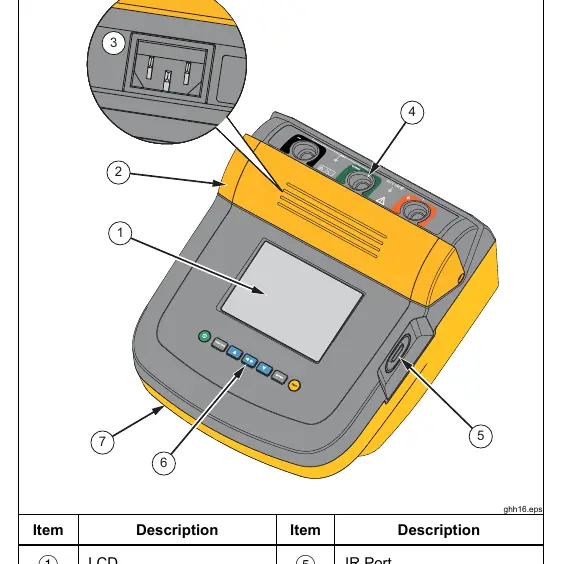
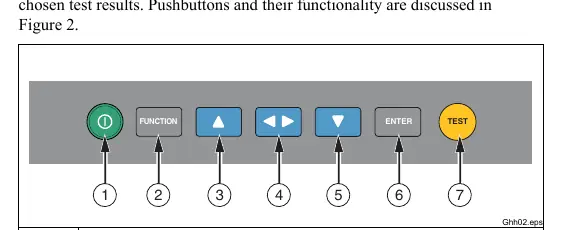
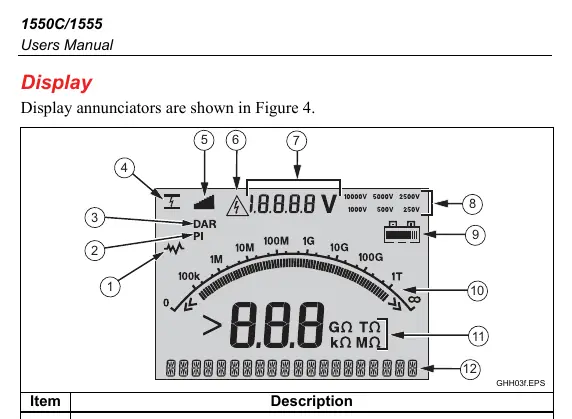
The device features a large LCD, input terminals, and a safety shutter. Use the pushbuttons to navigate menus, set test parameters, and view results. The IR port allows for downloading test data to a PC using the supplied software.
Measurements
To perform an insulation test:
- Move the safety shutter to access input terminals.
- Connect the test leads to the Tester and the circuit under test.
- Set the desired test voltage (250 V to 10,000 V).
- Optionally, enable Ramp mode or set a time limit.
- Press and hold the TEST button for 1 second to start.
The Tester provides measurements for insulation resistance, Polarization Index (PI), Dielectric Absorption Ratio (DAR), and capacitance.
Data Management
The Tester can store up to 99 sets of test data. After a test, you will be prompted to store the results. You can view stored data directly on the device or download it to a PC using the FlukeView Forms Basic software and the provided infrared adapter.
Maintenance
Periodically wipe the case with a damp cloth and mild detergent. Do not use abrasives or solvents. There are no user-replaceable parts inside the Tester; service should only be performed by qualified personnel.
Specifications
The Tester meets EN 61557 Parts 1 and 2, and EN 61010-1, CAT IV 600 V standards. It operates in temperatures from -20 °C to 50 °C. The device is IP40 rated.
Manufacturer information
Fluke Corporation
Practical help
Common problems
Tester beeps continuously and shows hazardous voltage
Remove power from the circuit under test or allow installation capacitance to fully discharge.
Tester gives unspecified reading below 200 kΩ
This is normal behavior for the input circuitry configuration and does not affect accuracy.
Battery life seems short
Ensure the battery is fully charged before storage and check the charge at regular intervals.
Before use
- Check test leads for damaged insulation or exposed metal.
- Confirm the Tester does not indicate hazardous voltage before testing.
- Ensure circuit under test is powered off and capacitors are discharged.
- Verify the safety shutter is not impaired.
- Connect common test lead before the live test lead.
Specs in practice
- PI (Polarization Index)
- Ratio of resistance at 10 minutes to 1 minute.
- DAR (Dielectric Absorption Ratio)
- Ratio of resistance at 1 minute to 30 seconds.
Images and diagrams
- Figure 1 shows standard items provided, including test cables and IR adapter.
- Figure 5 illustrates how to connect the AC power cord for charging.
- Figure 7 and 8 demonstrate the use of the Guard terminal to prevent surface leakage.
Model compatibility
- Meets EN 61557 Parts 1 and 2; EN 61010-1, CAT IV 600 V.
- Do not use in distribution systems with voltages higher than 1100 V.

Manual page author
Emily Carter
User documentation editor
Prepares concise manual descriptions and highlights the most useful setup, operation, and maintenance information for readers.