Power / Batteries Chargers
GYS Hydraulic Cylinder Kit (4T & 10T) Instruction Manual
Official instruction manual for the GYS Hydraulic Cylinder Kit (4T & 10T), covering setup, operation, maintenance, and troubleshooting for automotive body repair applications.
Table of contents
Product Overview
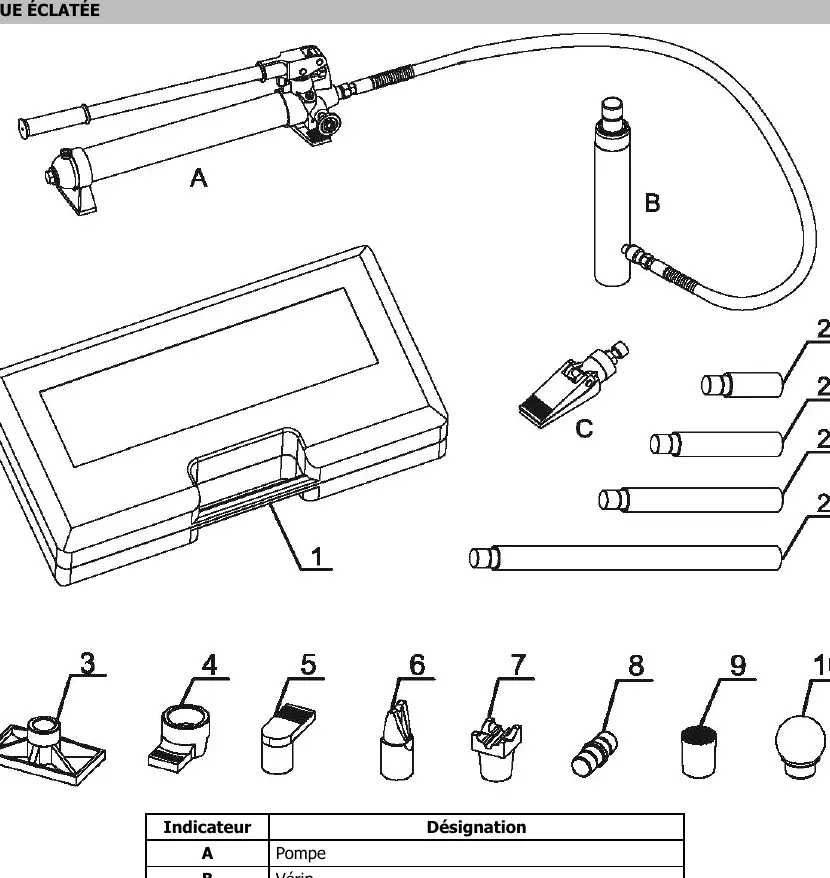
The GYS Hydraulic Cylinder Kit is a professional-grade tool designed for automotive body repair, including pushing, stretching, and spreading operations. It is available in 4-ton and 10-ton capacities. The kit includes a hydraulic pump, a ram, a spreader, and various attachments to accommodate different repair needs.
Safety Information
Warning: Failure to follow safety instructions can lead to serious injury or property damage. Always wear safety goggles and heavy-duty work gloves. Ensure the work area is clean, well-lit, and free of bystanders. Before working on a vehicle, turn off the engine, engage the parking brake, and block the tires.
Setup and Operation
The kit includes various attachments such as extensions, flat bases, V-bases, and rubber heads. Important: When using extension tubes or offset attachments, the rated capacity of the system is reduced by 50% for each connected piece. Always ensure the breather valve on the pump is open during operation. To operate, connect the desired attachments, position the ram or spreader, close the release valve by turning it clockwise, and pump the handle to apply pressure. To release, turn the valve counter-clockwise.
Maintenance
Keep the tool clean and free of grease. Before each use, inspect for loose components, misalignment, or damage. Change the hydraulic fluid annually. If the pump operation feels spongy, it may require bleeding to remove trapped air. Store the pump with the release valve open.
Contact
For technical support or service, contact JBDC SAS, 1, rue de la Croix des Landes, CS 54159, 53941 SAINT-BERTHEVIN Cedex, France. Visit www.gys.fr for more information.
Official resources from the manual
Manufacturer information
GYS
Practical help
Common problems
Ram does not operate when handle is pumped
Ensure the release valve is tightly closed. If air is in the pump, perform the bleeding procedure. If the internal steel ball is stuck, cycle the release valve and pump handle 10-15 times, repeating at least 3 times.
Ram will not hold load
Ensure the release valve is fully closed. If the issue persists, there may be dirt in the valve mechanism; perform the bleeding procedure to clear the system.
Ram tries to tilt to one side
Stop work immediately. Reposition the ram and base to ensure they are well-supported and as close to perpendicular to the repair area as possible.
Before use
- Check hydraulic fluid level.
- Inspect all hoses and connections for damage or leaks.
- Ensure the breather valve is open.
- Verify that the work area is secure and the vehicle is immobilized.
- Confirm that all attachments are correctly aligned and tightened.
Specs in practice
- Rated Capacity
- The maximum load the tool can handle; reduced by 50% for every extension or offset attachment used.
- Pump Working Pressure
- The pressure generated by the pump (63 MPa for 4T, 62 MPa for 10T). Ensure all attachments are rated for this pressure.
- Hydraulic Oil Capacity
- Required oil volume for the pump (250ml for 4T, 500ml for 10T).
Images and diagrams
- The kit includes a pump (A), ram (B), and spreader (C).
- Extensions (2a-2d) are used to reach desired lengths.
- Various heads (3-10) are provided for specific pushing, spreading, or surface-protecting tasks.
Model compatibility
- Only use accessories identified by the manufacturer for this specific model.
- Do not use thread seal tape on the fill screw.

Manual page author
Michael Turner
Technical manual editor
Reviews PDF manuals for structure, safety notes, and practical product details so readers can find the right information quickly.