Home Appliances / Refrigerators
User Manual for Haier HRF-380TMBM / HRF-380TMSM Refrigerator
Quick guide for the Haier 2-Door No Frost Refrigerator. Includes installation steps, temperature settings, food storage tips, cleaning instructions, and troubleshooting.
Quick answers from the manual
Quick answer
- This manual provides instructions for the Haier 2-Door No Frost Refrigerator (models HRF-380TMBM and HRF-380TMSM), covering safety, installation, operation, cleaning, and troubleshooting. p. 1
Key actions
- Initial Setup p. 8
- Cleaning p. 10
First start
- Clean the unit, place shelves, plug in, and run for 6 hours before storing food. p. 8
Problems and fixes
Not operating
Check power supply, temperature setting, and fuse.
p. 11Technical specifications
| Parameter | Value | Meaning | Pages |
|---|---|---|---|
| Total Capacity | 357L | Total storage volume | p. 12 |
Where to find it in the PDF
- Safety/Caution p. 3, 4
- Features p. 6
- Installation p. 7
- Operation p. 8
- Cleaning p. 10
- Troubleshooting p. 11
- Technical Specifications p. 12
Table of contents
Manual images
Click an image to enlargeQuick guide from the manual
This document provides essential instructions for the Haier 2-Door No Frost Refrigerator. Key procedures include proper installation, initial setup, temperature control, and maintenance. Always ensure the refrigerator is grounded and placed on a level surface. For initial operation, allow the unit to run for 6 hours before storing food.
Features
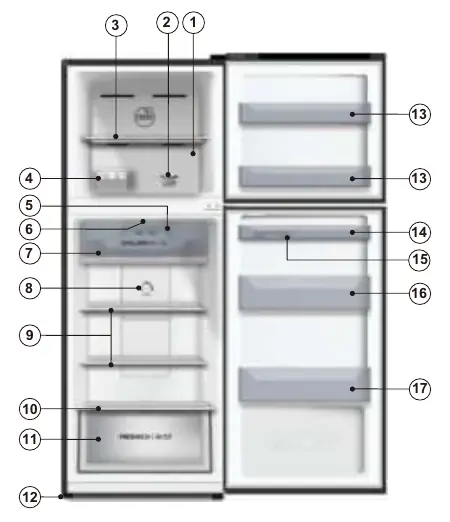
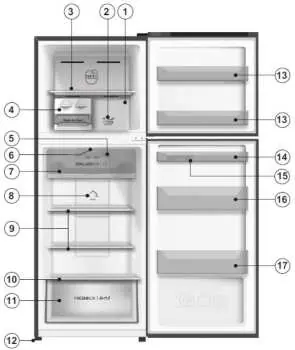
The refrigerator consists of a freezer compartment (top) and a refrigerator compartment (bottom). Key components include the freezer temperature control, refrigerator temperature control, chiller room, vegetable crisper, and various storage racks for eggs, bottles, and general items.
Installation

- Location: Select a strong, level floor. Adjust the height of the screw if the floor is uneven.
- Clearance: Allow sufficient space between the back and side walls to ensure the door opens fully and to minimize noise.
- Environment: Avoid direct sunlight, heat sources, and moist areas.
- Grounding: Ensure proper grounding to prevent electric shock. If adding a ground wire, attach it to a metal pipe or a rod buried at least 2.4 meters in the ground.
- Post-Installation: After moving the refrigerator, leave it static for 6 hours before switching it on to ensure proper cooling system operation.
Operation
Initial Setup
For faster cooling during the first use:
- Clean the refrigerator with a soft towel.
- Place shelves in their original positions.
- Keep the door open and plug the power cord into its own electrical outlet.
- Set the Freezer Compartment dial to MIN and the Refrigerator Compartment dial to MAX.
- After 6 hours, turn both dials to the middle MED position.
Temperature Control
The refrigerator is equipped with temperature control dials for both the freezer and refrigerator compartments. Adjust these settings based on your cooling needs.
Food Storage
- Air Circulation: Leave spaces between food items to help air circulation.
- Storage Tips: Store fish and meats requiring quick refrigeration at the rear of the compartment.
- Wrapping: Wrap foods that dry easily (e.g., fish, smoked meats) in moisture-vapor-proof material.
- Hot Foods: Pre-cool hot foods before storing them in the refrigerator.
- Bottles: Wipe water off the surface of bottles before storing.
Cleaning and Maintenance
- Preparation: Always unplug the refrigerator and remove all food before cleaning.
- Cleaning: Use a damp cloth for both exterior and interior parts. Dry with a soft, clean cloth.
- Prohibited Items: Never use brushes, acids, chemical thinners, gasoline, or benzine.
- Odors: To remove odors, mix lemon skin with warm water, wipe the surface, and dry thoroughly.
- Frequency: Clean the inside and door gasket once a month.
Troubleshooting
If the refrigerator is not operating, check if the power cord is plugged in, the temperature control is set to MIN, or if the fuse/circuit breaker is off. If the unit is warmer than usual, check for frequent door openings or large amounts of warm food. If there are unusual sounds, ensure the unit is balanced and not touching the wall.
Manufacturer information
Haier
Practical help
Common problems
Refrigerator not operating
Check if the power cord is plugged in, the temperature control is set to MIN, or if the home fuse/circuit breaker is off.
Warmer than usual
Reduce frequent door openings, check temperature control settings, and avoid placing large amounts of warm food inside.
Unusual sounds
Ensure the floor is level, the unit is balanced, and the back of the refrigerator is not touching the wall.
Moisture collects inside
Reduce frequent door openings and avoid storing warm food in humid weather.
Before use
- Clean the interior with a soft towel.
- Place all shelves in their original positions.
- Keep the door open and plug the power cord into its own electrical outlet.
- Wait 6 hours before storing food.
- Set temperature to MIN (freezer) and MAX (fridge) for initial cooling.
Specs in practice
- Total Capacity
- 357 Liters / 12.6 Cubic Feet
- Freezing Capacity
- 8kg per 24 hours
- Rated Voltage
- 220-240V, 50/60Hz
Images and diagrams
- The refrigerator features a freezer compartment with temperature control, ice cube box, and shelves.
- The fridge compartment includes a chiller room, temperature control, vegetable crisper, and various door racks.
Model compatibility
- Not intended for use by persons with reduced physical, sensory, or mental capabilities without supervision.
- Designed for household and similar applications.

Manual page author
David Miller
Documentation analyst
Organizes user manual content into clear summaries, with attention to model details, product context, and everyday usability.