Hvac / Heat Pumps
Ideal Evojet 1000kW Condensing Pressure Jet Boiler
Comprehensive user guide for the Ideal Evojet 1000kW commercial condensing pressure jet boiler, covering technical specifications, installation clearances, and operational features.
Table of contents
Product Overview
The Ideal Evojet 1000kW is a high-performance, floor-standing condensing boiler designed for commercial applications. It features a robust stainless steel heat exchanger stabilized with titanium to ensure maximum resistance to the corrosive effects of acid condensation. The unit is engineered for high efficiency, achieving up to 109.3% part-load efficiency, and utilizes a triple flue pass design to maximize heat transfer.
Operational Features
The boiler is designed for versatility, supporting single or multiple configurations. It offers advanced control options, including modulation via 0-10V BMS or Siemens RWF controllers, allowing for precise temperature management. The system is compatible with various fuel types, including Natural Gas, LPG, and Oil, depending on the burner selection. It is specifically designed to operate at a temperature differential of up to 40°C, provided that minimum flow rates are maintained.
Installation and Clearances
Proper installation is critical for the safe and efficient operation of the Evojet 1000kW. The unit requires specific minimum clearances to ensure adequate access for maintenance and cleaning. A minimum of 1000mm is required at the rear, top, and both sides of the boiler. For the front, the required clearance is the burner length plus an additional 600mm for access and maintenance, or the full boiler length for cleaning purposes.
Technical Specifications
The 1000kW model has a dry weight of 2085kg and dimensions of 1910mm (H) x 1080mm (W) x 2810mm (D). It is rated for a maximum working pressure of 6 bar and has a water content of 1395 liters. The electrical supply required is 230V ± 10% at 50Hz. The hydraulic connections include DN125 PN6 flow and return ports, and a DN80 PN6 safety valve connection. The boiler is designed to be integrated into fully pumped sealed water systems.
Safety and Maintenance
The boiler includes standard safety features such as high-limit protection and safety thermostat sensors to prevent overheating. Regular maintenance is essential to ensure the longevity of the stainless steel heat exchanger and the efficiency of the burner system. Users should ensure that the condensate drain is properly connected and that the system is maintained by qualified professionals in accordance with local regulations.
Practical help
Common problems
Insufficient gas pressure
Ensure 20mbar gas pressure is available at the appliance under max flow conditions; consult sales contact if pressure differs.
Inadequate flow rates
Ensure the system meets the minimum flow rate of 11,400 L/H for the 1000kW model to maintain operational efficiency.
Before use
- Verify that all hydraulic connections are secure.
- Ensure minimum clearances (1000mm sides/rear/top) are maintained.
- Confirm the electrical supply is 230V 50Hz.
- Check that the condensate drain is correctly installed.
- Ensure the system is fully pumped and sealed.
Specs in practice
- Boiler Output (mean 70°C)
- The heat output capacity of the boiler at a mean water temperature of 70°C, rated at 982.0 kW.
- Max Working Pressure
- The maximum internal pressure the boiler can safely withstand, rated at 6 bar.
- Water Content
- The total volume of water held within the boiler heat exchanger, which is 1395 liters.
Images and diagrams
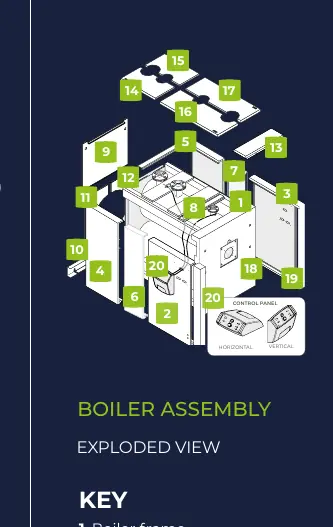
- The exploded view identifies 20 key components including the boiler frame, side panels, and the control panel.
- The dimensions diagram illustrates the footprint (A, B, C) required for installation planning.
Model compatibility
- Compatible with Natural Gas, LPG (special request), and Oil.
- Supports 0-10V DC BMS or Siemens RWF control systems.
- Suitable for B23 open flued configurations.

Manual page author
Michael Turner
Technical manual editor
Reviews PDF manuals for structure, safety notes, and practical product details so readers can find the right information quickly.