Optics / Telescope Accessories
User Manual for Orion 150mm f/12 Maksutov-Cassegrain
Comprehensive user guide for the Orion 150mm f/12 Maksutov-Cassegrain telescope. Includes setup, mounting, focusing, maintenance, and detailed optical collimation instructions.
Table of contents
Manual images
Click an image to enlargeQuick guide from the manual
The Orion 150mm Maksutov-Cassegrain is a high-quality optical tube assembly designed for both terrestrial and astronomical viewing. The unit comes factory-assembled and collimated. Before use, ensure the telescope is acclimated to the outside temperature for 30-60 minutes. Always keep dust covers on when not in use to protect the optics.
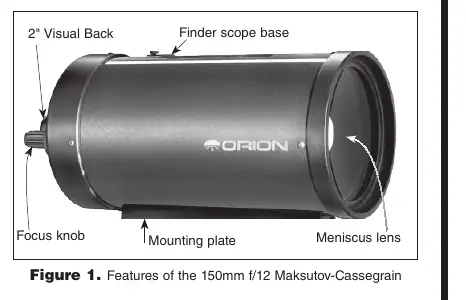
Mounting the telescope
The telescope features a Vixen-style dovetail mounting plate. It is designed to attach directly to any mount equipped with a compatible Vixen-style saddle. While the plate includes 1/4"-20 and M6x1.0 threaded holes for tripod attachment, standard consumer photo tripods are generally not recommended due to the telescope's weight (11.5 lbs).
Visual back and accessories
The telescope is equipped with a 2" visual back adapter. To use 1.25" accessories, ensure the included 2"-to-1.25" step-down adapter is installed. To install a diagonal:
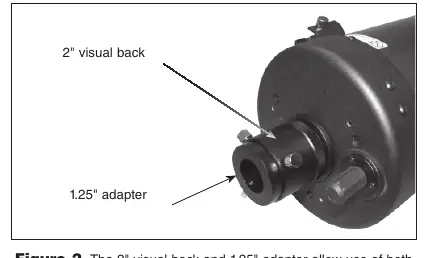
- Loosen the two thumbscrews on the 2" visual back.
- Remove the 1.25" adapter if using a 2" diagonal, or leave it in place for 1.25" diagonals.
- Insert the diagonal barrel and secure it with the thumbscrews.
- Insert the eyepiece into the diagonal and secure it.
Focusing
The focus knob on the rear cell moves the primary mirror. If the image is fuzzy, turn the knob in either direction until the image sharpens. If you have difficulty finding focus, rotate the knob counterclockwise as far as it will go, then slowly rotate clockwise while looking through the eyepiece.
Magnification
Magnification is calculated by dividing the telescope's focal length (1800mm) by the eyepiece's focal length. For example, a 25mm eyepiece yields 72x magnification. The useful power limit is approximately 300x (2x per millimeter of aperture). Start with the lowest-power eyepiece to find objects easily, then switch to higher power if conditions permit.
Care and maintenance
The telescope requires minimal mechanical maintenance. Keep the dust cover on the front and the cap on the eyepiece adapter when stored. Store in a clean, dry, dust-free environment. If the meniscus lens requires cleaning, use only optical lens cleaning tissue and fluid specifically designed for multi-coated optics. Never use regular glass cleaner.
Collimating the optics
Collimation is the process of aligning the optics. This should only be performed if the telescope has been handled roughly and a star test confirms misalignment.
Star-testing
Point the telescope at a bright star and de-focus the image. If the expanding disk is a circle with the secondary mirror shadow centered, the scope is collimated. If the circle is unsymmetrical or the shadow is off-center, adjustment is needed.
Collimation procedure
- Remove the diagonal and eyepiece.
- Point the telescope at a white wall in a well-lit room.
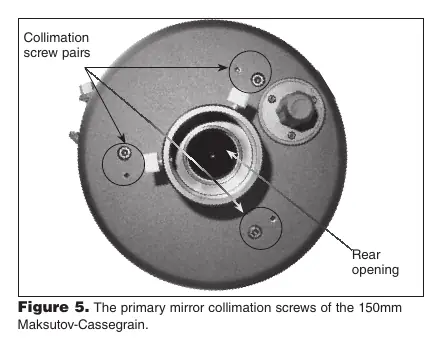
- Locate the three pairs of collimation screws on the rear cell. Each pair consists of a large and a small screw.
- Use 4mm and 2.5mm Allen wrenches to adjust the tilt. One screw pushes the mirror cell forward, while the other pulls it back.
- Adjust the pair nearest to the direction the front of the telescope needs to move to "fill" the black crescent seen in the rear opening.
- Tighten one screw and loosen the other by equal amounts.
- Perform a star test again to verify alignment.
Specifications
- Optical design: Maksutov-Cassegrain
- Aperture: 150mm (5.9")
- Effective focal length: 1800mm
- Focal ratio: f/12.0
- Weight: 11.5 lbs
- Mounting plate: Vixen-style
Practical help
Common problems
Image is fuzzy or out of focus
Rotate the focus knob to move the primary mirror. If still fuzzy, rotate the knob counterclockwise fully, then slowly clockwise while looking through the eyepiece.
Optics appear out of alignment
Perform a star test. If the out-of-focus star image is unsymmetrical, adjust the collimation screw pairs on the rear cell.
Telescope is too heavy for tripod
The telescope weighs 11.5 lbs (excluding accessories). Ensure your tripod is rated for this weight; standard consumer photo tripods may not be sufficient.
Before use
- Keep dust covers on when not in use.
- Ensure your mount is compatible with a Vixen-style dovetail.
- Acclimate the telescope to outside temperature for 30-60 minutes before observing.
- Check that the 1.25-inch adapter is installed if using 1.25-inch accessories.
- Never look directly at the Sun without a professional solar filter.
Specs in practice
- Aperture (150mm)
- Determines the light-gathering power of the telescope.
- Focal Length (1800mm)
- Determines the magnification when paired with an eyepiece.
- Focal Ratio (f/12.0)
- Indicates the speed of the optical system.
Images and diagrams
- Figure 1: Identifies the focus knob, mounting plate, and meniscus lens.
- Figure 3: Illustrates the star test patterns for determining collimation status.
- Figure 5: Locates the collimation screw pairs on the rear cell.
Model compatibility
- Compatible with Vixen-style mounting saddles.
- Accepts both 2-inch and 1.25-inch accessories.
- Secondary mirror is not adjustable.

Manual page author
Michael Turner
Technical manual editor
Reviews PDF manuals for structure, safety notes, and practical product details so readers can find the right information quickly.