Toys / RC Models & Drones
User Manual for Ruko 1601AMP/1601AMP3 RC Amphibious Car
Quick guide for the Ruko 1601AMP/1601AMP3 RC Amphibious Car. Learn how to install batteries, pair the transmitter, operate on land and water, and troubleshoot common issues.
Table of contents
Manual images
Click an image to enlargeQuick Start Guide
The Ruko 1601AMP/1601AMP3 is an amphibious remote-controlled vehicle. Before your first use, ensure you have read the safety guidelines. The vehicle requires a 5V/2A USB charger for the battery and 2x 1.5V AAA batteries for the transmitter. Always supervise children during operation, especially when driving on water.
Package Contents
- RC Amphibious Car
- Transmitter
- Rechargeable Battery
- Charging Cable
- Screwdriver
- User Manual
Transmitter Setup
The transmitter operates on a 2.4 GHz frequency with a range of approximately 40 meters on land and 20 meters on water.
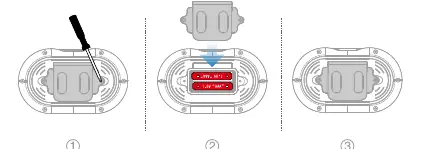
Battery Installation
- Use a screwdriver to remove the two fixing screws on the battery cover.
- Insert 2x 1.5V AAA alkaline batteries, ensuring correct polarity.
- Reinstall the battery cover and tighten the screws.
RC Car Setup
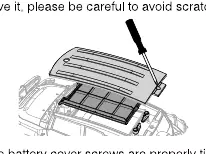
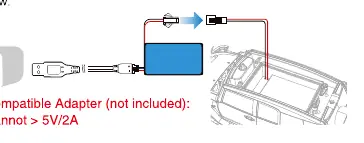
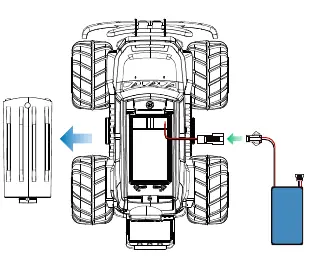
Battery Installation
- Unscrew the upper cover screws and remove the cover.
- Remove the battery compartment fixing clip.
- Connect the battery power cable to the car's interface.
- Reinstall the battery cover and secure it with the clip and screws.
Charging the Battery
Use the provided charging cable with a 5V/2A USB power source. Charging takes approximately 3 hours. The green indicator light on the charger will flash during charging and remain solid when complete. Do not use high-power fast chargers as they may damage the battery.
Operation and Driving Modes
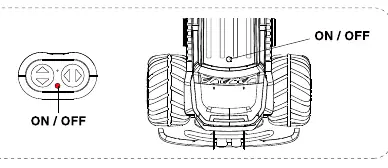
Pairing
- Turn on the RC Car using the body switch.
- Turn on the transmitter.
- The lights on the car and transmitter will change from flashing to steady, indicating successful pairing.
Driving
- Forward/Backward: Use the left stick on the transmitter.
- Turn Left/Right: Use the right stick on the transmitter.
- Spin: Use the right stick to rotate left or right.
Note that performance is slower on water (1.5km/h) compared to land (10km/h) due to surface resistance.
Maintenance and Troubleshooting
After driving in water, mud, or on the beach, remove the battery, wash the car, and dry it thoroughly to prevent corrosion. Store the battery at 50-60% charge in a cool, dry environment. If the car does not respond, check the battery level. If the battery does not charge, ensure you are using a 5V/2A charger and that the cable is not damaged.
Manufacturer information
Ruko
Practical help
Common problems
Car does not respond
Battery power is low; replace or charge the battery.
Battery will not charge
Ensure you are using a 5V/2A USB charger. High-power fast chargers may damage the battery or cable.
Short battery life
Cold weather, incomplete charging, or high resistance in water can reduce runtime.
Lost control
Adjust the steering stick sensitivity and practice controlling the steering amplitude.
Before use
- Charge the battery fully (approx. 3 hours).
- Install 2x 1.5V AAA batteries in the transmitter.
- Ensure battery cover screws are tightened to maintain the waterproof seal.
- Pair the car and transmitter before driving.
- Check that the battery compartment is dry and clean.
Specs in practice
- Charging Input
- 5V/2A USB power source required.
- Transmitter Range
- Up to 40m on land, 20m on water.
Images and diagrams
- Transmitter: Left stick controls forward/backward; right stick controls turning and spinning.
- Battery Compartment: Located under the upper cover, requires a screwdriver to access.
Model compatibility
- Use only original Ruko accessories.
- Do not use non-rechargeable batteries in the transmitter.
- Do not use high-power fast chargers (must be 5V/2A).

Manual page author
David Miller
Documentation analyst
Organizes user manual content into clear summaries, with attention to model details, product context, and everyday usability.