Furniture / Bedroom Furniture
Assembly Instructions for Treevol Furniture Floating Nightstand
Complete assembly and installation guide for the Treevol Furniture Floating Nightstand. Includes hardware identification, step-by-step assembly instructions, wall mounting procedures, weight capacity limits, and care recommendations.
Table of contents
Manual images
Click an image to enlargeQuick guide from the manual
This manual provides instructions for assembling the Treevol Furniture Floating Nightstand. Important: Verify all panels (A-M) and hardware are present and in good condition before starting. Assembly is best performed by two people. The cabinet must be securely fixed to the wall to prevent tipping.
Tools and Preparation
You will need the following tools:
- Phillips head screwdriver
- Flat head screwdriver
- Hammer
Prepare a flat, smooth surface for assembly, such as the cardboard from the box or a rug. An electric screwdriver is optional but can make assembly easier.
Hardware Identification
The hardware bag contains:
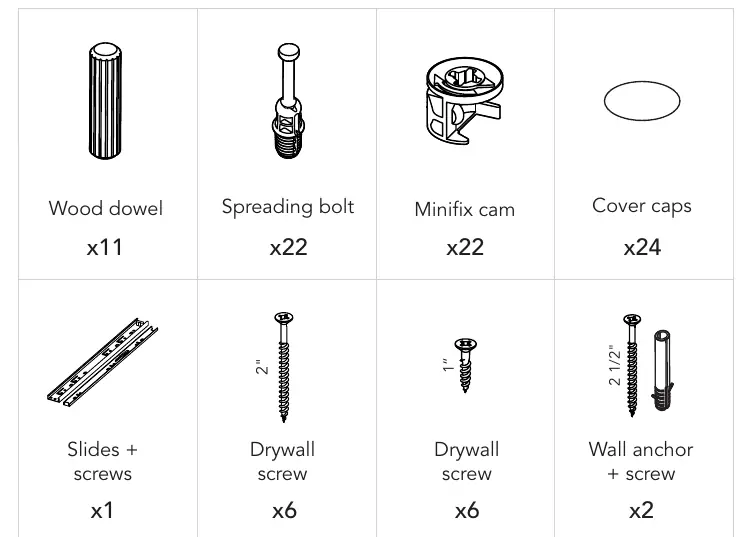
- Wood dowels (x11)
- Spreading bolts (x22)
- Minifix cams (x22)
- Cover caps (x24)
- Slides + screws (x1)
- Drywall screws (2" and 1")
- Wall anchors + screws (x2)
Assembly Techniques
Wood Dowels: Insert the dowel into the hole and tap softly until fully inside. When joining panels, gently hit the panels to adjust the joint.
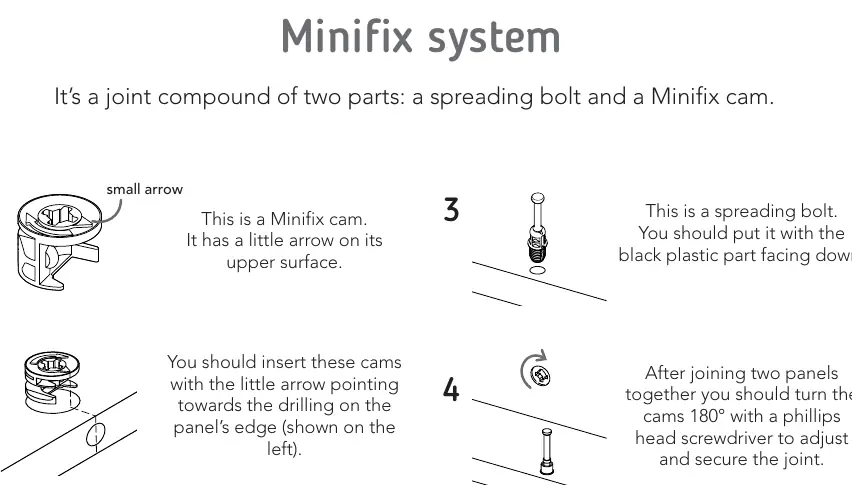
Minifix System: Consists of a spreading bolt and a Minifix cam. Insert the cam with the arrow pointing towards the panel edge. After joining panels, turn the cam 180 degrees with a Phillips head screwdriver to secure the joint.
Assembly Steps
- Panel Preparation: Install spreading bolts and dowels into the designated panels (D, G, E, A, M, C, B, F, H, I, K) as shown in the specific steps.
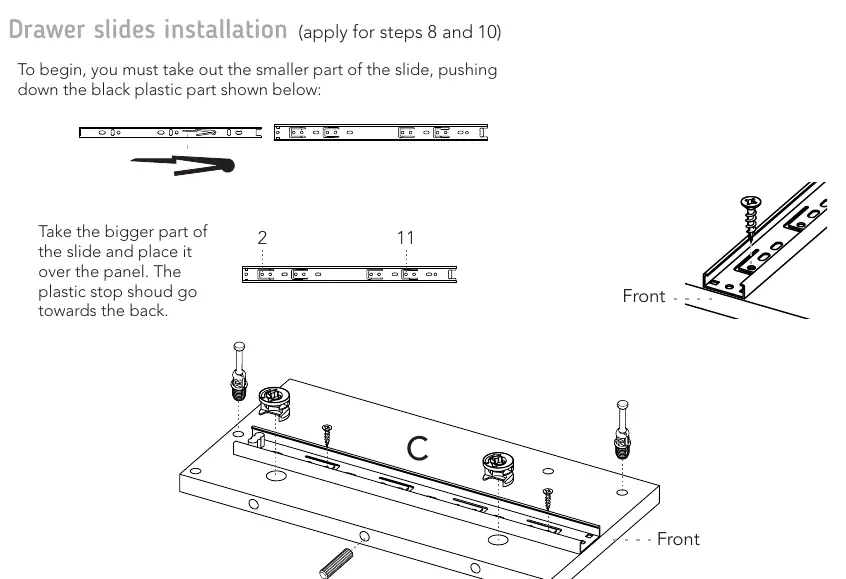
- Drawer Slides: Separate the slide into two parts. Attach the larger part to the panel (C) ensuring the plastic stop faces the back.
- Cabinet Assembly: Follow the sequence (Steps 1-16) to connect panels A through M using the Minifix system and screws.
- Drawer Assembly: Assemble the drawer box (H, I, J, L, K) and attach the drawer slides.
- Final Assembly: Slide the assembled drawer into the cabinet.
Wall Mounting
Warning: Fixing the cabinet to the wall is essential to avoid tipping and injury.
- Measure and mark the points on the wall as indicated in the diagram.
- Drill holes using a 5/16" drill bit.
- Insert wall anchors.
- Secure the cabinet to the wall using the provided screws.
Weight Limits
The cabinet has specific weight capacities (in pounds):
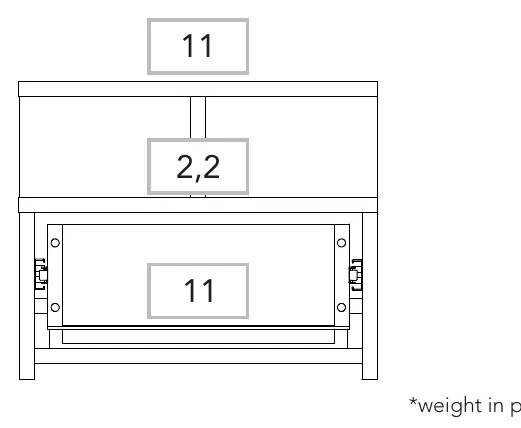
- Top surface: 11 lbs
- Drawer: 11 lbs
- Shelf: 2.2 lbs
Care and Maintenance
- For indoor use only; avoid direct sunlight.
- Clean metallic hardware with a dry cloth.
- Clean the cabinet with thinner, a soft soap solution, or a damp cloth.
- Do not paint the cabinet.
- Do not drag the cabinet; lift it with assistance.
- Avoid contact with water, fire, or high heat.
Practical help
Common problems
Cabinet is unstable or tips over
Ensure the cabinet is securely fixed to the wall using the provided wall anchors and screws.
Drawer slides are not installing correctly
Ensure you have separated the slide into two parts before installation. The plastic stop must face the back of the panel.
Minifix cam is loose
Ensure the cam is inserted with the arrow pointing toward the panel edge and turned 180 degrees to lock.
Before use
- Verify all panels (A-M) are present.
- Check hardware bag contents against the list.
- Prepare a flat, smooth surface for assembly.
- Have a Phillips head screwdriver, flat head screwdriver, and hammer ready.
- Ensure you have a second person to assist with assembly.
Specs in practice
- Top Surface Weight Limit
- 11 lbs maximum load.
- Drawer Weight Limit
- 11 lbs maximum load.
- Shelf Weight Limit
- 2.2 lbs maximum load.
- Drill Bit Size
- 5/16 inch for wall mounting.
Images and diagrams
- Minifix system: Requires inserting the cam with the arrow facing the panel edge and turning 180 degrees to lock.
- Drawer slides: Must be separated into two parts; the larger part attaches to the cabinet panel with the plastic stop facing the back.
Model compatibility
- For indoor use only.
- Must be mounted to a wall.

Manual page author
David Miller
Documentation analyst
Organizes user manual content into clear summaries, with attention to model details, product context, and everyday usability.