Home Appliances / Small Kitchen Appliances
User Manual for Westinghouse 1.7L Kettle
Quick guide for the Westinghouse 1.7L Kettle. Learn how to operate, clean, and troubleshoot your appliance safely.
Table of contents
Quick Guide
This kettle is designed for boiling water in household environments. Before using it for the first time, perform two rinse and clean cycles to remove any manufacturing residue. Always ensure the kettle is placed on a stable, dry, and level surface before operation.
Safety Instructions
- Do not operate the kettle if the cord or plug is damaged.
- Never immerse the kettle body, power base, or mains plug in water.
- Do not fill the kettle past the maximum water level mark.
- Keep the kettle out of reach of children under 8 years old.
- Always ensure hands are dry before handling the plug or switching on the appliance.
- Do not operate the kettle on an inclined plane or move it while switched on.
- Allow the kettle to cool down for approximately 30 minutes before cleaning or storing.
Parts and Features
The kettle consists of the following main components:
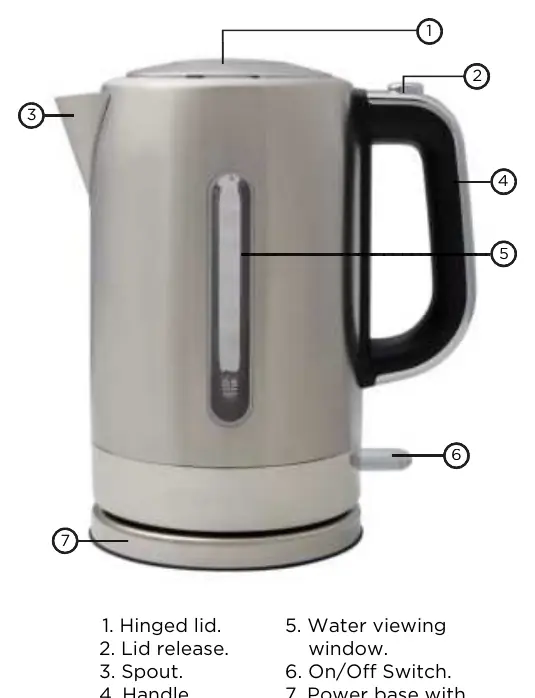
- Hinged lid: Top cover for filling.
- Lid release: Button to open the lid.
- Spout: For pouring water.
- Handle: For safe handling.
- Water viewing window: Allows you to check the water level.
- On/Off Switch: Activates the boiling process.
- Power base: Includes cord storage.
Installation and First Use
Follow these steps to prepare your kettle:
- Unpack the kettle and remove all packaging materials.
- Place the power base on a stable, dry, and level surface.
- Fill the kettle to the maximum level mark and close the lid.
- Place the kettle on the power base and plug it into a wall outlet.
- Push the switch down to turn the kettle on. It will automatically shut off once boiled.
- Discard the water and repeat the process once more to ensure the kettle is clean.
Daily Operation
- Place the power base on a stable surface.
- Fill the kettle to the desired level (do not exceed the max mark).
- Ensure the exterior of the kettle is dry, then place it on the power base.
- Plug the power base into a mains power outlet.
- Push the on/off switch down to start boiling. The indicator light will illuminate.
- The kettle will automatically shut off once the water has boiled.
Cleaning and Care
- Always unplug the appliance from the mains before cleaning.
- Use a soft, damp cloth and mild detergent to clean the exterior. Do not use harsh or abrasive cleaning agents.
- If the kettle becomes noisy or scale builds up, use a descaling product following the manufacturer's instructions.
- Store in a dry place away from steam and humidity.
Troubleshooting
If you encounter issues, check the following before calling for service:
- Kettle does not turn on: Ensure it is plugged in securely and the power outlet is working. Check if the on/off switch is activated.
- Kettle is noisy: This usually indicates that descaling is needed.
Practical help
Common problems
Kettle does not turn on
Check that the kettle is plugged into a working power outlet and the switch is pushed down.
Kettle has become noisy
Descaling is needed. Purchase a descaler and follow the instructions on the product packaging.
Before use
- Unpack the kettle and remove all packaging.
- Place the power base on a stable, dry, and level surface.
- Perform 2 rinse and clean cycles by boiling water and discarding it.
- Ensure hands are dry before handling the plug.
Images and diagrams
- 1. Hinged lid: Top cover for filling.
- 2. Lid release: Button to open the lid.
- 5. Water viewing window: Check water level.
- 6. On/Off Switch: Activates the boiling process.
Model compatibility
- For household and similar applications only.
- Not intended for commercial use.
- Do not use with an external timer or remote-control system.

Manual page author
David Miller
Documentation analyst
Organizes user manual content into clear summaries, with attention to model details, product context, and everyday usability.