Computers / Mobile Computers
Voice Deployment Guide for Zebra Mobile Computers with Aruba WLAN
A comprehensive best practices guide for deploying Zebra mobile computers in an Aruba WLAN environment. Includes device settings, network requirements, RF characteristics, and infrastructure configuration for optimal voice quality.
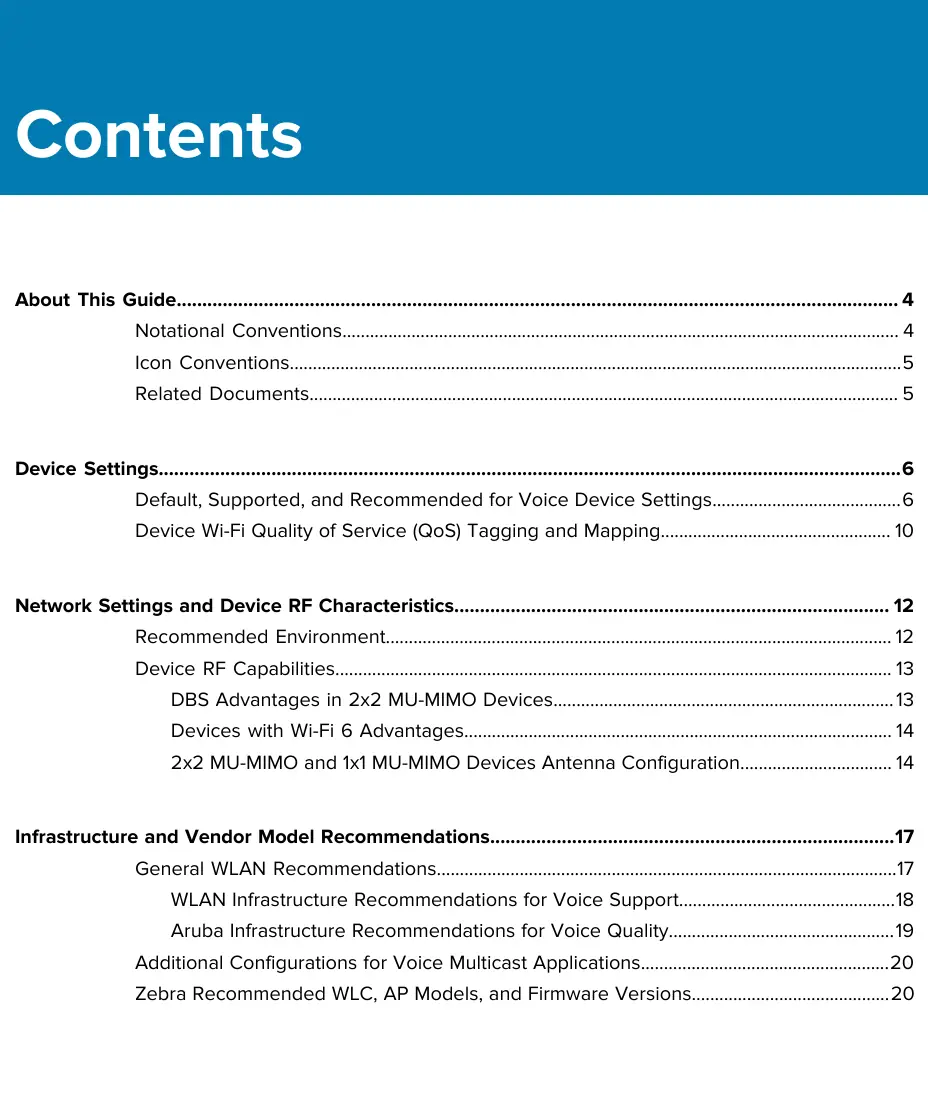
Table of contents
Manual images
Click an image to enlargeQuick Guide from the Manual
This guide provides best practices for deploying Zebra mobile computers in an Aruba WLAN environment to ensure high-quality voice performance. It covers device-side settings, network environment requirements, and specific Aruba infrastructure configurations.
Device Settings
For optimal voice performance, ensure the following device settings are configured:
- PMKID: Disabled by default. Enable only if your infrastructure requires it, and disable OKC.
- Battery Optimization: Do not use Android battery optimization (Doze Mode) for voice applications, as it interrupts communication.
- MAC Randomization: Enabled by default on Android 10+. It does not affect voice performance, but may be disabled for troubleshooting.
- Band Selection: 5 GHz is recommended for voice traffic.
- Channel Mask: Configure the device and network to a reduced set of channels (e.g., 1, 6, 11 for 2.4 GHz; non-DFS channels for 5 GHz).
Network Recommendations
To support voice, the network environment must meet specific criteria:
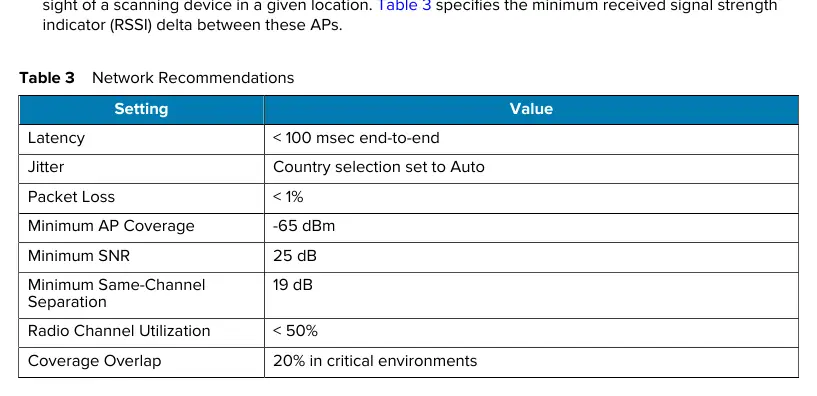
- Latency: < 100 msec end-to-end.
- Packet Loss: < 1%.
- Minimum AP Coverage: -65 dBm.
- Minimum SNR: 25 dB.
- Radio Channel Utilization: < 50%.
- Coverage Overlap: 20% in critical environments.
RF Characteristics
The guide details the differences between 2x2 MU-MIMO and 1x1 MU-MIMO devices:
- 2x2 MU-MIMO: Offers better performance in challenging RF environments due to Maximum Ratio Combining (MRC) and Cyclic Delay Diversity (CDD).
- DBS (Dual Band Simultaneous): Devices with DBS perform better in roaming scenarios by reducing off-channel scanning time.
- Wi-Fi 6 (802.11ax): Utilizes OFDMA to increase efficiency and handle higher capacity for time-sensitive applications.
Infrastructure Recommendations
Specific Aruba infrastructure settings are required for voice support:
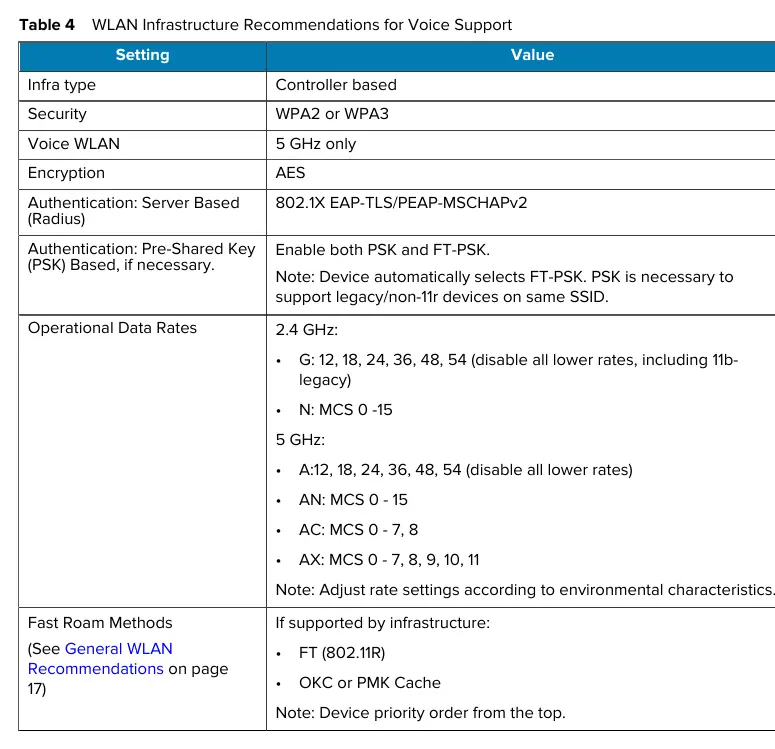
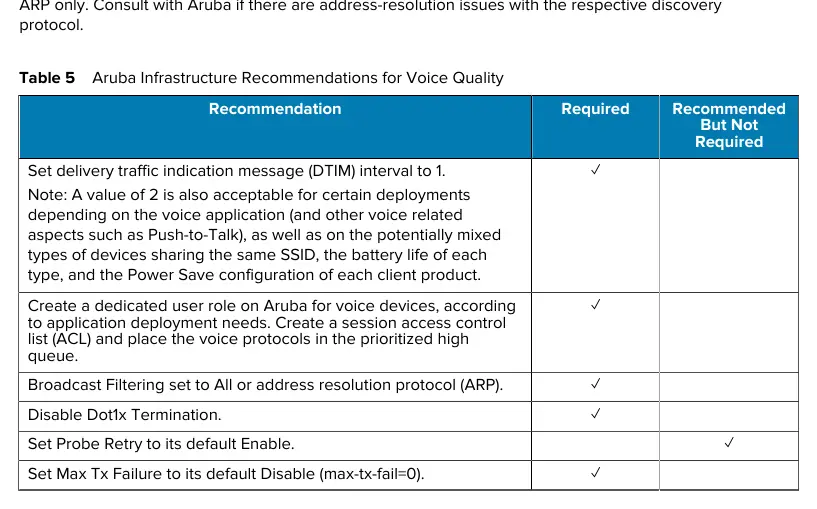
- Security: WPA2 or WPA3.
- Encryption: AES.
- Authentication: 802.1X EAP-TLS/PEAP-MSCHAPv2 or FT-PSK.
- Fast Roaming: 802.11r is strongly recommended.
- DTIM Interval: Set to 1.
- Broadcast Filtering: Set to All or ARP.
- Voice Aware Scan: Enable and ensure voice traffic is detected on the controller.
Manufacturer information
Zebra Technologies
Practical help
Common problems
Poor voice quality or dropped calls
Verify SNR is at least 25 dB, latency is under 100ms, and packet loss is under 1%. Ensure 5 GHz band is used.
Roaming issues
Enable 802.11r on the network and ensure Fast Roam Methods are configured correctly.
Battery drain during voice calls
Disable Android battery optimization (Doze Mode) for voice applications.
Before use
- Verify Aruba controller firmware version (e.g., 8.7.1.x, 8.8.0.1, 8.10.0.x).
- Ensure 5 GHz band is used for voice traffic.
- Configure WPA2 or WPA3 security.
- Set DTIM interval to 1.
- Enable 802.11r on the network.
- Disable unused Fast Roam Methods.
Specs in practice
- SNR (Signal to Noise Ratio)
- The delta between noise and coverage RSSI; minimum 25 dB required for voice.
- DTIM Interval
- Delivery Traffic Indication Message; set to 1 for voice to ensure timely packet delivery.
Images and diagrams
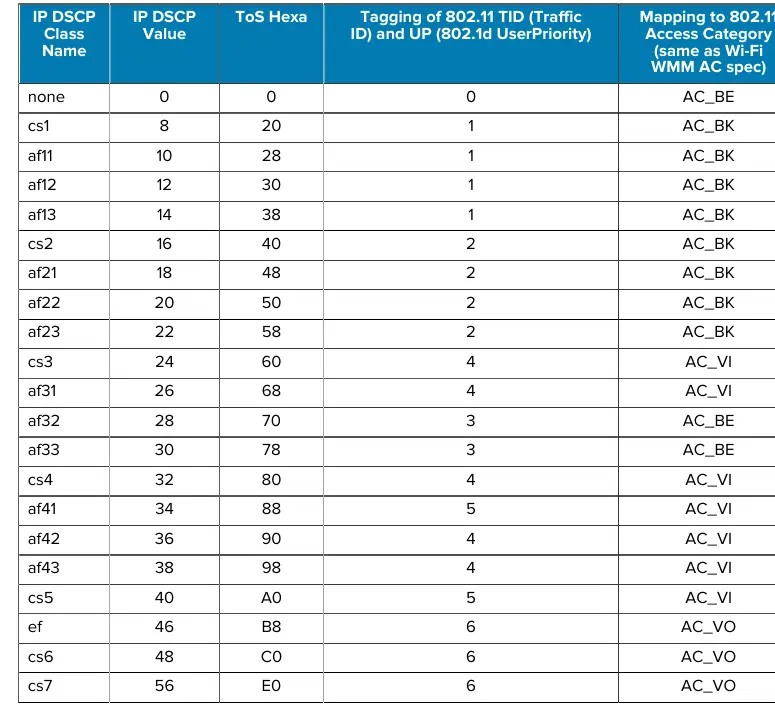
- QoS Mapping Table: Shows how IP DSCP values map to 802.11 Access Categories (AC_VO, AC_VI, etc.).
- Network Recommendations Table: Lists critical RF thresholds for voice deployment.
Model compatibility
- Supported devices include TC52, TC57, TC72, TC77, PC20, MC93, EC30, TC21, and TC26.
- TC21/TC26 require Zebra mDNA license for voice deployment.
- Aruba controller models 73xx, 72xx, and 70xx are supported.

Manual page author
Michael Turner
Technical manual editor
Reviews PDF manuals for structure, safety notes, and practical product details so readers can find the right information quickly.