Electronics / RFID Barcode Scanners
Voice Deployment Best Practices Guide for Zebra Mobile Computers
Optimize your Zebra mobile computer voice deployment with this comprehensive guide. Includes recommended device settings, Cisco WLAN infrastructure configurations, QoS tagging, and RF environment best practices.
Table of contents
Manual images
Click an image to enlargeQuick Guide for Voice Deployment
This guide provides best practices for deploying voice applications on Zebra mobile computers within a Cisco WLAN infrastructure. It covers device-side settings, network requirements, and infrastructure configurations to ensure stable, high-quality voice communication.
Device Settings
Proper device configuration is critical for voice performance. Key recommendations include:
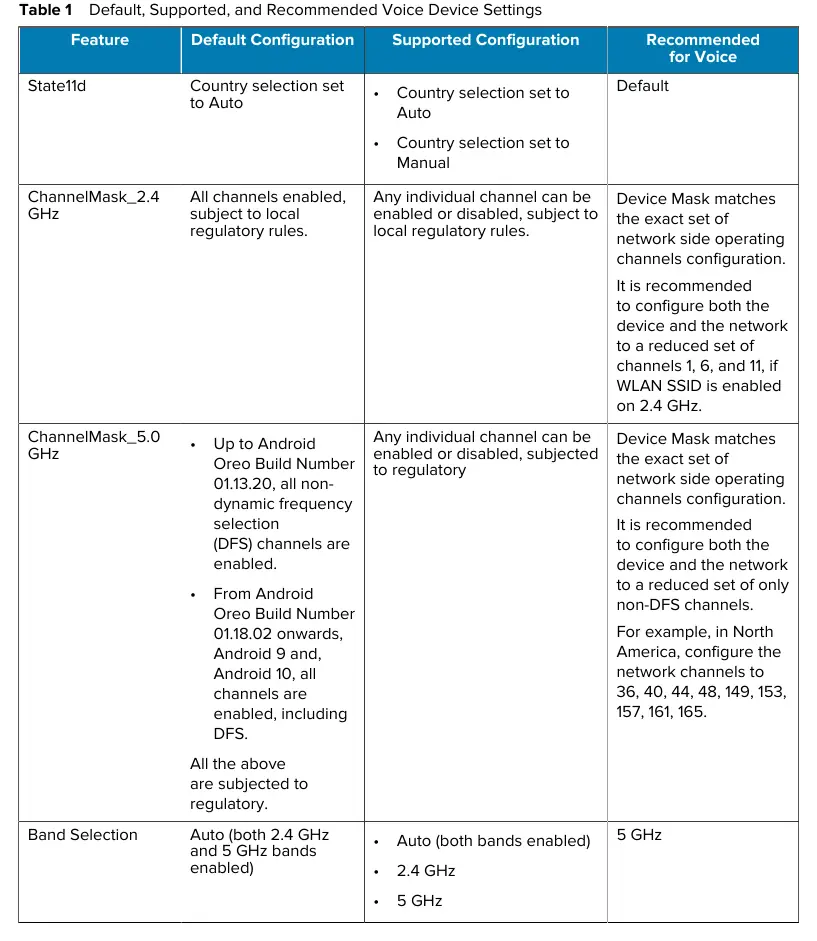
- MAC Randomization: Enabled by default on Android 11+; does not affect voice performance.
- Battery Optimization: Do not use Android battery optimization (Doze Mode) for voice applications as it interrupts communication.
- Band Selection: 5 GHz is recommended for voice traffic.
- Fast Roaming: 802.11r (FT) is strongly recommended.
- PMKID: Disabled by default; enable only if required by infrastructure.
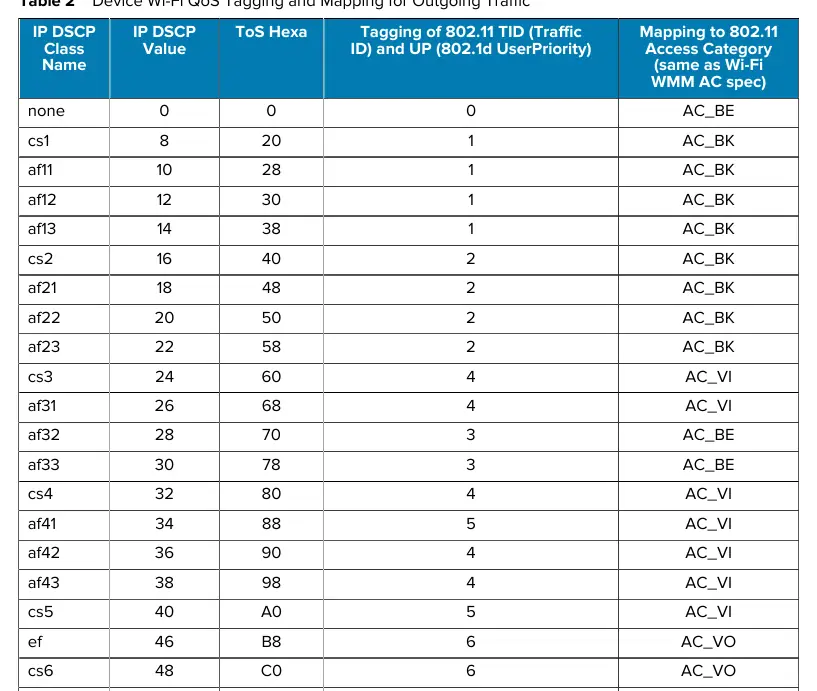
Device Wi-Fi QoS Tagging
The device maps outgoing packets to 802.11 Access Categories based on DSCP values. For example, voice traffic (EF) is mapped to AC_VO. Ensure your infrastructure respects these tags to prioritize voice packets.
Network and RF Recommendations
To maintain voice quality, the RF environment must meet specific criteria:
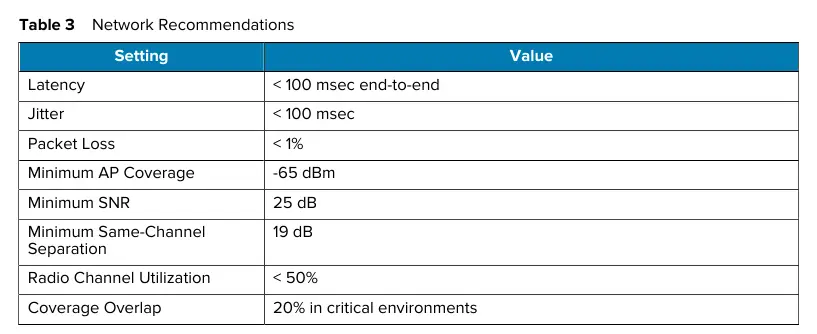
- Latency: < 100 msec end-to-end.
- Jitter: < 100 msec.
- Packet Loss: < 1%.
- Minimum AP Coverage: -65 dBm.
- Minimum SNR: 25 dB.
- Radio Channel Utilization: < 50%.
DBS (Dual Band Simultaneous): Devices with 2x2 MU-MIMO and DBS offer superior roaming performance by allowing one antenna to scan while the other maintains the connection.
Infrastructure and Vendor Recommendations
For Cisco WLAN environments, the following configurations are recommended:
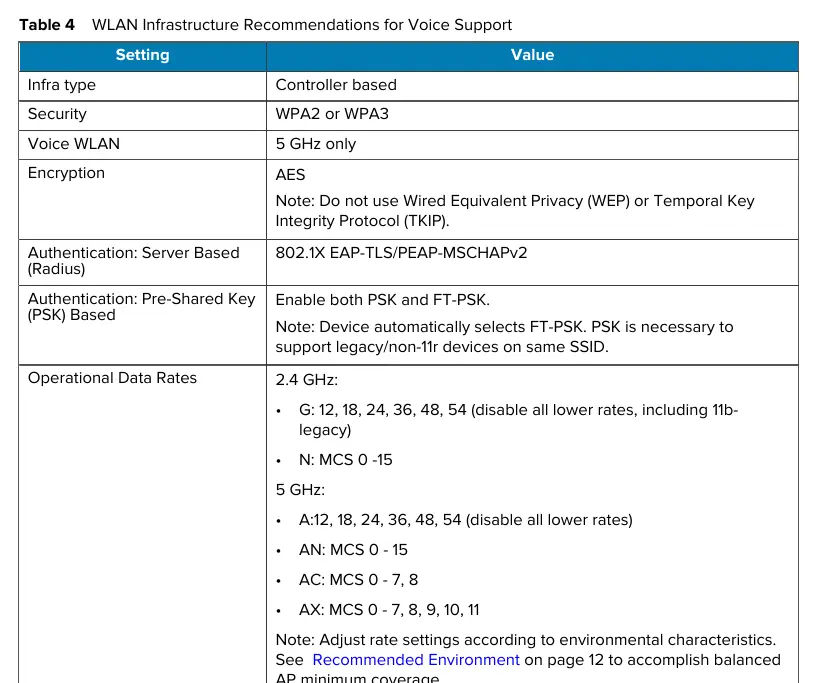
- Security: WPA2 or WPA3.
- Voice WLAN: 5 GHz only.
- Encryption: AES (Do not use WEP or TKIP).
- Fast Roaming: Prioritize FT (802.11r), then CCKM, then OKC/PMK Cache.
- WMM: Must be enabled.
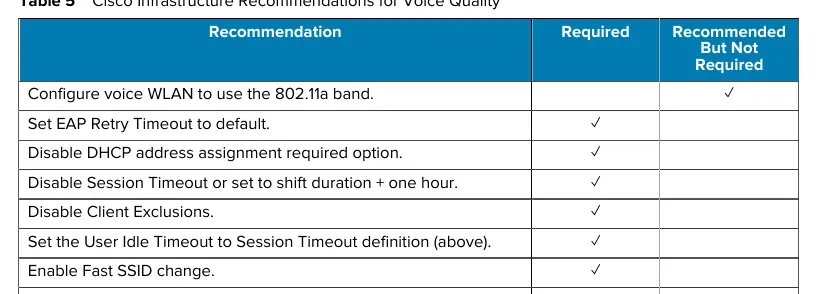
- Cisco Controller Settings: Disable DHCP address assignment required, disable client exclusions, and mark Voice WLAN with Platinum QoS.
Recommended WLC and AP Models
Zebra recommends specific Cisco controller versions for stability:
- WLC 5508: Software Version 8.5.171.0.
- WLC 3504 and 5520: Software Versions 8.10.151.x, 8.10.162.x, 8.10.171.x.
- WLC 9800: Software Version 17.3.4, 17.6.3.
Manufacturer information
Zebra Technologies
Practical help
Common problems
Poor voice quality or dropped calls
Verify SNR is at least 25 dB, packet loss is under 1%, and WMM is enabled on the WLAN.
Slow roaming between access points
Ensure 802.11r (FT) is enabled on the network. Disable unused Fast Roam methods.
High latency
Check for air medium contention. If interference is high, consider disabling AMPDU.
Before use
- Verify Cisco WLC/AP firmware versions match recommendations.
- Ensure Voice WLAN is set to 5 GHz only.
- Enable WMM on the voice WLAN.
- Disable legacy data rates (11b) on 2.4 GHz.
- Configure QoS tagging (Platinum for voice) on the controller.
- Disable DHCP address assignment required option.
Images and diagrams
- Table 1: Lists default vs recommended device settings for voice.
- Table 2: Maps IP DSCP values to 802.11 Access Categories.
- Table 3: Network requirements for voice grade site surveys.
- Table 4: WLAN infrastructure settings for voice support.
- Table 5: Specific Cisco controller configurations.
Model compatibility
- Supports TC52, TC52x, TC52ax, TC57, TC57x, TC72, TC77, PC20, MC93, EC30, TC21, TC26 series.
- TC21/TC26 require Zebra mDNA license.
- Cisco WLC 5508, 3504, 5520, 9800 supported.

Manual page author
Emily Carter
User documentation editor
Prepares concise manual descriptions and highlights the most useful setup, operation, and maintenance information for readers.