General / Other Manuals
Biomean 13/MMP-13 ELISA Kit Instruction Manual
Quick guide for the Biomean 13/MMP-13 ELISA Kit, covering assay principles, sample preparation, standard dilution procedures, and troubleshooting for accurate research results.
Table of contents
Manual images
Jump to the sectionQuick guide from the manual
This document provides instructions for the Biomean 13/MMP-13 ELISA Kit (Cat#: FK-1277). It is intended for in vitro research use only and not for clinical diagnosis. The kit utilizes a sandwich ELISA method to detect human MMP-13 concentrations in serum, plasma, and cell culture supernatants.
Kit Performance and Storage
- Detection Range: 31.25 pg/mL - 31.25 pg/mL.
- Sensitivity: Minimum detectable dose is less than 7.812 pg/mL.
- Storage: Store all kit components at 2°C-8°C. The kit is valid for 6 months.
- Stability: Do not use expired kits. Ensure all reagents reach room temperature (20-25°C) before use.
Sample Preparation
Do not use sodium azide as a preservative. If samples are not analyzed immediately, aliquot and freeze at -20°C.
- Serum: Allow blood to clot at room temperature for 30 minutes, centrifuge at 2000 x g for 20 minutes, and collect serum.
- Plasma: Use heparin, citrate, or EDTA as anticoagulants. Centrifuge at 2000 x g for 20 minutes. For platelet-free samples, centrifuge further at 10000 x g for 10 minutes.
- Cell Culture Supernatant: Centrifuge to remove precipitates.
- Cell Lysate: Wash cells with PBS/saline, add lysis buffer, and ensure full lysis before centrifuging at 10000-14000 x g.
Reagent and Standard Preparation
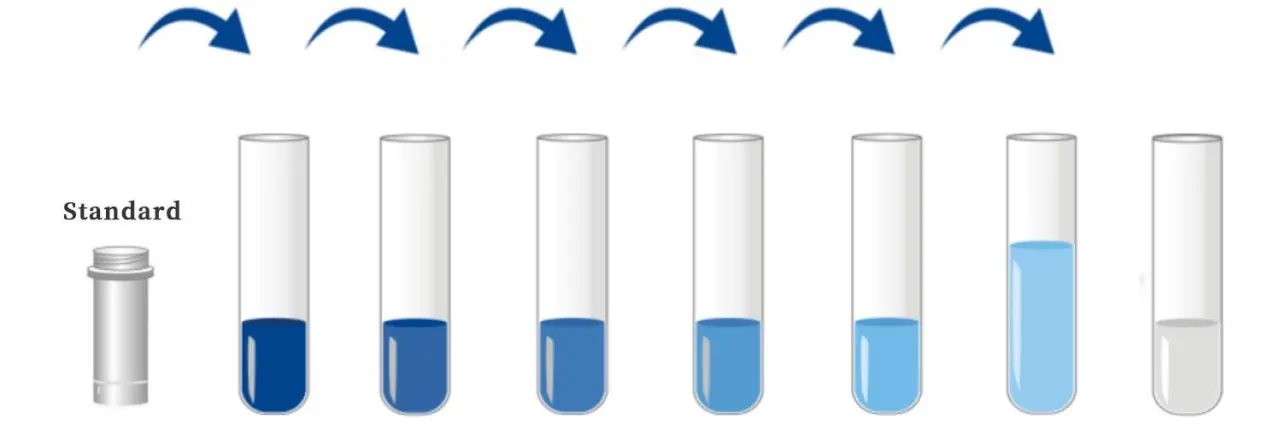
Allow all components to equilibrate to room temperature for at least 120 minutes before use. Dilute the concentrated wash solution with distilled water at a 1:20 ratio. To prepare standards, centrifuge the calibrator at 10,000 x g for 1 minute, redissolve to 2000 pg/mL, and perform a serial dilution using the provided diluent to achieve concentrations of 1000, 500, 250, 125, 62.5, 31.25, and 0 pg/mL.
Assay Procedure

- Add 50 μL of standard or sample to the wells, then add 100 μL of biotin-labeled antibody. Incubate at 37°C for 60 minutes.
- Wash the plate 5 times.
- Add 100 μL of HRP-conjugated streptavidin to each well. Incubate at 37°C for 20 minutes.
- Wash the plate 5 times.
- Add 100 μL of TMB substrate. Incubate at 37°C for 15 minutes.
- Add 50 μL of stop solution and read absorbance at 450 nm immediately.
Troubleshooting
If results are inconsistent, check pipetting accuracy, ensure proper washing (including soak steps), verify incubation times and temperatures, and ensure the microplate reader is preheated and set to the correct wavelength.
Manufacturer information
Chongqing Biomean Technology Co., Ltd.
Practical help
Common problems
Weak or no color development
Check incubation time, experimental temperature, reagent volume, and ensure enzyme/substrate activity.
High background
Ensure complete washing, check for blockages in automatic washer, and use fresh wash solution.
Unstable control results
Check pipetting accuracy, ensure sufficient equilibration time, and verify washing volume.
Before use
- Verify all reagents are at room temperature (20-25°C).
- Check expiration date on the box label.
- Ensure microplate reader is preheated for 15 minutes.
- Prepare fresh working solutions.
- Check that wash solution crystals are fully dissolved.
Specs in practice
- Recovery Rate
- Expected range between 85%-115%.
Images and diagrams
- The serial dilution diagram illustrates the step-by-step process of creating working standards from the 2000 pg/mL stock solution.
- The standard curve graph shows the relationship between concentration (x-axis) and absorbance (y-axis) using a 4-PL model.
Model compatibility
- For research use only; not for clinical diagnosis.
- Do not mix components from different kits or manufacturers.
- Interference from human anti-mouse antibodies may affect results.

Manual page author
Emily Carter
User documentation editor
Prepares concise manual descriptions and highlights the most useful setup, operation, and maintenance information for readers.