Power / Batteries Chargers
User Manual for V-TAC VT-303 Energy Storage Power Supply
Quick guide for the V-TAC VT-303 Energy Storage Power Supply. Includes technical specifications, charging instructions, safety warnings, and troubleshooting steps.
Table of contents
Manual images
Jump to the sectionQuick guide from the manual
The V-TAC VT-303 is an energy storage power supply designed for portable power needs. Before first use, it is recommended to fully charge the battery to avoid issues caused by insufficient power. The device features an air cooling system, so slight noise during operation is normal. Always ensure the device is used in a well-ventilated and dry environment.
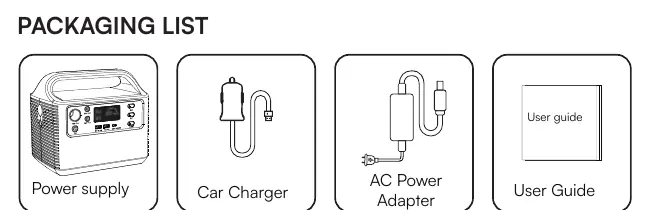
Technical Specifications
- Battery Capacity: 252Wh
- Net Weight: 3.2kg
- Dimensions: 230x208x168mm
- DC Input: 20V 3A (Supports 12-24V)
- AC Output: 230V, Pure Sine Wave, 300W (Peak 600W)
- USB Outputs: 5V 2.4A, QC3.0, USB-C 30W
- Operating Temperature: -10 to 40°C
- Charging Temperature: 0 to 40°C
Parts and Description
The device includes the following key components:
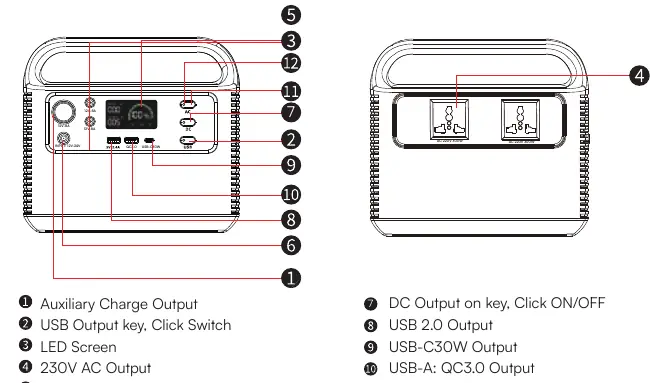
- Auxiliary Charge Output: 12V 8A
- USB Outputs: USB 2.0, USB-C 30W, and USB-A QC3.0
- AC Output: 230V AC port
- LED Screen: Displays input/output power and battery percentage
- Controls: Dedicated keys for DC output, USB output, and AC output
Charging Instructions
The device can be charged using several methods:
- Standard Charger: Approximately 7.5 hours.
- Car Charger: Approximately 9 hours.
- Solar Photovoltaic Panel: Approximately 10 hours (100W panel).
During charging, the indicator light is blue. The LED screen shows the current charging ratio and power. A full charge is indicated when the screen shows 100%.
Safety Warnings
- Installation must be performed by a qualified electrician.
- Do not dismantle the product; this may lead to fire, explosion, or electric shock.
- Do not use damaged wires, plugs, or output cables.
- Keep the product away from fire and temperatures exceeding 130°C.
- Avoid using or placing the product in high-temperature environments like direct sunlight or hot car interiors.
- Charge the product at least every three months to maintain battery health.
- This product cannot be taken on a plane as it exceeds the 100Wh limit for lithium batteries.
Troubleshooting
If you encounter issues, check the following:
- Product cannot be charged: Ensure the charger and product are in good contact with the power supply. If the indicator is still off, contact customer service.
- No output: Ensure the equipment is properly connected and the specific output port switch (DC, USB, or AC) is turned on.
- Output interrupt: If the equipment's starting power exceeds the product's rated power, or if there is a short circuit, the device will automatically shut off output. Check your equipment's power requirements.
Practical help
Common problems
Product cannot be charged
Check if the charger and product are in good contact with the mains power supply. If the charging indicator remains off, contact customer service.
No output from ports
Ensure the connection line is plugged in properly and the specific output port switch (DC, USB, or AC) is turned on.
Output interrupt during use
Verify that the nominal or instantaneous starting power of your equipment does not exceed the product's rated power. If a short circuit occurs, the device will automatically shut off.
Before use
- Fully charge the battery before the first use.
- Ensure the device is placed in a well-ventilated and dry area.
- Verify that all cables and plugs are undamaged.
- Check that the equipment you intend to power is within the rated output range of the VT-303.
- Ensure the ambient temperature is within the operating range (-10 to 40°C).
Specs in practice
- Battery Cycle
- Rated for 1000 or more cycles.
Images and diagrams
- The front panel features the LED screen, DC input port, auxiliary charge output, and various USB/AC output ports.
- The LED screen displays input power, output power, and the percentage of battery remaining.
- The AC output section includes two 230V sockets.
Model compatibility
- Not suitable for air travel due to lithium battery capacity exceeding 100Wh.
- Supports solar charging via 12-24V charge controllers.
- Automatic protection triggers at temperatures >= 75°C.

Manual page author
Emily Carter
User documentation editor
Prepares concise manual descriptions and highlights the most useful setup, operation, and maintenance information for readers.