Lighting / Fixtures
Eterna 1023-V1 LED Upgrade Guide
A comprehensive guide to understanding LED lighting specifications, including lumen-to-wattage conversion, energy efficiency, and the benefits of upgrading to LED technology.
Table of contents
Manual images
Click an image to enlargeQuick Guide to LED Upgrading
This guide provides essential information for transitioning from traditional lighting (CFL, Fluorescent, Halogen) to LED technology. It explains how to interpret modern lighting specifications, which are now based on lumens rather than wattage, and provides a conversion reference to help you select the correct LED replacement.
Understanding LED Specifications
When selecting new LED fittings, refer to these key specifications to ensure the correct light output:
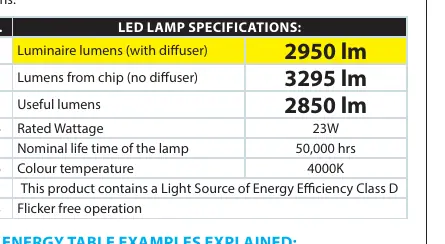
- Luminaire lumens (with diffuser): The total light output measurement of the entire fitting as it will be installed. This is the primary figure for determining light levels.
- Lumens from chip (no diffuser): The raw output of the LED array before passing through a diffuser.
- Useful lumens: The visible light output measured within a 120-degree beam angle.
- Rated Wattage: The power consumption required to achieve the stated lumen output.
- Nominal life time: The average expected lifespan of the fitting in hours.
- Colour temperature: Measured in Kelvin (K). 3000K provides a warm orange glow, while 6000K provides a clean blue glow.
- Energy Efficiency: Note that energy ratings have been re-scaled as of 2022. A fitting rated 'A' in 2021 may now be classified as 'D' or 'E', which reflects the efficiency of the light source itself.
- LED Driver: This component converts AC to DC and steps down voltage to provide constant current, which eliminates visible flicker.
Lumens to Wattage Conversion
Use the following reference to compare the power requirements of different lamp types to achieve specific brightness levels:
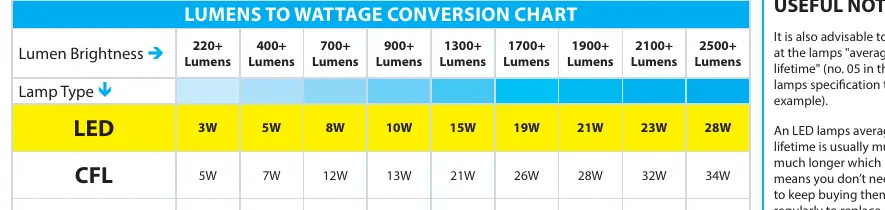
- 220+ Lumens: LED 3W / CFL 5W / Halogen 20W
- 400+ Lumens: LED 5W / CFL 7W / Halogen 35W
- 700+ Lumens: LED 8W / CFL 12W / Halogen 40W
- 900+ Lumens: LED 10W / CFL 13W / Halogen 50W
- 1300+ Lumens: LED 15W / CFL 21W / Halogen 75W
- 1700+ Lumens: LED 19W / CFL 26W / Halogen 90W
- 1900+ Lumens: LED 21W / CFL 28W / Halogen 95W
- 2100+ Lumens: LED 23W / CFL 32W / Halogen 100W
- 2500+ Lumens: LED 28W / CFL 34W / Halogen 150W
Benefits of Switching to LED
- Energy Savings: LEDs use up to 90% less power than traditional incandescent sources, potentially reducing lighting bills by up to 80%.
- Mercury Free: Unlike fluorescent lighting, LEDs do not contain RoHS restricted substances.
- Instant Light: LEDs provide full brightness immediately without a warm-up period.
- Operating Temperature: LEDs perform effectively in low-temperature environments, expanding installation options.
Manufacturer information
Eterna Lighting
Practical help
Common problems
Choosing the correct brightness replacement
Use the Lumens to Wattage conversion chart to match your existing CFL or Halogen wattage to the equivalent LED lumen output.
Understanding energy efficiency ratings
Be aware that 2022 re-scaling means older 'A' ratings may now appear as 'D' or 'E' on new packaging; this does not mean the product is less efficient.
Before use
- Identify your current lamp type (CFL, Halogen, or Incandescent).
- Determine the required brightness in lumens for your space.
- Select the desired colour temperature (3000K for warm, 6000K for cool).
- Check the 'average lifetime' specification to estimate replacement frequency.
Specs in practice
- Luminaire lumens
- Total light output including the diffuser; use this for determining light levels.
- Useful lumens
- Visible light output within a 120-degree beam angle.
- Rated Wattage
- Power consumption required to achieve the stated lumen output.
- Colour temperature
- Measured in Kelvin (K); 3000K is warm orange, 6000K is clean blue.
Images and diagrams
- The conversion chart allows for direct comparison of power requirements (Watts) between LED, CFL, and Halogen technologies based on target lumen output.
Model compatibility
- LEDs are suitable for low-temperature environments.
- LEDs provide instant full brightness with no warm-up period.

Manual page author
David Miller
Documentation analyst
Organizes user manual content into clear summaries, with attention to model details, product context, and everyday usability.